


Tech companies digging for gold in the Middle East have entered a "wartime state."

After the outbreak of military conflicts in the Middle East, many Chinese technology companies quickly entered a "wartime state." For example, a technology company in Shenzhen immediately recalled its business travelers and suspended flights, urgently procuring supplies. Over the past year, the Middle Eastern market has attracted numerous Chinese enterprises, especially in the technology and photovoltaic sectors, but the sudden outbreak of war has posed severe challenges to expansion plans. Companies like Meituan and JD.com are actively laying out their strategies in the Middle Eastern market, with rapid developments in the fields of autonomous driving and medical devices
On the day the military conflict in the Middle East broke out, many domestic workers had not yet seen the exact news on social media, but for companies on the front lines of overseas expansion, the shock had already been transmitted internally.
An insider from a technology company in Shenzhen told All Weather Technology that they never expected the war to be so close. Personnel on business trips were immediately recalled, all planned flights were suspended, and the company urgently procured supplies for the local team in Dubai.
This tense "emergency brake" scene is a true reflection of the severe tests faced by some Chinese technology companies against the backdrop of the rapidly escalating situation in the Middle East.
In the past year, the Middle East has been a hot "land" for Chinese companies going overseas, especially favored by technology giants and photovoltaic enterprises.
In the technology sector, not only have internet giants like Meituan and JD.com accelerated their layouts, but Robotaxi technology innovation companies represented by Baidu's Luobo Kuaipao, Pony.ai, and WeRide have also entered this market.
Thanks to the energy transition strategies vigorously promoted by the governments of many Middle Eastern countries, the market is experiencing a significant explosive growth trend, with companies like JA Solar and Junda Co., Ltd. rushing to Oman to build factories.
When the shadow of war suddenly looms over this land, all the ambitious expansion plans face a life-and-death test in an instant.
Ready to Adapt
In the past one to two years, the Middle East has witnessed a rapid advance of Chinese capital and technology, with multiple tracks converging here:
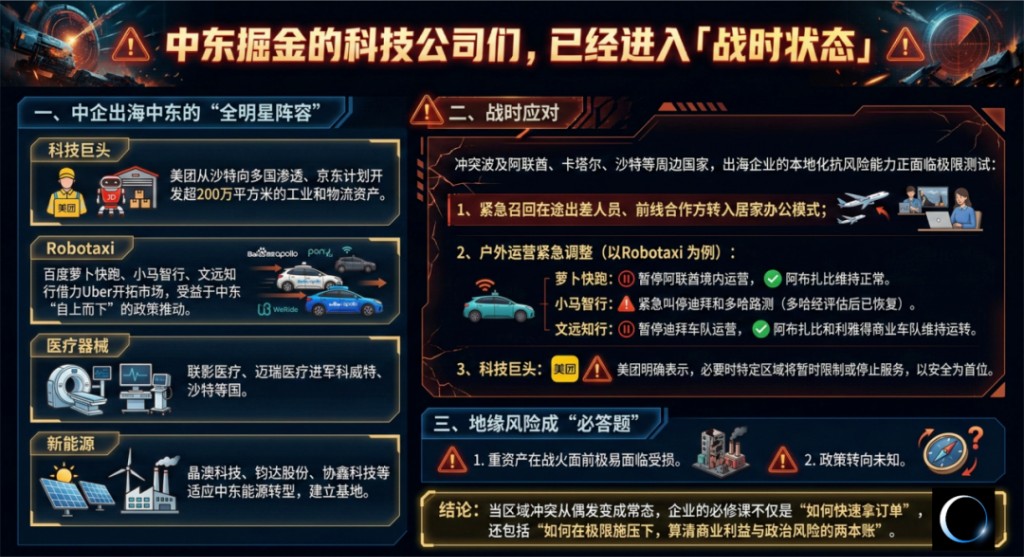
In the technology sector, Meituan (Keeta) has rapidly penetrated the markets of Qatar, Kuwait, and the UAE since launching in Saudi Arabia as the starting point for the Middle Eastern market in September 2024;
JD.com plans to collaborate with the Saudi Industrial Cities and Technology Zones Authority to develop over 2 million square meters of industrial and logistics assets locally;
In the autonomous driving sector, benefiting from local government support, Baidu's Luobo Kuaipao, WeRide, and Pony.ai are leveraging Uber to expand their markets in places like Dubai;
In the medical device sector, United Imaging Healthcare's high-end PET/CT uMI Panorama 35 has entered Kuwait, and Mindray's information and support services have also landed in countries like Saudi Arabia;
Photovoltaic companies are advancing rapidly, with many large photovoltaic projects backed by Chinese manufacturers such as GCL-Poly, Junda Co., Ltd., and TCL Zhonghuan.
However, with the large-scale joint military strikes by Israel and the United States against Iran, and Iran's counterattack, surrounding countries such as the UAE, Qatar, and Saudi Arabia were subsequently affected, and the entire Gulf region was suddenly drawn into war.
The sudden crisis left many people gasping in shock.
“At that time, we actually didn’t expect it to be so serious. We originally planned to go on a business trip, but because the flights were canceled, we didn’t go. Looking back now, it seems we ‘escaped a disaster’,” a Beijing-based insider from an internet technology company told All Weather Technology The partners on the front line have quickly entered a wartime state.
"Israeli clients are now working from home, but fortunately, we can still communicate normally these days," an insider from a security company in Shenzhen told All Weather Technology.
In the face of the sudden geopolitical shock, from the communication situation between All Weather Technology and various companies, although there has been a short-term interruption in local business development, Chinese companies going overseas have not fallen into panic.
The first to be affected are those directly exposed outdoors, "people and vehicles."
Keeta told All Weather Technology that they are closely monitoring the situation in the Middle East, and the safety of riders, merchants, users, and employees is always the top priority.
Keeta also stated that they are maintaining close contact with relevant departments in the Middle East and strictly adhering to all government guidelines and directives, including any instructions related to operational suspensions or service adjustments. If necessary, specific areas will temporarily restrict or stop services to ensure community safety, and they will respond quickly based on the situation.
Robotaxi companies such as Loquat Fast Run, WeRide, and Pony.ai have suspended services in certain areas.
To ensure testing safety, Loquat Fast Run has suspended operations within the UAE, while services in the Abu Dhabi area are still operating normally; Pony.ai initially halted road testing in Dubai and Doha, but after assessment, testing in Doha resumed on March 2nd.
WeRide has also suspended operations of its fleet in Dubai, but its commercial fleets in Abu Dhabi and Riyadh, the capital of Saudi Arabia, are still operating normally.
This sudden outbreak of war is testing the localized risk resistance capabilities of all parties.
Geopolitical Risks Become a Must-Answer Question
In recent years, the Middle East has become a "hot land" for Chinese companies going overseas.
On one hand, domestic market competition is becoming increasingly fierce, and companies urgently need to seek incremental space abroad to alleviate "involution";
On the other hand, many countries in the Middle East are in a period of economic transformation. Top-level planning represented by Saudi Arabia's "Vision 2030" is attempting to break free from a single reliance on oil and is opening its doors to foreign investment in high-tech and new energy sectors.
For example, in the Robotaxi industry, a leader from an autonomous driving company told All Weather Technology: "The development of L4 Robotaxi in the Middle East is driven from the top down, and there is a clear timeline, so everyone is actively participating. Moreover, there are actually no local Robotaxi companies in the Middle East, so there is no local protection, which gives them more motivation to attract foreign investment."
Against the backdrop of energy transformation in the Middle East, a wave of factory construction by Chinese giants has also arrived.
The massive new energy plans put forward by governments in many Middle Eastern countries have attracted a large number of heavy asset projects. As early as June 2024, Junda Co., Ltd. signed a non-binding letter of intent with the Omani government entity to invest approximately $560 million to build an N-type TOPCon battery production base with a total capacity of about 10GW, with its 5GW first-phase project expected to enter commercial production in 2026.
In November of the same year, JA Solar Technology also signed a memorandum of understanding with the UAE to plan the establishment of a 2GW solar cell and module factory In the face of such enticing policy dividends and a blue ocean market, many Chinese companies have sparked a frenzy to "mine for gold" in the Middle East.
In this process, geopolitical factors are often overlooked by the market, perhaps only serving as a formatted risk warning at the end of due diligence reports.
However, in the face of this sudden war, geopolitics has transformed from a low-probability event on paper into a tangible variable with real financial implications.
It is precisely these heavy asset projects, which often involve investments of hundreds of millions of dollars, that appear extremely passive in the face of uncontrollable military conflicts. Once the flames of war spread, leading to halted shipping routes or damaged infrastructure, companies will face the heavy cost of wasted investments and broken supply chains.
At the same time, whether the originally "top-down" open attitude of countries like Saudi Arabia will shift under external pressures of national competition and camp confrontation remains uncertain.
Undeniably, the Middle East is still one of the few markets in the world with significant purchasing power, but the frenzied window period where one could "mine for gold" with their eyes closed has ended.
As regional conflicts transition from sporadic black swan events to structural norms, the essential lesson for Chinese companies going abroad is not only how to quickly secure orders but also how to calculate the dual accounts of commercial interests and political risks in an environment of extreme pressure, and truly establish a system that can withstand fluctuations.
Risk Warning and Disclaimer
The market carries risks, and investments should be made with caution. This article does not constitute personal investment advice and does not take into account the specific investment goals, financial situation, or needs of individual users. Users should consider whether any opinions, views, or conclusions in this article align with their specific circumstances. Investing based on this is at one's own risk
