


Natural gas prices soar by 75%, the EU may reconsider the ban on Russian gas imports

Natural gas prices surged by 75%, and the European Union may reconsider the ban on Russian gas imports. Norwegian Energy Minister Terje Aasland stated that the current geopolitical situation makes it difficult for the EU to break free from its dependence on Russian energy. The actions of the United States and Israel against Iran and its retaliations may prompt the EU to reassess the ban. The EU passed regulations in January this year, planning to gradually prohibit the import of gas from Russia, with the relevant ban set to take effect in 2027
According to CCTV News, Norway's Energy Minister Terje Aasland stated at a conference in Oslo, the capital of Norway, on the 3rd that the European Union has consistently expressed its desire to reduce dependence on Russian oil and gas, but events that have occurred in the past three to four days have complicated the situation. Given the current geopolitical landscape, he believes that relevant discussions will resume.
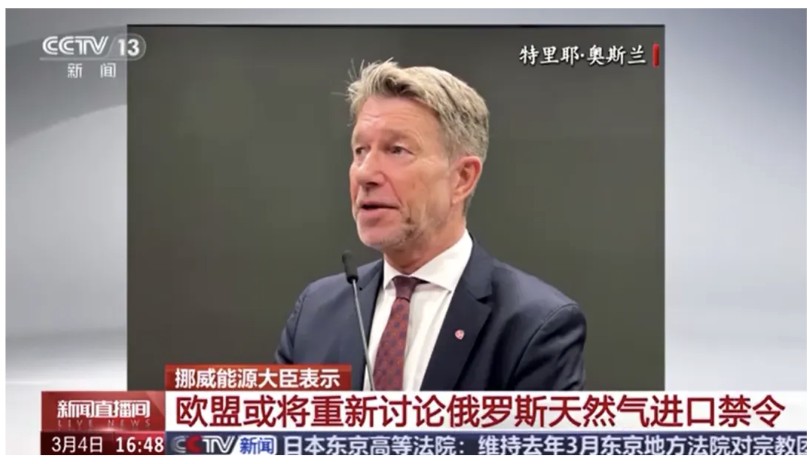
It is reported that Aasland's statement implies that the strikes by the United States and Israel against Iran, as well as Iran's retaliatory actions, may prompt the EU to restart discussions on the ban on Russian gas imports. It is noted that the situation in the Middle East affects gas exports from the Gulf region, and European gas prices have surged by 75% this week.
According to Xinhua News Agency, on January 26 of this year, the 27 member states of the EU officially passed regulations to gradually prohibit the import of pipeline gas and liquefied natural gas from Russia.
Cyprus's Minister of Energy, Commerce and Industry, Michael Demetriades, who holds the rotating presidency of the EU, stated in a press release that the regulation aims to eliminate dependence on Russian gas and is an important step for the EU "towards establishing an autonomous energy union."
According to the regulation, the EU will completely ban the import of pipeline gas and liquefied natural gas from Russia, with the ban set to take effect six weeks after the regulation comes into force, and existing contracts will have a transition period. The announcement indicates that a complete ban on the import of liquefied natural gas from Russia will take effect at the beginning of 2027, while a complete ban on the import of pipeline gas will take effect in the fall of 2027.
The regulation also stipulates that in the event of a state of emergency declared by the EU and one or more EU countries facing serious supply threats, the European Commission may suspend the implementation of the import ban for a maximum period of four weeks. By March 1, 2026, member states must develop national plans to achieve diversification of gas supply.
The announcement states that the regulation will take effect the day after it is published in the EU's official journal. The European Commission also plans to propose legislation to gradually stop importing Russian oil by the end of 2027.
In recent years, the EU has significantly reduced its imports of gas and oil from Russia. The announcement shows that by 2025, the proportion of Russian oil in the total oil imports of the EU will drop to below 3%, but Russian gas still accounts for about 13% of the EU's total imports, valued at over 15 billion euros.
Additionally, according to Caixin, by 2025, 57% of the EU's liquefied natural gas supply will come from the United States.
Previously, EU Competition Commissioner Teresa Ribeiro warned that the EU "should be careful not to become overly dependent on U.S. gas."
The trade agreement reached between the U.S. and EU last year included a clause for the EU to "purchase $750 billion worth of U.S. energy before 2028." According to the latest estimates from the Institute for Energy Economics and Financial Analysis, if the EU fulfills all its liquefied natural gas supply agreements with the U.S., the region could see 80% of its liquefied natural gas imports coming from the U.S. by 2030 Risk Warning and Disclaimer
The market carries risks, and investment should be approached with caution. This article does not constitute personal investment advice and does not take into account the specific investment goals, financial situation, or needs of individual users. Users should consider whether any opinions, views, or conclusions in this article align with their specific circumstances. Investment based on this is at one's own risk
