The "supply shortage" crisis is escalating, is Europe's 2022 nightmare reappearing?

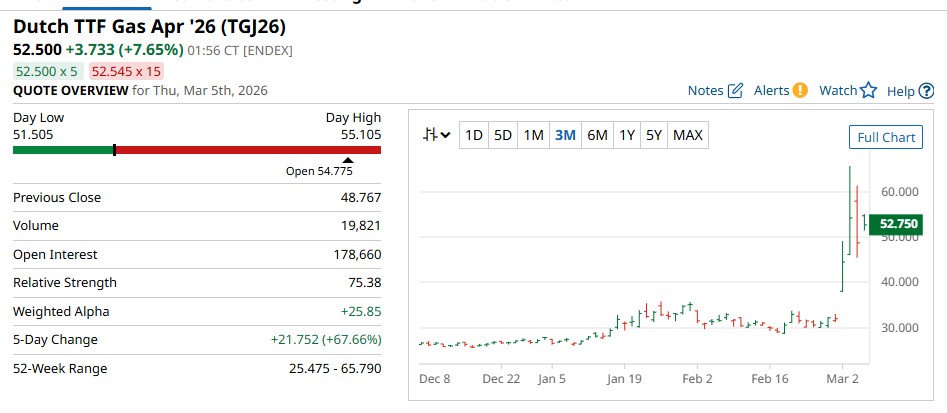
The escalation of conflict in the Middle East has led to the most severe supply crisis in the European natural gas market since 2022. Qatar's production halt, disruptions in the Strait of Hormuz, and Russia's threat to cut supplies have caused European gas storage levels to drop to their lowest in recent years. The natural gas benchmark price TTF has risen by 67%, reaching its highest point in 2023. The surge in energy prices could trigger inflation, with consumer prices in the Eurozone accelerating year-on-year to 1.9%. Qatar Energy has suspended LNG production due to attacks on its facilities, impacting the global LNG supply chain
The spread of war in the Middle East has led to the most severe supply shock in the European natural gas market since 2022. With Qatar halting production, the Strait of Hormuz obstructed, and Russia threatening to cut off supplies, European gas storage levels have fallen to their lowest levels for this time of year in recent years, casting a shadow of a new energy crisis over the continent.
Since the U.S. and Israel launched attacks on Iran, the European natural gas benchmark price TTF has risen by 67%, briefly surpassing €54 per megawatt-hour, reaching its highest level since 2023.

Previously, Qatar Petroleum announced the suspension of liquefied natural gas (LNG) production due to attacks on its facilities, and shipping through the Strait of Hormuz has effectively come to a standstill, a vital route that carries about one-fifth of global LNG trade. Meanwhile, on Wednesday, a liquefied natural gas ship originally bound for France suddenly turned around and headed for Asia, marking the first diversion case on the Atlantic route.
What further tightens market nerves is that Russian President Vladimir Putin stated on March 4 that since the EU will eventually ban imports of Russian gas, it would be better for Russia to proactively "cut off the gas" and turn to emerging markets. Currently, Europe's gas storage rate is only 30%, which is 15 percentage points lower than the five-year average for the same period. This critical window for replenishment has become increasingly perilous under the dual pressures of supply contraction and soaring prices.
The surge in energy prices threatens to reignite inflation, with consumer prices in the Eurozone unexpectedly accelerating to a year-on-year rate of 1.9% in February, exceeding expectations even before the recent spike in energy prices. Philip Lane, the chief economist of the European Central Bank, warned that a prolonged conflict in the Middle East could trigger "a significant surge in energy-driven inflation and a sharp decline in output." European stock markets fell more than 3% on Tuesday, with financing costs for government bonds in countries like the UK, Italy, and Greece rising simultaneously.
Qatar's Production Halt Disrupts Global LNG Supply Chain
The direct trigger for this crisis is Iran's retaliatory strikes against Qatar's energy facilities.
State-owned QatarEnergy announced on Monday that it has suspended liquefied natural gas production due to attacks on two of its facilities. Qatar is the world's second-largest LNG supplier, and the halt of production at its core export hub, Ras Laffan, directly shakes the global gas market.
Although LNG imported by the EU from Qatar accounts for only about 8% to 10% of its total supply, the global LNG market is highly interconnected, and the ripple effects of localized supply disruptions far exceed the scale indicated by direct percentages. According to euro news, Baird Langenbrunner, an analyst at a global energy monitoring agency, stated that Qatar's production halt "will have a substantial chain impact on the global LNG market before production can resume, and it is currently unclear when that will be." At the same time, the shipping in the Strait of Hormuz, known as the "throat" of the global energy market, has effectively come to a standstill. This passage carries one-fifth of the global LNG volume, and its closure means that the energy artery from the Middle East to the rest of the world has been cut off. Trump has publicly stated that military actions against Iran will last "far beyond" the expected five weeks, further exacerbating market concerns about a long-term disruption in supply.
Morgan Stanley warned in its latest report that the current TTF prices mainly reflect expectations of disruptions lasting one to two weeks. In extreme scenarios, if Qatar's production is halted for several months, there is a risk that TTF could soar to €100, or approach the squeeze market conditions of 2022. However, the bank also pointed out that the current fundamentals in Europe are more robust than in 2022, and the degree of supply-demand imbalance is expected to be less severe than it was then.
Asia rushes to secure supplies, Europe may be forced to compete
Qatar is one of the most important LNG sources for major Asian economies such as China, Japan, South Korea, and India. With supply disruptions, Asian buyers have no choice but to turn to other sources for replenishment, directly competing with Europe.
Signals of panic buying have already emerged. According to the Financial Times, commodity data agency Kpler reported that a vessel loaded with Nigerian LNG, originally bound for France, suddenly changed course on Wednesday to sail around the Cape of Good Hope to Asia, marking the first instance of an Atlantic route being diverted to Asia, signaling an escalation in the competition for gas supplies between Asia and Europe.
Commodity analysis firm Argus Media analyst Natasha Fielding pointed out that "Europe needs to outbid Asia to complete sufficient replenishment before next winter arrives."
Gas prices in Europe and Asia surged in tandem this week, and the charter costs for LNG carriers also increased accordingly. In contrast, the United States has maintained its status as an energy exporter due to ample shale gas capacity, with domestic gas prices remaining relatively stable and not significantly impacted.
Putin threatens to "cut off gas," Europe faces challenges from all sides
Just as the market is on edge, Russia has introduced a new variable.
According to CCTV International News, Russian President Putin stated in an interview with Russian media on March 4 that the current rise in oil and gas prices is a result of the combined effects of energy restrictions on Russia and actions by the U.S. and Israel against Iran. He then declared : Since the EU will eventually ban imports of Russian natural gas, it would be better for Russia to proactively "cut off gas," stopping supplies to the European market and turning to emerging markets.
Although Putin's statement has been characterized as "just a casual remark," its psychological impact cannot be underestimated at this sensitive moment in the market. Analysts pointed out that if Russia takes action before the ban officially takes effect, the pressure on Europe to replenish supplies will further increase.
According to a previous report by Xinhua News Agency, the EU's 27 member states officially passed legislation on January 26 this year to completely ban imports of pipeline gas and LNG from Russia—the comprehensive ban on LNG will take effect in early 2027, while the ban on pipeline gas will take effect in the fall of 2027 According to a report by Reuters, analysis firm Rystad assesses that, in extreme scenarios, the EU's re-expansion of LNG imports from Russia is theoretically an option, but it is politically explosive and explicitly opposed by the United States, making the likelihood "extremely low."
Stockpiling window overlaps with high price pressure, gas reserves are urgent
At the outbreak of this crisis, Europe's gas storage was particularly thin.
According to data from Gas Infrastructure Europe, the current EU gas storage level is less than 30% of total capacity, far below the five-year average of about 45% for this time of year. Germany's gas storage caverns are only filled to 21%, the lowest level for the same period since records began in 2017; countries like the Netherlands, Sweden, Croatia, and Latvia also face tight reserves. Italy is particularly exposed—over one-third of the country's total LNG imports come from Qatar.
Simeone Tagliapietra, a senior researcher at the Bruegel think tank, stated, "The gas storage level at this time of year has never been so low. The work to replenish stocks for next winter must start now. Completing this at such high prices will be a heavy burden for Europe."
The European Commission has urgently convened a meeting of energy experts, requesting member states to submit their national reserve assessment reports, and whether to restore the mandatory gas storage targets established after the 2022 crisis, which were relaxed last year, is expected to become a core topic.
Capital Economics estimates that if gas prices remain at current levels, the inflation rate in the Eurozone could rise by 0.5 percentage points. Earlier, the Eurozone's February CPI year-on-year rate had already exceeded expectations, rising to 1.9%; European Central Bank Chief Economist Philip Lane has also warned that the ongoing Middle East conflict could trigger "a significant surge in energy-driven inflation and a sharp decline in output."
However, some officials have made relatively optimistic assessments of the situation. An EU official stated that it is still feasible to refill gas storage to 90% before next winter; a senior energy trader pointed out that typically, net gas withdrawals stop after the end of March, and given the current warm weather, "we have basically stopped drawing gas."
The ghost of 2022 reappears, what is different this time?
Amid multiple compounding factors, market concerns about a repeat of the 2022 European energy crisis are growing stronger.
Tagliapietra from the Bruegel think tank bluntly stated, "Europe breathed a sigh of relief after the energy crisis, and now we find ourselves possibly standing at the starting point of another energy crisis." Jan Rosenow, a professor of energy and climate policy at the University of Oxford, also described this moment as "a bit like déjà vu."
In 2022, Russia significantly reduced pipeline gas supplies after the Russia-Ukraine conflict, causing European gas prices to soar to €348 per megawatt-hour in August of that year, with inflation peaking at around 11%. The EU had to rush into action—member states expedited the construction of floating LNG receiving terminals, with Germany completing its first floating LNG terminal in just 194 days, and the government injected hundreds of billions of euros in subsidies to industries and residents to withstand the impact of high prices EU officials emphasize that the current situation is fundamentally different from that in 2022: at that time, during the crisis, Europe had to build alternative supply chains from scratch without any preparation; whereas today, the supply chain is more diversified, with about 58% of the EU's LNG coming from the United States, and dependence on Russia has decreased from 45% in 2021 to 13% last year, with overall supply being more abundant. Elisabetta Cornago, assistant director of the European Reform Centre, pointed out that "the core contradiction of this crisis is price, rather than an immediate shortage of gas supply."
High gas prices may still have a tangible impact on the European economy. The price of electricity for industrial use in the EU is about twice that of the United States and 1.5 times that of China, and rising energy costs will further compress the competitive space for European manufacturing. Companies like Siemens Energy and BASF have seen their stock prices among the largest declines in Europe this week. According to Capital Economics, if current gas prices remain unchanged, the inflation rate in the Eurozone could rise by about 0.5 percentage points, and the market is increasingly betting that the European Central Bank will maintain higher interest rates to curb inflation.
Risk Warning and Disclaimer
The market has risks, and investment should be cautious. This article does not constitute personal investment advice and does not take into account the specific investment goals, financial situation, or needs of individual users. Users should consider whether any opinions, views, or conclusions in this article are suitable for their specific circumstances. Investment based on this is at their own risk