


"Critical point" approaching! JP Morgan: The chaos in the Middle East has caused a substantial supply shock, and aluminum prices are aiming for $4,000!
JP Morgan warned that major smelters in the Middle East, such as Qatar Energy, have successively halted production or declared force majeure, affecting nearly 18% of global primary aluminum exports. Meanwhile, the inventory of alumina, the raw material, is only sufficient to last for a few weeks, making larger-scale production cuts at smelters imminent. If the production cut trend continues to evolve, there is potential for aluminum prices to rapidly hit the $4,000/ton mark. Bank of America also sees the fragility of the supply chain, raising its forecast for the aluminum supply gap in 2026 from 1 million tons to 1.5 million tons
The Middle East conflict has entered its seventh day, and the global aluminum market is facing the most severe supply shock in years. The shipping in the Strait of Hormuz has effectively come to a standstill, forcing major local smelters to successively announce production halts or force majeure. JP Morgan has issued a warning—if the production cut situation continues to evolve, there is potential for aluminum prices to rapidly approach the $4,000/ton mark.
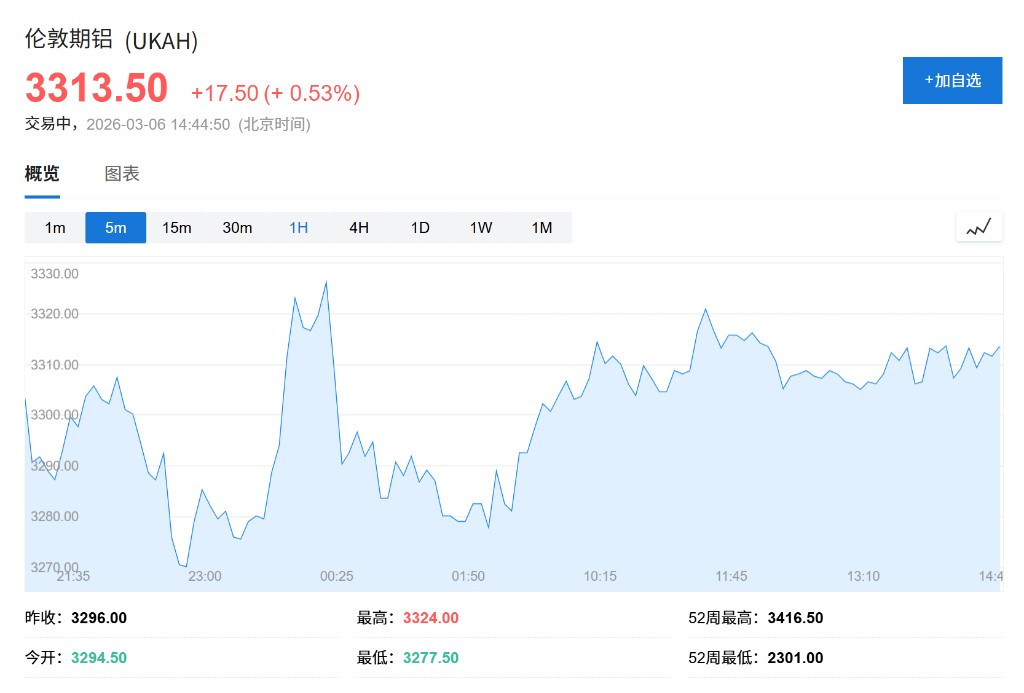
As of March 6, LME aluminum prices rose 0.5% to $3,313 per ton, with a cumulative increase of over 5% this week, reaching the highest level since 2022 and recording the largest single-week increase since September 2024. The aluminum futures forward curve has switched to a backwardation structure, with implied volatility of options rising to a multi-year high, and Rotterdam physical premiums have also surged significantly, as market sentiment rapidly shifts from "logistical misalignment" to "substantial production cuts."
Key events triggering the supply shock have been unfolding: Qatar's Qatalum smelter (with an annual capacity of about 650,000 tons) announced a controlled production halt to be completed by the end of March, with shareholder Hydro stating that a full restart would take 6 to 12 months; Aluminium Bahrain (Alba), with an annual capacity of about 1.6 million tons, announced force majeure on some supply contracts; Emirates Global Aluminium (EGA) also acknowledged delays in the shipment and delivery of finished aluminum.
According to news from the trading desk, JP Morgan's Gregory C. Shearer team characterized the current situation in a March 5 research report as a "supply-driven event horizon" for the aluminum market, expecting more production halt announcements to follow in the coming weeks. At that time, aluminum prices have the potential to "rapidly surge to $4,000/ton."
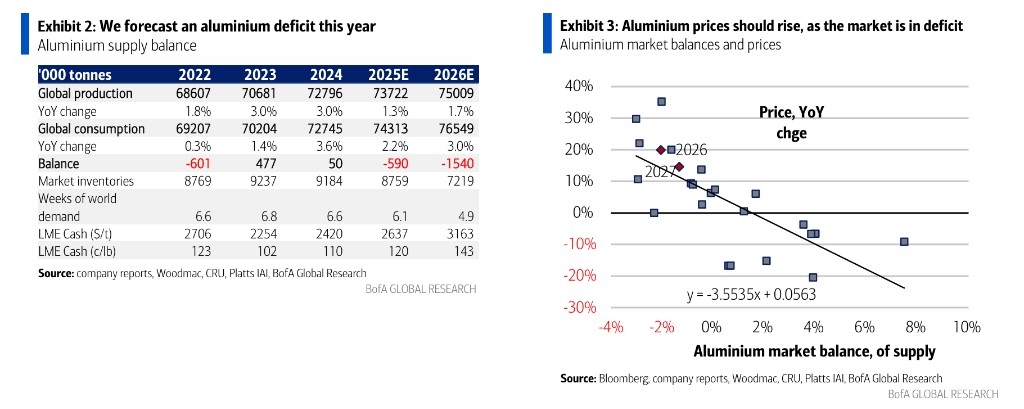
The Bank of America Securities team led by Michael Widmer also raised its forecast for the aluminum market supply gap in 2026 from 1 million tons to 1.5 million tons in a report on the 5th, and is bullish on aluminum prices reaching a peak of $4,000/ton in the second quarter of 2027. At this point, LME aluminum inventories are nearly depleted, with over half of the remaining stocks being Russian aluminum ingots, which are not the preferred category for Western consumers, leaving very limited buffers.
Early production halts, force majeure declarations accelerate
The Middle East region exports about 5 million tons of primary aluminum annually, accounting for approximately 18% of global demand outside of China. According to JP Morgan, the Gulf Cooperation Council (GCC) is expected to export about 1.3 million tons of primary aluminum to Europe and about 700,000 tons to the United States in 2025, with the Strait of Hormuz being the core artery for raw material input and finished aluminum output.
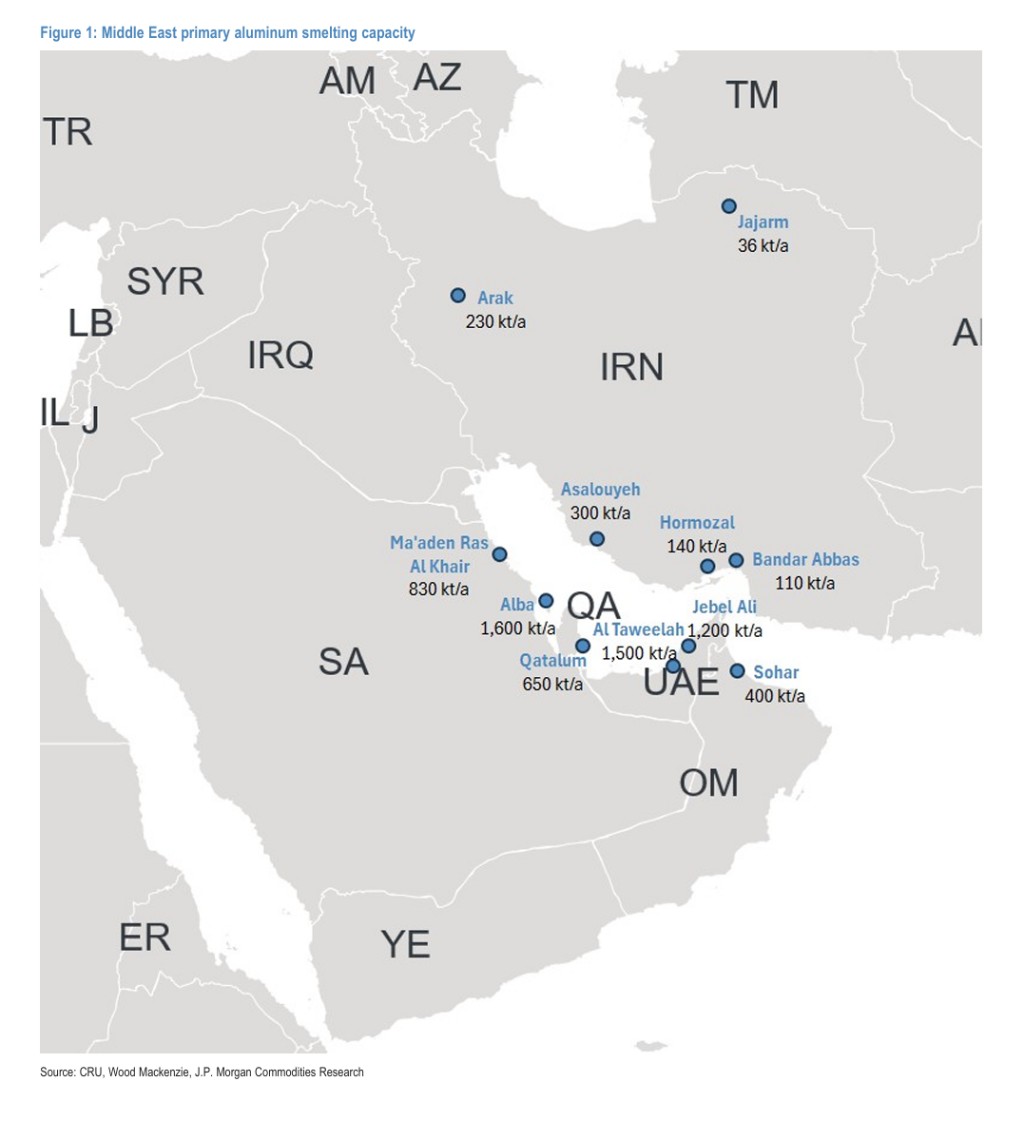 Qatalum has become the first smelter to announce a shutdown. Wallstreetcn previously mentioned that on March 3rd, QatarEnergy notified this joint venture smelter that it would suspend natural gas supply due to an Iranian attack that forced its main liquefied natural gas plant to shut down. The joint venture partner Hydro immediately announced a controlled shutdown, expected to be completed by the end of March, and stated that a full restart would require 6 to 12 months after the gas supply is restored. JP Morgan estimates that the most optimistic scenario (a six-month shutdown) will lead to a reduction of about 325,000 tons in aluminum supply in 2026, further tightening the global primary aluminum supply-demand balance to a gap of 550,000 tons.
Force majeure declarations are spreading rapidly. According to a previous article by Wallstreetcn, Alba announced force majeure on some supply contracts on March 4th; Emirates Global Aluminium (EGA) also acknowledged delays in the shipment and transportation of finished metal, stating that it is "taking all measures to alleviate the situation, including opening additional ports and utilizing inventory outside the UAE." JP Morgan expects that if there are no substantial changes on the shipping side, more force majeure declarations will emerge in the coming days.
Currently, Trump has announced that the U.S. will "quickly" provide insurance guarantees and naval escorts for tankers and other commercial vessels crossing the Strait of Hormuz, but JP Morgan points out that it is unclear when these arrangements will be implemented. Additionally, the current insurance cap of the U.S. International Development Finance Corporation (DFC) may not be sufficient to cover the required risk exposure, and exceeding the cap will require legislative authorization from Congress.
Countdown Begins: Alumina Shortage Will Trigger Broader Production Cuts
Even if external shipments are currently impossible, Middle Eastern smelters can maintain production and accumulate inventory for a period of time. However, JP Morgan warns that this window is quite limited.
Based on communications with the industry, JP Morgan assesses that most smelters in the Middle East have alumina inventories that can only sustain consumption for about 20 to 30 days. Meanwhile, shutting down an aluminum smelter is far more complex than simply "turning off the power"; the entire process itself takes several weeks—Qatalum's cycle from initiating a controlled shutdown to completely stopping production took about a month as evidence. This means that even if the smelter has a certain buffer of raw materials, more production cut announcements will begin to emerge in the coming weeks, potentially involving full capacity shutdowns or partial electrolytic cell closures.
JP Morgan further points out that compared to force majeure, announcements of capacity shutdowns have a greater impact on supply-demand balance and prices—because restarting a smelter takes months, the lost output during this period will have a lasting effect on the market In addition, if infrastructure continues to be attacked, there is also a risk of sudden power outages at smelters. Once an uncontrolled power outage occurs, the molten aluminum in the electrolytic cell will freeze, and the electrolytic cell will need to be completely relined to restart, significantly increasing costs and time.
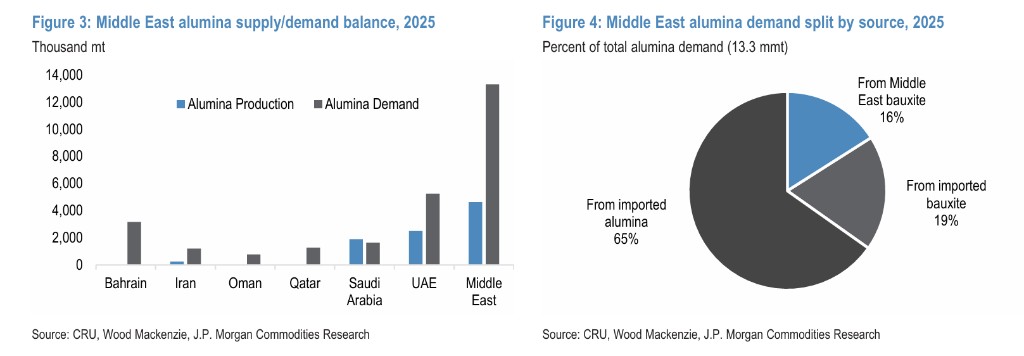
From the perspective of supply chain vulnerability, the self-sufficiency rate of alumina in the Middle East is extremely limited. According to JP Morgan, the alumina production in the Middle East is about 4.6 million tons, which can only cover about 35% of the local aluminum consumption needs, with 65% of the alumina demand relying on imports. Only Saudi Arabia's Ma'aden has a complete integrated supply chain; EGA's Al Taweelah alumina refinery can only meet less than half of its alumina demand and still relies on imported bauxite.
From a geographical perspective, JP Morgan believes that the Sohar smelter in Oman (with an annual capacity of about 400,000 tons) and the Ma'aden smelter (with an annual capacity of about 840,000 tons) are currently relatively less impacted—Sohar port is located in the Gulf of Oman, and shipping does not need to pass through the Strait of Hormuz; Ma'aden maintains production through its integrated supply chain. However, this still means that a combined capacity of about 4.3 million tons per year in Bahrain and the UAE, as well as about 600,000 tons per year in Iran, are in a high-risk state. If the aforementioned capacity of about 5.6 million tons per year is forced to shut down, more than 460,000 tons of primary aluminum will exit the market each month.
Weak Inventory Barriers: Market Buffer Nearly Exhausted
LME aluminum inventories have been declining for years and are now close to historical lows. According to Bank of America, there are about 462,000 tons of aluminum ingots in LME warehouses, with more than half produced in Russia, which is not a priority procurement category for consumers in Europe and the United States, making the effectively available inventory even more limited.
Changes in the structure of the futures curve further confirm the tension in the market. The aluminum forward curve has switched from contango to backwardation, meaning that spot prices are higher than forward prices, indicating that the market is willing to pay an additional premium for immediate delivery. According to Bank of America, the implied volatility of options has risen to multi-year highs, and the risk reversal indicator has significantly increased, showing a clear bullish bias in the market.
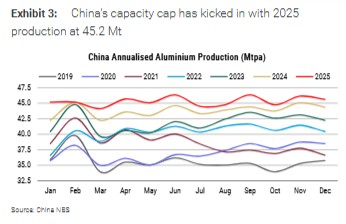
According to a previous article from Wall Street Insight, Morgan Stanley pointed out in a research report released on March 2 (before the current conflict escalated) that the global aluminum supply side is facing systematic constraints primarily driven by electricity scarcity—China's production capacity is capped, Indonesia's incremental production is constrained by power bottlenecks, and smelting capacities in Europe and the United States continue to shrink. Even without the Middle East conflict, the aluminum market is already in a tight state, laying the foundation for the price transmission of the current supply shock
Europe and the United States Depend on Middle East Imports, Supply Competition Intensifies
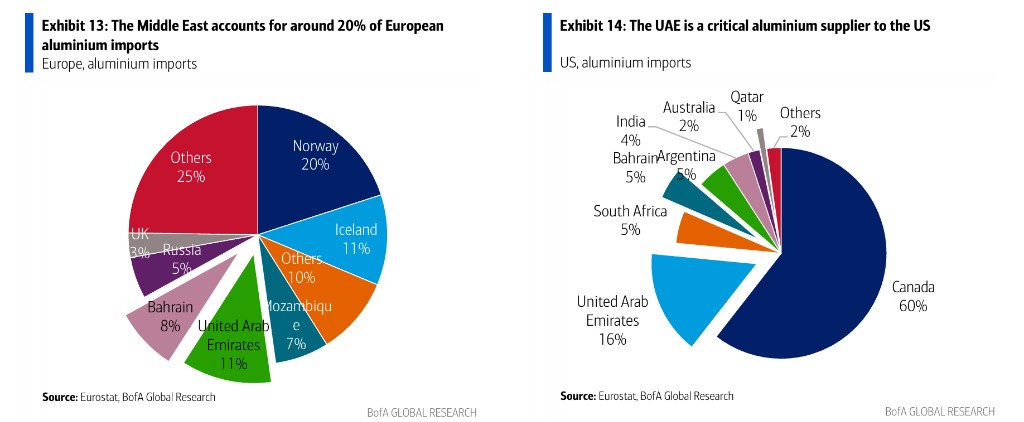
Supply shocks will be transmitted to Europe and the United States in the most direct way, as both are highly dependent on aluminum imports from the Middle East. According to Bank of America, the Middle East accounts for about 20% of Europe's aluminum imports, with the UAE contributing about 11% and Bahrain about 8%; the UAE is also one of the most important sources of primary aluminum imports for the United States.
The pressure facing the European market is particularly pronounced. In addition to disruptions in Middle Eastern supply, the Mozal smelter in Mozambique, owned by South 32 (with an annual capacity of about 500,000 tons), has decided to close due to the inability to renew contracts at economically viable electricity prices (around $50 per megawatt-hour), while the electricity supplier Eskom's quote is about $100 per megawatt-hour. Bank of America data shows that Mozal exported about 430,000 tons of aluminum to Europe in the first ten months of 2025. The physical aluminum premium in Europe (including taxes) has risen to about $360 per ton, the highest level since the end of 2022.
In the United States, tariffs have significantly increased the difficulty of finding alternative supply sources. According to a previous report by Morgan Stanley, the average monthly primary aluminum import volume has decreased by about 77,000 tons since the implementation of tariffs, and the increase in scrap aluminum imports is far from filling the gap. Currently, the aluminum premium in the U.S. Midwest has risen to about 104 cents per pound, higher than the theoretical value of about 98 cents based on tariff levels.
Major Banks Warn: Supply Critical Point Approaches, Aluminum Prices Aim for $4,000
Based on the above supply and demand logic, JPMorgan Chase clearly stated in its report that the aluminum market is being "steadily pushed toward a significantly bullish supply-driven critical point." The bank pointed out that if Middle Eastern supply continues to face substantial disruptions, aluminum prices have the conditions to "rapidly surge to $4,000 per ton," which would bring significant upside risks to its recent price forecasts—JPMorgan's current average price forecast for 2026 is $3,044 per ton.
Bank of America has also explicitly raised its forecast for the global aluminum deficit in 2026 to 1.5 million tons and maintained its peak price forecast of $4,000 per ton in the second quarter of 2027. The bank emphasized that only in extreme demand contraction scenarios similar to the global financial crisis or the COVID-19 pandemic would the aluminum market shift to oversupply, a historical precedent that is extremely rare. Morgan Stanley has set a target price of $3,700 per ton for the 2026 bull market scenario, believing that the copper-aluminum price ratio will remain at historically high levels above 4 times, indicating significant room for aluminum to catch up relative to copper.
It is worth noting that JPMorgan Chase pointed out that potential negative feedback on the demand side—including the suppression of the macroeconomy by rising energy prices and demand suppression caused by rising aluminum prices—currently remains a "second-order effect" and is not the core variable driving market logic. "In the context of ongoing supply chain disruptions and expanding production stoppages, the primary trading logic for aluminum remains significantly upward "JP Morgan wrote in the report
