Goldman Sachs comments on JD's performance: Overall encouraging, differentiated advantages underestimated by the market

Goldman Sachs stated that JD.com is an undervalued differentiated company, possessing a leading scale among retailers, a unique "self-operated online direct sales + platform" model, and industry-leading self-built warehousing and supply chain capabilities. The company's guidance for 2026 is positive, with single-digit growth in retail, logistics revenue increasing by over 20%, and profit growth at an even faster pace. Coupled with the accelerated implementation of AI and investments in new businesses, the profitability resilience provides clear support and a safety margin for valuation
JD Group's fourth quarter and full-year performance highlights for 2025 are impressive, with retail business profits reaching a historical high, logistics sector growth accelerating, and a positive shareholder return policy boosting investor confidence.
Goldman Sachs released a research report on March 6, indicating that despite a slight year-on-year decline in JD Retail's fourth-quarter revenue due to the high base effect of government trade-in subsidies, strong growth in advertising revenue and a continued narrowing of food delivery losses, combined with the management's cautiously optimistic guidance for 2026, all exceeded market expectations.
The report stated that JD is an undervalued differentiated company in the Chinese internet sector, with a large-scale retailer size, a unique self-operated + platform dual-drive model, and industry-leading self-built warehousing and supply chain capabilities.
This performance validates the profitability resilience of JD Retail. The company's outlook for mid-single-digit revenue growth and stable profit margins in 2026, along with JD Logistics' stronger-than-expected growth guidance—revenue growth of over 20% and faster profit growth—provides investors with a clearer fundamental support. Meanwhile, the ongoing repurchase and dividend initiatives also provide a margin of safety for the stock price.
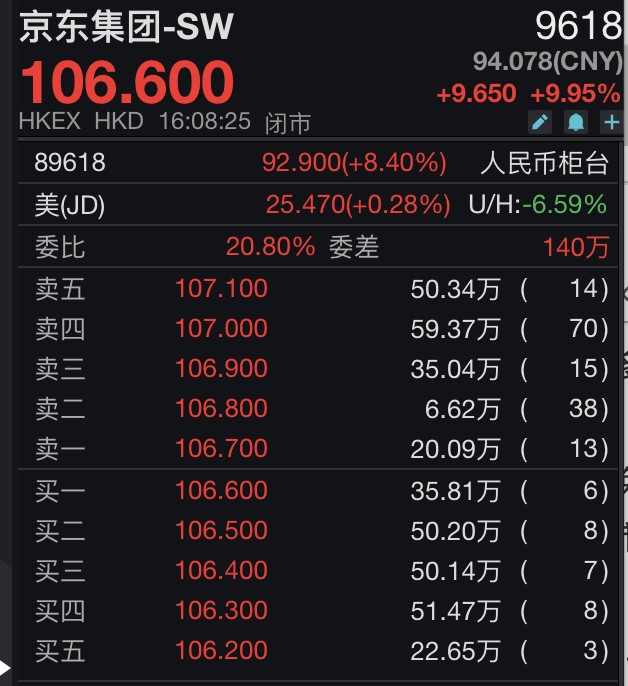
From the capital market's performance perspective, JD's Hong Kong stock surged nearly 10% today, as investors expressed their recognition of the financial report with real money.

Fourth Quarter Core Data: Retail Profit Margin Exceeds Expectations, New Business Losses Meet Expectations
According to Goldman Sachs' research report, JD Group's fourth-quarter revenue grew by 2% year-on-year, which is basically in line with market expectations. In terms of segments, product net revenue decreased by 3% year-on-year, while service net revenue increased by 20%.
Revenue from electronics and home appliances declined by 12% year-on-year, slightly better than Goldman Sachs' forecast of -15%, mainly affected by the high base of the trade-in subsidy policy that started in September 2024.
General merchandise revenue grew by 12% year-on-year, maintaining double-digit growth for five consecutive quarters, but slightly lower than Goldman Sachs' expectation of 16%. Market platform and advertising revenue grew by 15% year-on-year, significantly exceeding Goldman Sachs' expectation of 8%, benefiting from AI advertising technology, increased platform traffic, and incremental advertising revenue from the delivery business.
It is noteworthy that profitability continues to improve. JD Retail's operating profit margin reached 3.1% in the fourth quarter, higher than Goldman Sachs' forecast of 2.7%. The annual operating profit reached 51.4 billion yuan, a year-on-year increase of 25%, exceeding Goldman Sachs' expectation of 49 billion yuan; the annual operating profit margin increased from 4.0% in 2024 to 4.6%, setting a historical high. The new business segment reported a loss of 14.8 billion yuan, which is basically in line with Goldman Sachs' forecast of 14.9 billion yuan, with food delivery losses narrowing by 20% quarter-on-quarter.
2026 Outlook: Steady Growth in Retail, Accelerated Logistics
Management has provided a relatively positive business guidance for 2026. JD Retail expects to achieve mid-single-digit revenue growth, with profit margins remaining stable year-on-year, and operational efficiency improvements will offset the pressure from the marginal weakening of national subsidy policies. In the long term, the company's goal is to raise JD Retail's operating profit margin to a high single-digit level, with the main drivers coming from optimized procurement capabilities, improved operational efficiency in general merchandise and supermarkets, and optimized category structure.
The electronics and home appliances category will still face high base pressure in the first half of 2026, but it is expected to gradually recover in the second half as the comparative base becomes more lenient—government subsidy consumption in the first half of 2025 is higher than in the second half, providing a favorable year-on-year basis for the second half of 2026.
The general merchandise and supermarket business is expected to maintain double-digit growth, with increased penetration rates in healthcare and fashion categories being the main drivers. As of the reporting period, JD's annual active users exceeded 730 million, with JD PLUS members surpassing 40 million.
Regarding JD Logistics, Goldman Sachs pointed out that its guidance is stronger than expected: revenue growth is expected to exceed 20% in 2026, with profit growth even faster. In the fourth quarter, JD Logistics' revenue grew by 22% year-on-year to 63.5 billion yuan, slightly exceeding Goldman Sachs' forecast of 21%, with internal comprehensive supply chain revenue increasing by 68% year-on-year, mainly driven by the expansion of on-demand delivery services.
Multiple New Businesses Advancing Simultaneously, AI Empowering Operational Efficiency
Goldman Sachs' research report outlined JD's progress in several emerging business directions.
In the area of food delivery and retail innovation, food delivery in the fourth quarter maintained its scale while reducing losses by 20% quarter-on-quarter, and in 2026, losses will be further narrowed through optimized subsidy efficiency and fulfillment efficiency; as of February 2026, the number of 7FRESH restaurant stores exceeded 50.
In terms of international business, JoyBuy is in a trial operation phase, and user feedback on the fulfillment experience is positive. The company expects to increase investment slightly quarter-on-quarter but will maintain a cautious pace.
In the lower-tier market, Jingxi focuses on supplying white-label products in lower-tier cities. Management expects a slight increase in investment this year, with unit economic efficiency continuing to improve.
At the same time, the company is accelerating its AI applications comprehensively. The number of merchants using JD's AI digital person JoyStreamer exceeded 50,000 in the fourth quarter; the AI customer service system handled over 4.2 billion user inquiries during the Double Eleven shopping festival; and the number of internal AI agents deployed exceeded 50,000.
The self-developed large model JoyAI supports over 1,000 actual business scenarios, with token call volume increasing nearly a hundredfold compared to 2024; JoyAgent's annual active users surpassed 150 million, with a user penetration rate exceeding 20%. The company's goal is to double the user base by 2026.
Annual Return Rate Exceeds 10%, Buyback Plan Continues to Advance
Goldman Sachs' research report shows that JD's shareholder return efforts for the full year of 2025 are significant. In the fourth quarter, the company repurchased $1.5 billion in stock under its $5 billion buyback plan (valid until August 2027), with a total repurchase of $3 billion for the year, accounting for approximately 6.3% of total outstanding shares.
As of the end of 2025, the remaining buyback amount is $2 billion. The company also distributed an annual cash dividend of $1.4 billion, approximately $1 per ADS, with the total shareholder return rate exceeding 10% for the year Goldman Sachs believes that JD Retail's strong profit performance in 2025 provides ample financial space for the company to increase investment in new growth areas such as food delivery, Jingxi, and international business since the second quarter, which will help build more sustainable growth momentum after the benefits of the trade-in policy fade.