Strait of Hormuz Update: Nearly Stagnant for 7 Consecutive Days, Only Iranian Vessels Passed in the Last 24 Hours
Ship tracking data shows that in the past 24 hours, only one bulk carrier related to Iran has sailed out of the Persian Gulf, with no vessels entering the Gulf from the opposite direction, effectively interrupting commercial shipping. A very small number of merchant ships have attempted to pass through the strait by labeling themselves as "Chinese," but there have been few follow-ups. The crisis has led to oil storage accumulation in multiple Gulf countries and forced production cuts. Saudi Arabia has activated a record alternative route through the Red Sea for exports, but the actual diversion volume is far below theoretical potential
The commercial shipping crisis in the Strait of Hormuz is deepening.
On March 9, according to ship tracking data compiled by Bloomberg, this globally crucial energy passage has been in a state of "near stagnation" for the seventh consecutive day, with only one bulk carrier related to Iran having exited the Persian Gulf in the past 24 hours, and no vessels entering the Gulf from the opposite direction. The last commercial vessel with no obvious ties to Iran—a Chinese bulk carrier named "Sino Ocean"—completed its transit last Saturday morning.
According to an article from Wall Street View, this cargo ship broadcast the signal "CHINA OWNER_ALL CREW" while passing through the narrowest part of the strait, becoming the second vessel flying the "Chinese shipowner" identity flag after the "Iron Lady." However, this case remains rare, and no more Chinese cargo ships have followed suit with similar navigation plans.
The blockade effect in the strait is rapidly transmitting along the supply chain. Bloomberg reports that due to tankers being unable to enter and exit the Persian Gulf normally, coastal oil storage tanks are continuously piling up, and some refineries have reduced production capacity; Iraq has been forced to cut oil output, with Kuwait and the UAE following suit; as of last Friday, only nine supertankers remained vacant in the Gulf.
Meanwhile, Saudi Arabia is switching its crude oil exports to the Red Sea route, with the number of supertankers loaded from the Red Sea coastal ports of Yabu and Al Muajjiz reaching a historic record in the first seven days of March. However, analysts warn that there is significant uncertainty about whether this alternative route can continue to function effectively.
Only Iranian vessels allowed, commercial shipping effectively interrupted
According to ship tracking data compiled by Bloomberg, in the most recent observation window, only one bulk carrier related to Iran has exited the Persian Gulf in the past 24 hours, with no vessels entering the Gulf from the Oman Gulf direction. This indicates that two-way commercial passage through the Strait of Hormuz has effectively been interrupted.
Multiple missile and drone attacks targeting commercial vessels have been the direct trigger for this shipping stagnation. Bloomberg points out that missile and drone activities continue to pose a "critical risk" to all nearby vessels, and this security threat has led the vast majority of commercial shipowners to choose to avoid this waterway.
According to an article from Wall Street View, the Joint Maritime Information Center (JMIC) reported on March 6 that there were only two confirmed commercial passages in the Strait of Hormuz in the past 24 hours, both being cargo ships rather than tankers, with traffic volume dropping to single digits. Data from the Lloyd's Market Association shows that approximately 1,000 vessels, with a total value of about $25 billion, remain trapped in the Gulf and surrounding waters, most still waiting and observing.
It is worth noting that Bloomberg warns that due to widespread signal interference and transponder shutdowns in the area, real-time ship tracking near the Strait of Hormuz faces significant difficulties—vessel positions often take days to reappear in satellite signals for confirmation, therefore the actual traffic volume may be somewhat underestimated.
"Chinese Identity" Becomes a Passage Permit, but Few Follow Suit
According to an article mentioned by Wall Street Journal, in the very few successful crossing cases, the "Chinese identity" label is becoming a means for some vessels to attempt to evade risks.
As reported by Liberation Daily, on March 5th, Beijing time, the bulk carrier "Iron Lady" changed its transponder signal to "China Owner" and successfully crossed the Strait of Hormuz along the coast of Oman.
Subsequently, the bulk carrier "Sino Ocean," flying the Liberian flag, adopted the same strategy on the morning of March 7th, continuously broadcasting the signal "CHINA OWNER_ALL CREW" while crossing at the narrowest point of the strait, becoming the second vessel to use this method for crossing.
This practice is prompting imitation in the commercial shipping industry. According to media reports citing analysis from Marine Traffic data, at least 10 vessels have modified their transponder signals in the past week to claim a connection to China, covering various types of ships including container ships and tankers.
Matthew Wright, an analyst at shipping data company Kpler, pointed out, "They can change almost anything; they can fill in whatever they want. The crew is trying to obscure connections to specific ports, destinations, or nationalities, which carries a certain element of deception."
He also noted that this practice of disguising identity to evade risks is not new, dating back to the time of Houthi attacks on merchant ships during the Red Sea situation in 2023.
Although the "Iron Lady" successfully crossed the strait, according to Liberation Daily's report on the afternoon of March 7th, this case remains rare, with no more Chinese cargo ships following its navigation plan.
Saudi Red Sea Exports Hit Record, but Alternative Routes Have Risks
In the face of substantial obstruction of export routes in the Persian Gulf, Saudi Arabia is actively utilizing alternative routes.
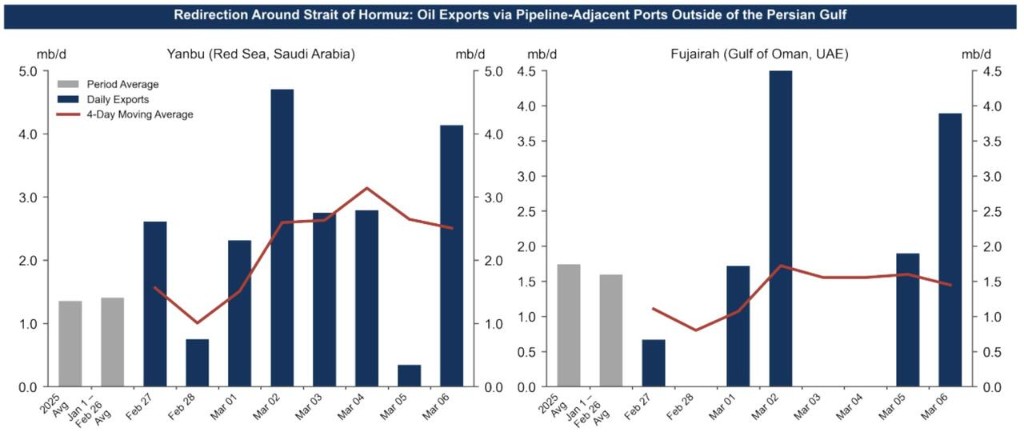
According to Bloomberg, Saudi Arabia is transporting crude oil to the Red Sea coast via east-west pipelines. In the first seven days of March, eight supertankers were loaded at the Yanbu and nearby Al Muajjiz terminals, each with a capacity of about 2 million barrels. If Saudi Arabia maintains this loading pace for the remainder of the month, the average monthly export volume will reach about 2.3 million barrels per day, approximately 50% higher than any single month of Red Sea exports since the end of 2016.
According to data from Saudi Aramco, the rated capacity of the east-west pipeline is about 7 million barrels per day, while the actual operating volume before the war was less than half of the rated capacity, theoretically leaving about 5 million barrels per day of additional transport capacity. However, this alternative route faces two major potential obstacles:
First, the aforementioned facilities have never reached their nameplate rated capacity, and it remains unclear whether they can sustain the current high-intensity operation in the long term
Secondly, the main buyers of Saudi crude oil are concentrated in Asia, while most of the shipments from Yanbu are directed north towards the Suez Canal, with very limited cargoes heading south to Asia—so far this month, only one super tanker, the "Arsan," has sailed south from Yanbu, destined for Malaysia.
Meanwhile, the Houthi armed group in Yemen has threatened to resume attacks on shipping in the southern Red Sea following U.S. and Israeli strikes against Iran, raising doubts about the security of the Red Sea corridor itself.
Goldman Sachs estimates that the net diversion volume achieved through pipelines and the ports of Yanbu and Fujairah over the past four days is only about 900,000 barrels per day, far below the theoretical potential diversion capacity of 3.6 million barrels per day.
Goldman Sachs also warned that this week's attacks on the port of Fujairah and oil storage facilities, local shortages of marine fuel (which is typically imported from the Gulf via the Strait of Hormuz), and previous attacks on pipelines all pose downside risks to diversion flows.
Supply Chain Pressures Continue to Mount
The ongoing blockage of the Strait of Hormuz is causing a chain reaction along the energy supply chain.
According to Bloomberg, due to tankers being unable to enter and exit the Persian Gulf normally, coastal oil storage tanks are becoming increasingly congested, and some refineries have been forced to cut production. Iraq has taken the lead in reducing oil output, followed by Kuwait and the UAE. As of last Friday, only nine super tankers remained vacant in the Persian Gulf, with available capacity extremely tight.
From a broader perspective, the Strait of Hormuz accounts for about one-fifth of global oil trade flow, and its continued stagnation cannot be underestimated in terms of its impact on the global energy market.
Although Saudi Arabia's Red Sea alternative exports provide some buffer, Goldman Sachs' calculations indicate a significant gap between actual diversion volumes and theoretical potential, coupled with the security threats facing the Red Sea corridor itself, meaning the substantive alternative effect on global oil supply remains very limited