


Global Optical Communication Conference (OFC 2026) Preview: Scale-Across Gives Rise to a New Super Cycle of Optical Modules

As AI computing power surges, network bottlenecks are quietly emerging. A recent report from Bank of America Securities reveals that the evolution of data center architecture towards "Scale-Across" is driving optical communication into a "super cycle"—the 800G optical module market is expected to grow nearly tenfold by 2026, with a compound annual growth rate of 83%. Ciena and Cisco are likely to be the first beneficiaries
Against the backdrop of the continuous explosion in AI computing power demand, the optical communication industry is entering a new round of prosperity cycle. As the OFC 2026 Global Optical Communication Conference approaches, multiple institutions are beginning to reassess the long-term demand for optical network infrastructure.
According to the Chase Wind Trading Desk, Bank of America Securities pointed out in its latest forward-looking report that AI infrastructure is driving optical network demand into a new "super cycle." The core driving force is not merely the expansion of computing power, but rather the evolution of data center architecture from "Scale-Up" to "Scale-Across," a change that is significantly enhancing the demand for optical interconnects across data centers.
Bank of America expects that the global optical transmission market will maintain growth of over 10% from 2026 to 2027, with 800G coherent optical modules and ZR/ZR+ pluggable optical modules becoming the fastest-growing segments.
Optical Networks Become the Next Bottleneck
In the past two years, AI infrastructure investment has primarily focused on GPUs and computing servers, but as the scale of computing power rapidly expands, network bandwidth is gradually becoming the new performance bottleneck.
Bank of America noted that the current explosion in optical communication demand mainly comes from three major driving forces:
First, the increased bandwidth demand of traditional data centers. Even in non-AI data center scenarios, cloud vendors are continuously enhancing network capacity, for example, Microsoft has significantly increased its procurement of front-end network devices.
Second, a new round of large-scale data center construction. According to Bank of America's estimates, from 2026 to 2028, cloud vendors will add several gigawatts (GW) of data center capacity, with an investment scale of about $55 billion for each 1GW data center.
Third, the interconnect demand across data centers brought about by the Scale-Across architecture. As the scale of AI training expands, a single data center can no longer accommodate all computing power, and computing clusters are beginning to deploy across multiple data centers, thereby driving a surge in high-bandwidth optical interconnect demand.
This means that AI infrastructure is shifting from "computing power-driven" to "computing power + network collaborative-driven."
Scale-Across: A Key Turning Point for AI Cluster Architecture
Traditional AI clusters mainly rely on the Scale-Up model, which continuously increases the number of GPUs within a single data center.
However, as model scales break through trillions of parameters, this architecture begins to face two major limitations: power and cooling bottlenecks in data centers, and increased complexity in network topology.
As a result, large cloud vendors are beginning to shift to the Scale-Across architecture—distributing AI computing resources across multiple data centers and forming a unified computing power pool through high-speed optical networks. Under this architecture:
AI training tasks can be flexibly scheduled between different data centers
Network bandwidth demand significantly increases
Data center interconnect (DCI) becomes a core infrastructure
According to Bank of America's forecast, the Scale-Across AI network market will grow 11 times to $808 million by 2026, becoming one of the fastest-growing areas in AI network infrastructure, and this trend directly drives the explosion in demand for optical modules.
Optical Module Technology Roadmap: The Full Opening of the 800G Era
Against the backdrop of surging demand for optical interconnects, optical module technology is also rapidly upgrading.
The current mainstream technology routes include:
Copper cable connections (<10 meters) suitable for short-distance connections within cabinets, with the lowest cost.
IMDD optical modules (10 meters—10 kilometers) suitable for internal networks in data centers.
Coherent optical modules (>10 kilometers) used for long-distance connections between data centers.
Among these, the core demand for AI infrastructure comes from the third category—coherent optical interconnects. In the past few years, 400G ZR optical modules have been the mainstream solution, but the market is rapidly upgrading to 800G.
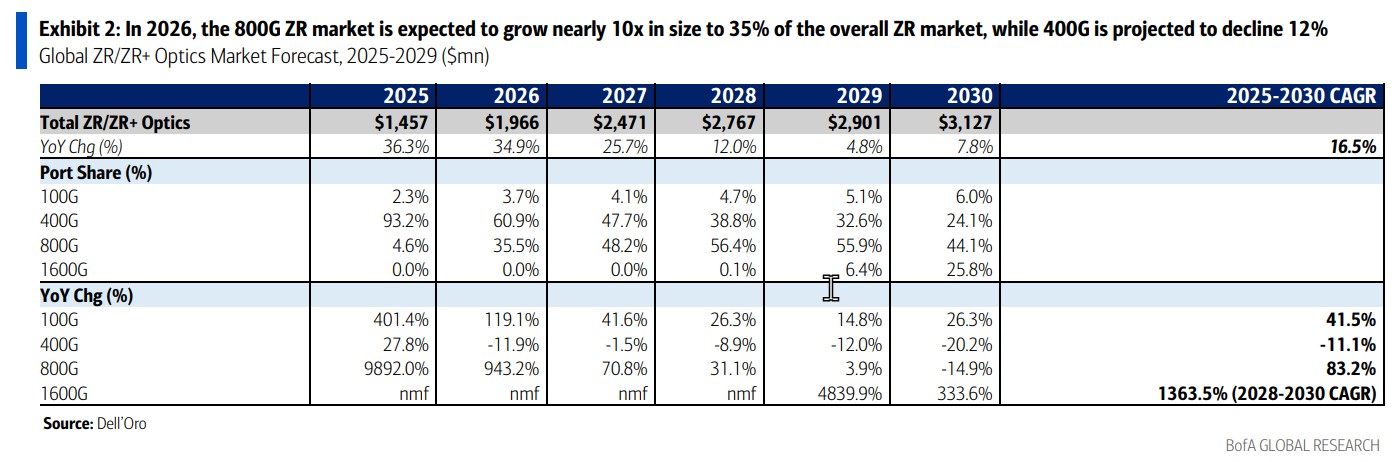
According to Dell’Oro, 400G ZR will account for 93% of the market in 2025, and this proportion will drop to 61% in 2026, while the share of 800G will leap to 35%.
More critically, the market size for 800G is expected to grow nearly tenfold by 2026. Bank of America predicts that from 2025 to 2030, the compound annual growth rate of revenue from 800G ZR/ZR+ optical modules will reach 83%, making it the most important growth engine in the optical communication industry.
Pluggable Optical Modules: Structural Transformation of Network Architecture
Another significant change in optical networks in the AI era is the proliferation of pluggable optical module architecture.
Traditional telecom networks typically procure integrated optical system equipment, but cloud vendors have chosen a completely different path:
-
Separation of routers/switches and optical modules
-
Optical modules directly inserted into devices in ZR/ZR+ form
-
More modular network architecture
The advantages of this model include: lower costs, lower power consumption, and more flexible network architecture. Therefore, pluggable optical modules have become the mainstream solution for interconnecting large-scale data centers.
2025 will be a critical turning point for coherent pluggable optical modules, with the ZR optical module market growing by 36% and the overall optical transmission market growing by 18%.
Vendor Landscape: Cisco and Ciena Compete for New Cycle Dividends
In this round of optical network upgrade cycles, Bank of America believes that two companies are most likely to benefit.
1. Ciena: Leader in Cloud Optical Networks
Ciena currently holds about 30% market share in the optical transmission market. Its core advantages include:
-
WaveLogic series DSP technology
-
Leading position among cloud customers
-
RLS optical line system
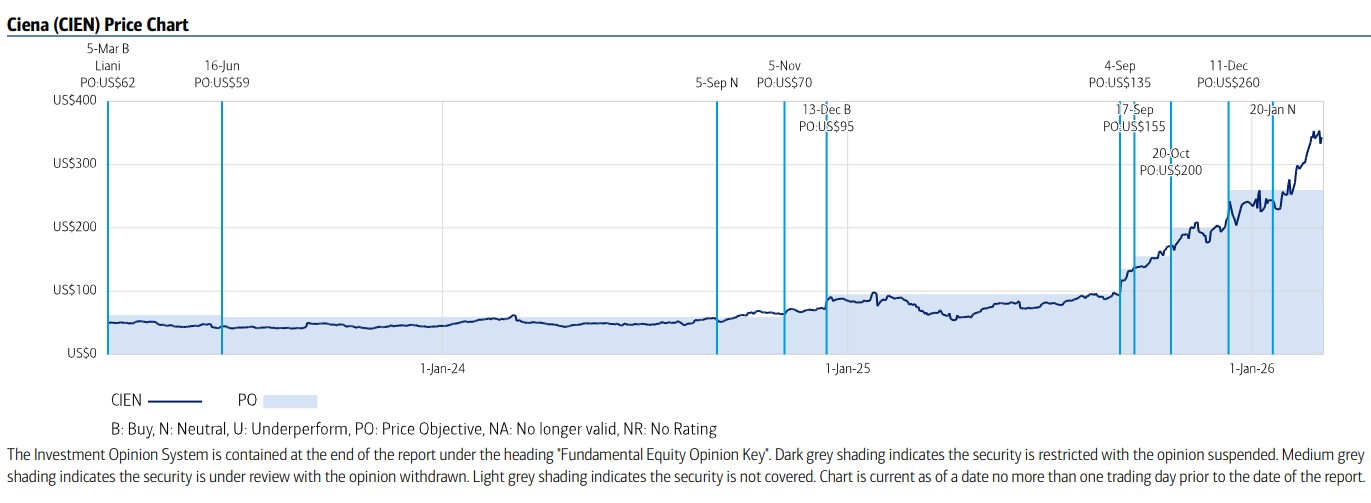
Bank of America expects Ciena to continue expanding its share in the 800G optical module market, with its WaveLogic 6 Nano chip utilizing 3nm DSP technology, providing significant advantages in power consumption. Additionally, Ciena has developed the DCOM data center management system for Meta, which is expected to generate over $100 million in revenue by 2026. Bank of America has given Ciena a "Buy" rating with a target price of $355
2. Cisco: First-Mover Advantage in the 800G Cycle
Cisco holds only about 6% of the market share in the optical transmission system market, but is more competitive in the pluggable optical module sector.
In the 400G ZR optical module market:
-
Marvell holds about 52%
-
Cisco about 35%
-
Ciena about 13%.
In the 800G market:
-
Cisco's current share exceeds 50%
-
Ciena about 29%.
Bank of America believes that Cisco, with its router and switch ecosystem, still holds an important position in the AI data center network upgrade. Bank of America has given Cisco a "Buy" rating with a target price of $95.
After AI Computing Power, Networks Become the Next Super Cycle
In the past two years, the focus of the AI industry chain has been on GPUs and computing power servers.
However, as model sizes continue to expand, computing power density and data traffic are surging simultaneously, making network infrastructure the new critical bottleneck.
According to Bank of America, this means that the AI investment cycle is transitioning from a "computing power cycle" to a "dual-cycle of computing power + network."
In this process, Scale-Across architecture, data center interconnect (DCI), and 800G/1.6T optical modules will jointly drive the optical communication industry into a new long-term upward phase.
OFC 2026 may be the starting point of this round of optical module super cycle
