


A complete "AI hardware" ecosystem is growing on OpenClaw

OpenClaw is rapidly transforming the smart hardware ecosystem, especially wearable devices. Users are increasingly concerned about whether sports watches support OpenClaw access when making their choices. OpenClaw is no longer just a software tool; it has become an AI operating system responsible for task understanding and action planning. More and more hardware products, such as smart glasses and headphones, are beginning to access OpenClaw, forming a rapidly developing hardware ecosystem
After using OpenClaw for a while, I found that it has quickly changed my decision-making logic for daily shopping.
For example, recently I wanted to buy a sports watch, and when I hesitated about which brand to choose, the first thought that flashed through my mind was: does it support integration with OpenClaw? If it doesn't support it, then I won't buy it.
The idea of wanting to buy a sports watch initially also came from OpenClaw.
Not long ago, I told OpenClaw to help me set up a fitness plan. I provided it with my goals and asked it to remind me daily, and it did just that.
However, after each workout, it would ask me like a coach about what I trained, how long I trained, and how the data looked. I need to input this manually, which is quite troublesome. If I could directly sync the data from the sports watch to OpenClaw, allowing it to analyze and record on its own, it would be much more convenient. Moreover, with more data, its guidance and interpretation of my physical condition would be more comprehensive.
At this point, I realized that a key factor in my selection of a sports watch was whether it supports integration with OpenClaw and whether its API or software interface could be easily called by the Agent.
The OpenClaw craze has lasted for two months, and its impact on hardware products is beginning to become evident.
We can see that more and more hardware products—from robotic dogs and robotic arms to AI glasses, headphones, watches, and even open-source robots DIYed by developers—are starting to actively integrate with OpenClaw.
In this new structure, OpenClaw is no longer just a software tool, but more like an AI operating system. It is responsible for understanding tasks, planning actions, and calling tools, while different hardware devices become its sensory and execution organs.
Thus, we found that a loosely connected but rapidly emerging "OpenClaw hardware" ecosystem is taking shape.

OpenClaw Changes Smart Hardware
- Wearable devices become the mobile entry point for Agents
The first commercial devices to integrate with OpenClaw are various wearable products.
For example, the smart glasses brand Rokid.
Rokid has launched a "customized agent" feature, allowing developers to connect the glasses to locally deployed OpenClaw via the SSE (Server-Sent Events) communication protocol.
As an AI glasses, it is equipped with a camera, microphone, and display system, capable of continuously collecting first-person perspective information.
In theory, when developers connect OpenClaw to the smart agent interface of the glasses, the glasses become an interface for collecting visual and audio data, with OpenClaw responsible for understanding and decision-making, and then returning the results to the user or calling tools This means that OpenClaw can understand the world users see in real time.
For example, when a user stands on the street of an unfamiliar city, the glasses capture the street scene, and OpenClaw can recognize the environment, query information, and even help the user plan a route.
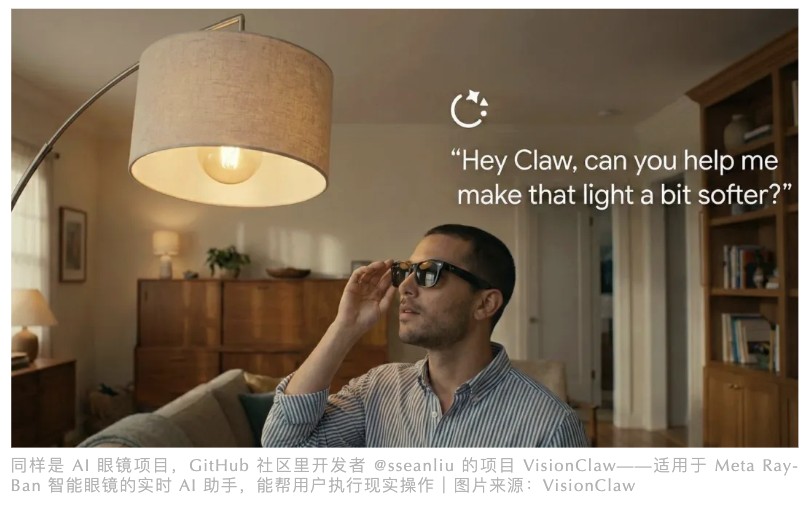
Similar attempts have also appeared on Li Weike's AI glasses.
According to official descriptions, users can directly invoke OpenClaw through voice commands to initiate tasks and command the AI to operate the computer. For instance, remotely directing the computer to handle emails, write daily reports, retrieve files on the computer, and so on.
At this point, the glasses serve as a portable smart command center.
Recently, Guangfan Technology, which just announced the completion of a 300 million yuan seed round financing, is also doing the same. Guangfan Technology's founder, Dong Hongguang, is a member of the founding team of Xiaomi Group and was responsible for developing MIUI. Their recently launched AI headphones and smartwatches are also integrated with OpenClaw.
Users can say a phrase through the headphones, such as "Help me book a flight to Shanghai tomorrow," and the device sends the voice input to OpenClaw, which then automatically completes a series of operations like searching, comparing prices, and placing orders.
Finally, the results can be displayed to the user on the smartwatch screen.
In this process, the headphones and smartwatch act more like input gateways and display interfaces for the AI Agent. They both play the role of mobile data entry points for AI in the physical world.
- OpenClaw Integrated with Robots
There has been a rapid increase in cases of integrating OpenClaw with robots and changing the way robots are controlled.
For example, the Vbot robotic dog from the embodied intelligence startup Weita Power.
In traditional architectures, robotic dogs often rely on preset programs or simple remote control. However, after integrating with OpenClaw, its capabilities have changed significantly: the robotic dog is no longer just executing fixed commands but can understand tasks.
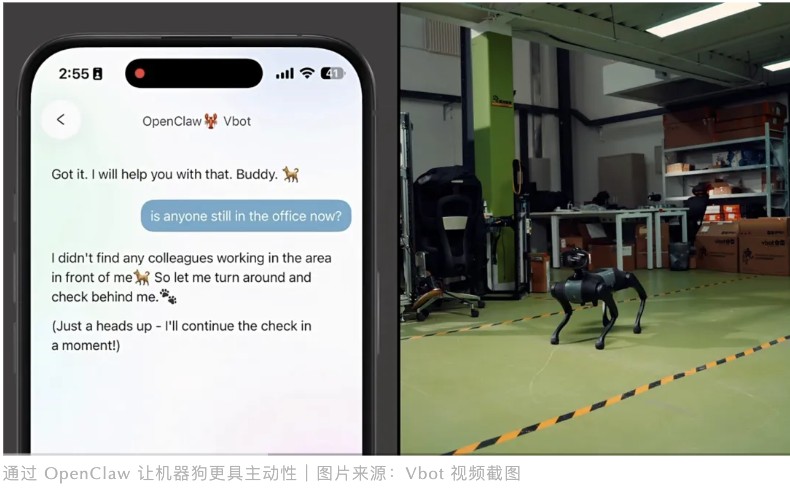
Users only need to issue commands through voice, such as "Patrol the living room" or "Check if there is anyone at the door," and OpenClaw will complete a series of actions:
Understanding the command, planning the task, invoking the robot control interface, and the robotic dog executes.
In this process, OpenClaw acts as the task brain, while the robotic dog becomes the executing body.
Similar cases have also appeared in the field of robotic arms, such as the seven-axis robotic arm from Songling Robotics.
Developers can connect the seven-axis robotic arm to OpenClaw and directly describe the robotic arm's actions in natural language, such as "Grab the cup on the left," and OpenClaw will automatically generate executable code scripts, plan the task path, and control the robotic arm to complete the action In theory, developers can create custom skills, such as "welding" or "handling," allowing robotic arms to possess expert capabilities in specific fields.
Therefore, with the help of AI, not only has software development become as simple as speaking a few words, but hardware applications are also following the same trend.
If past robots were a set of automated devices, after integrating an agent like OpenClaw, they begin to resemble an "assistant" that can understand tasks.
This is one of the reasons many developers are excited:
AI agents are, for the first time, gaining true physical execution capabilities.
- True imagination comes from the open-source ecosystem
However, what has truly driven the rapid expansion of the OpenClaw ecosystem is not commercial companies, but the open-source developer community.
On GitHub, a large number of developers have begun to use OpenClaw to control various open-source hardware devices. For example, DIY open-source robotic dogs, Raspberry Pi robots, Jetson AI robots, smart home systems, and so on.
A hundred flowers bloom.
More importantly, the emergence of a series of small open-source projects is opening up imagination for "AI hardware."
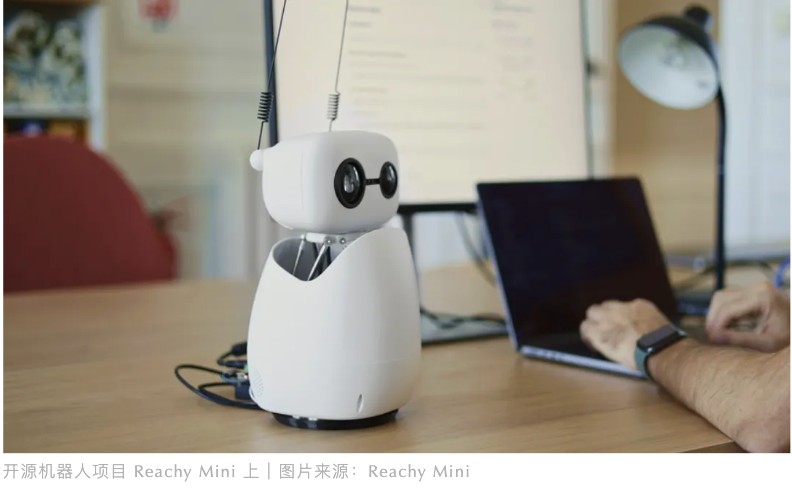
For instance, someone has directly connected OpenClaw to the mature open-source robot project Reachy Mini, enabling remote voice control through software like Telegram to execute various complex actions, even without needing to understand code.
OpenClaw can read sensor data from the robot, such as camera images, depth information, or LiDAR data, while also being able to send control commands to the robot, such as turning its head, twisting antennas, or recognizing people.
Similarly, a recent standout is MimiClaw.
This project, created by Chinese developers, can fit OpenClaw into a 10-yuan ESP32 development board. It is developed entirely in C language, requiring no operating system (Linux) or Node.js environment, and runs directly on the microcontroller.
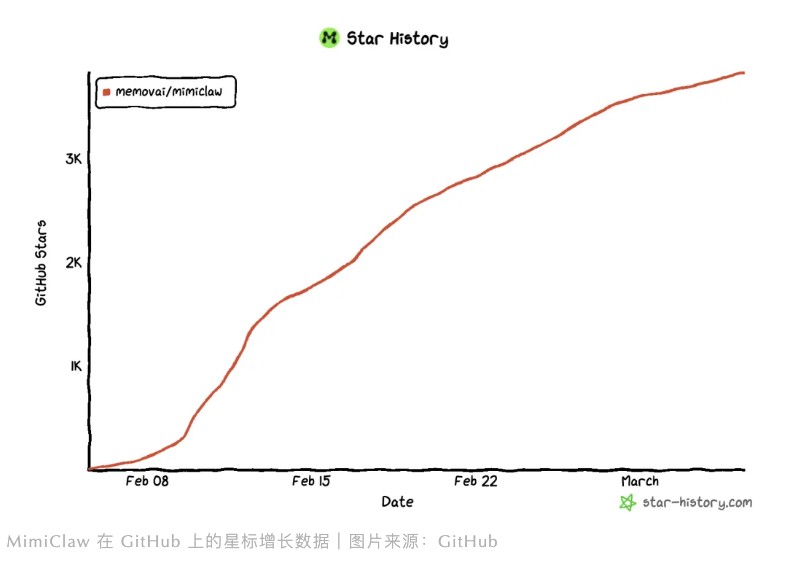
Users can communicate with it using messaging software like Telegram, calling on cloud-based large models, and MimiClaw also has local memory systems (Markdown file storage), tool invocation, and autonomous scheduling capabilities.
Users do not need to purchase expensive Mac devices to experience the physical version of OpenClaw.
Imagine, it actually opens up new possibilities for consumer-grade smart hardware Perhaps, a new era of smart hardware with lower costs, higher autonomy, strong privacy, and interconnectivity between hardware agents is about to begin?
Five Trend Predictions for "AI Hardware" After OpenClaw
One of the charms of OpenClaw lies in its provision of an open agent framework that allows various hardware to connect to the same "smart brain."
Thus, robotic dogs become the legs of AI, robotic arms become the hands of AI, glasses become the eyes of AI, and headphones become the ears of AI.
If we look at the recent wave of hardware integration around OpenClaw from a longer time perspective, the changes it brings may not only be the popularity of an open-source agent framework, but the role of smart hardware may also undergo more profound changes.
From hardware forms, interaction methods to industrial division of labor, a series of new trends have already begun to emerge. Let’s make a few predictions:
- Smart hardware will become more proactive, with unprecedented efficiency improvements
OpenClaw has strong proactivity, and when this proactivity connects to the physical world, the efficiency of hardware will also be unprecedentedly enhanced. For example, the Vbot robotic dog mentioned above, after connecting to OpenClaw, can be commanded to proactively greet people or remind children to drink water every 30 minutes.
Thus, hardware transforms from a passive "tool" into an active "partner."
Similarly, a smartwatch that used to push health data summaries once a day may in the future sync every 30 minutes, transforming from a mere information data provider to a companion or advisor for the user.
- Hardware will become "decentralized," unified by AI scheduling
As mentioned above, open-source projects like MimiClaw are allowing the OpenClaw ecosystem to penetrate into extremely low-cost hardware. In the future, more ordinary devices (such as glasses, headphones, robots) may instantly possess "OpenClaw Ready" capabilities.
In this scenario, hardware will mainly be responsible for executing specific actions, while reasoning power will call upon the cloud "brain." Once this capability matures, robots, desktop devices, and wearable devices may all become execution nodes for agents.
For example, AI can understand vague commands like "prepare to watch a movie" and automatically execute a series of physical actions such as turning off the lights, lowering the curtains, and starting the projector.
At this point, different hardware may share the same cloud "brain," and different hardware can interconnect, awaiting unified scheduling from the cloud AI to cooperate.
- Mobile phones may also become mere display terminals
For the past decade, almost all smart hardware has relied on mobile phones.
Watches, headphones, and glasses are essentially peripherals of mobile phones. However, in the agent era, this structure may be broken.
When cloud AI can directly understand voice, visual, or environmental information through various "distributed hardware," the interaction between hardware and users will become more direct, such as through voice interaction and tactile feedback (vibration) At this time, many devices no longer need to use smartphones as intermediaries. For example, in autonomous driving scenarios, onboard AI, home robots, continuously running desktop devices, and all-day wearable assistants.
These devices can connect directly to cloud agents instead of going through smartphones. In other words, smartphones may degrade from being the "control center" to one of many terminals.
- Completely independent hardware categories may be about to explode
According to the previous reasoning, future hardware may no longer be an accessory to smartphones.
A large number of software and hardware use cases are emerging around OpenClaw, diverse and varied. Some previously non-existent demands have even emerged, such as AI Nas, which has recently been popularized by OpenClaw.
When various new demands can be systematically gathered together, it may support the emergence of new hardware categories. Who will become that lucky one?
- The core capability of hardware will become perceptual ability
In the era of traditional smart hardware, product capabilities often depended on the device itself: computing power, algorithms, functional modules.
However, after the emergence of the OpenClaw architecture, hardware is more responsible for "perceiving the world," while AI agents are responsible for "understanding the world."
The core value of future hardware may no longer be its computing power but rather perceptual ability—including richer and more precise sensor inputs and scene data that are closer to the real world.
Sensors themselves may become more important.
If the core issue of smart hardware in the past decade was "how to make better devices," the next question may become:
How to connect devices to smarter AI.
As agent systems begin to connect sensors, robots, and wearable devices, smart hardware is no longer just independent terminal products but also interfaces for AI systems to interact with the real world.
AI hardware entrepreneurs and developers are all being drawn into a new competitive landscape.
Risk Warning and Disclaimer
The market has risks, and investment requires caution. This article does not constitute personal investment advice and does not take into account individual users' specific investment goals, financial conditions, or needs. Users should consider whether any opinions, views, or conclusions in this article align with their specific circumstances. Investing based on this is at their own risk
