


Can WeChat raise lobsters now? Tencent released three lobsters in one day, and this final move is a bit ruthless

Tencent has launched the powerful AI tool QClaw, which features the groundbreaking "WeChat Direct Connect" killer feature. With just a WeChat message, AI can remotely control your computer to automatically generate reports, write code, and post tweets. It requires zero threshold for deployment and all data is fully localized. This is not only a revolutionary office tool but also signifies that WeChat is evolving into an all-powerful "super interface."
The current information flow and Moments are almost in the shape of "lobsters," and even Ma Huateng has expressed in Moments, "I didn't expect it to be so popular."
APPSO recently organized a beginner's guide for OpenClaw, but honestly, whether it's local deployment or cloud deployment, there is still a bit of a threshold for ordinary users. This has led to the emergence of many "installation services," and now there are even "lobster USB drives."
Today, Tencent has launched three "lobsters" at once, among which the most noteworthy is QClaw.
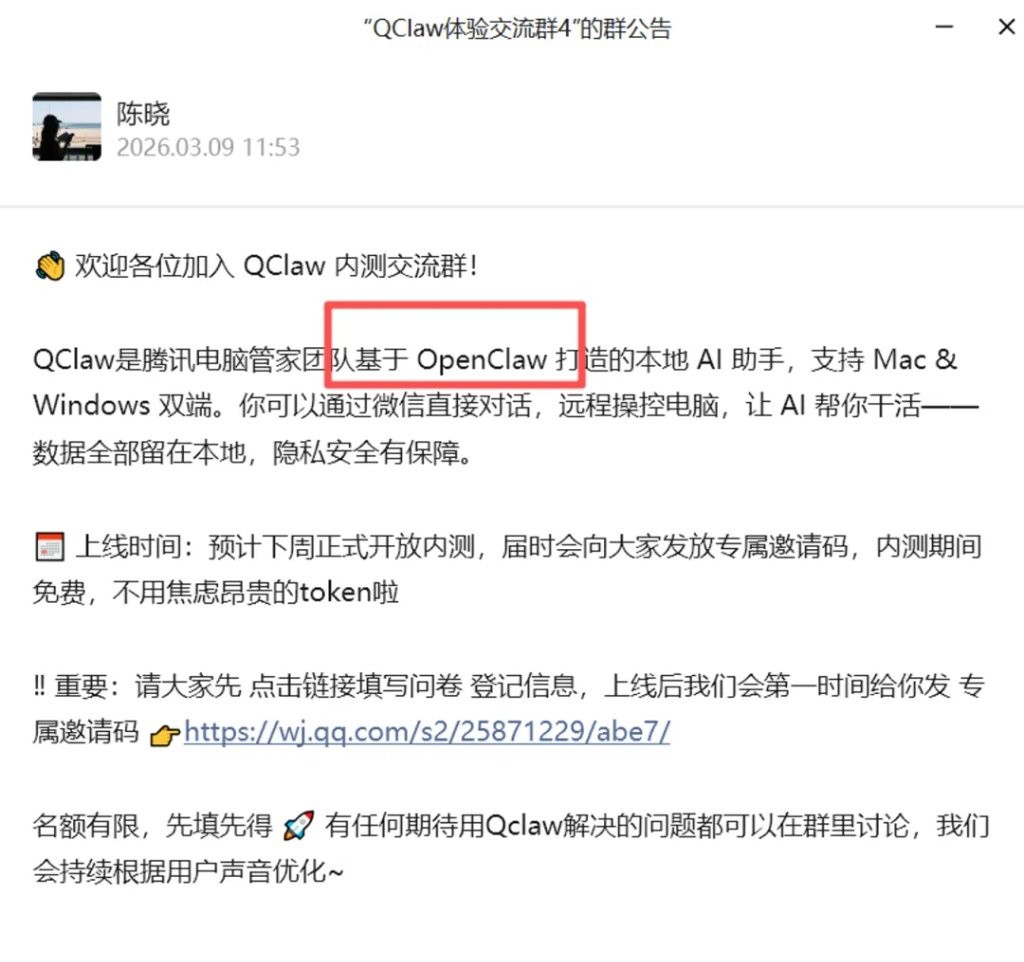
This is a local AI assistant developed by Tencent's PC Manager based on OpenClaw, which can be installed with one click.
In simple terms, it's an "overlay" of OpenClaw. Around this time last year, there was a shell product that went viral online called Manus.
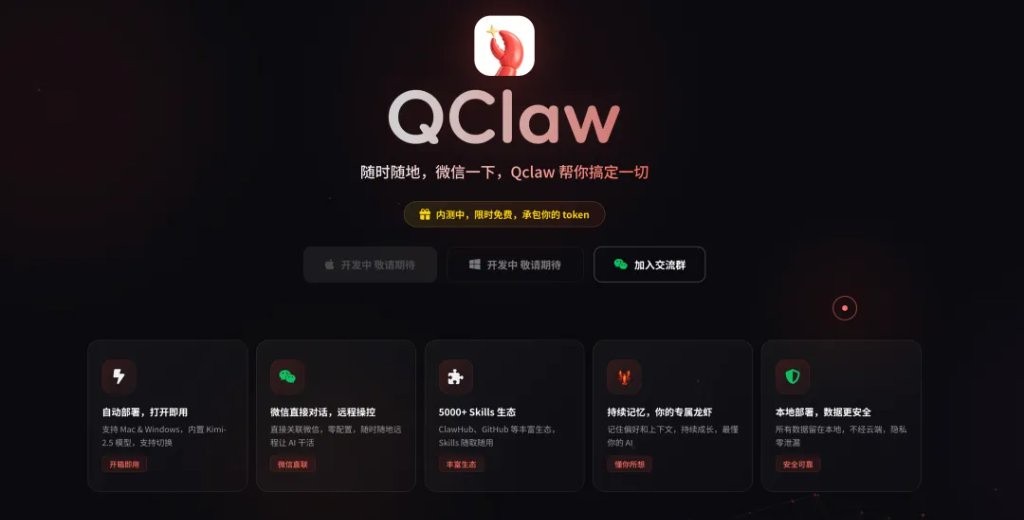
Here comes the key point: QClaw has a "killer" feature that all current OpenClaw products do not have — directly chatting with the lobster on WeChat to help you get things done.
Currently, QClaw has not officially launched, and APPSO will share the experience with everyone as soon as possible.
Making "raising lobsters" as easy as installing WeChat
According to the official website, it supports both Mac and Windows, with the Kimi-2.5 model built-in. The interface displayed by beta users shows that it can be default linked to built-in models like Kimi, Minimax, GLM, DeepSeek, and also allows users to customize large models.
Of course, the most significant feature is the zero-configuration direct link to WeChat. Whether you are commuting or lying on the sofa, you can send a message to this "lobster" on WeChat, and it can remotely control your computer to get things done.
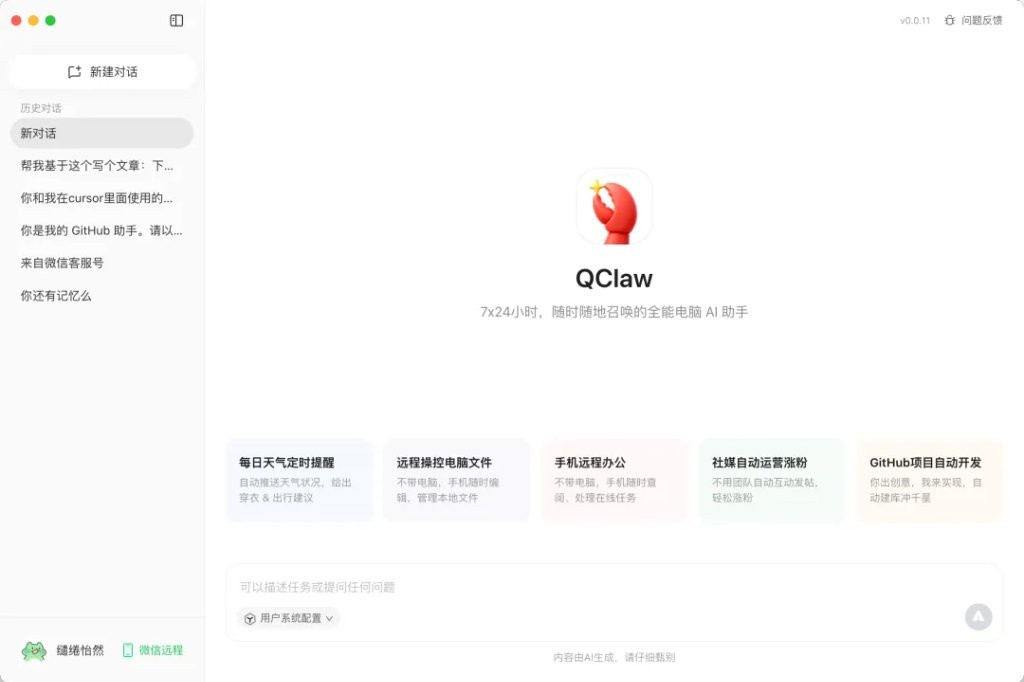
(QClaw user interface, image from: Agent Universe)
QClaw is backed by a vast Skills ecosystem, linking ClawHub and GitHub, with over 5,000 Skills reserves. This means it can not only chat with you but also help you run code, check data, and even manage projects, filling up the skill tree.
This lobster also has the ability of "continuous memory," remembering your preferences and context like an old friend, becoming more handy the longer you use it, truly growing into something that understands you.
As for the data security concerns many people have, QClaw keeps all data local and does not go to the cloud.
Of course, since it needs to perform system-level operations (such as file operations, browser control, etc.), you need to grant certain permissions. It is recommended to set a strong password and identity verification (Token), limit the chat range (only allow trusted contacts), and enable double confirmation for sensitive operations
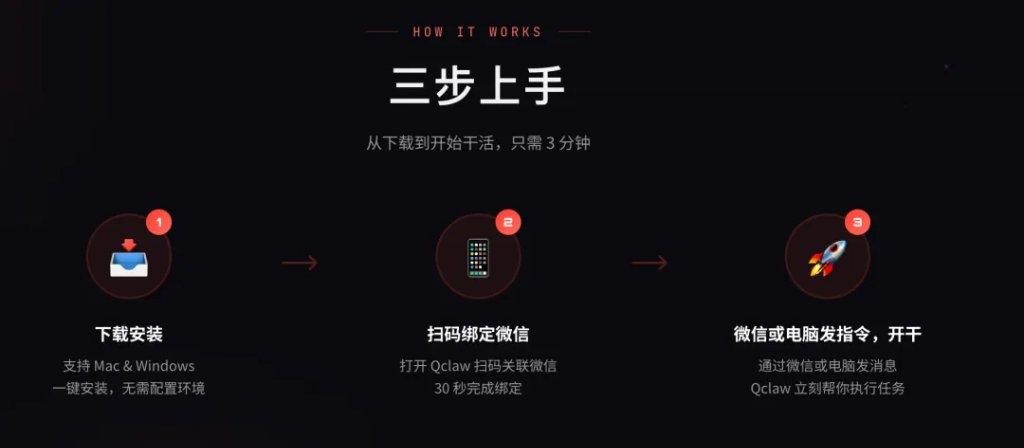
The access process of Qclaw features a "foolproof" operation, which looks very user-friendly:
-
Download the client: Currently supports both Mac and Windows platforms (not available for download yet).
-
Scan to bind: After installation, open it and use your WeChat to scan the QR code on the screen.
-
Start using: Once bound successfully, you will have a "lobster" friend in your WeChat.
What can you do with "raising lobsters" on WeChat QQ?
After all this, what exactly can QClaw do?
Currently, the official website does not support downloads. According to messages in the official beta testing group, it is expected to officially open beta testing next week, and will be developed in the form of invitation codes, claiming that the flagship beta testing will be free, solving Token anxiety.
 Let's put it this way, when you are out and about and your boss suddenly asks for data, you just need to say to WeChat, "Help me open the Q3 report.xlsx on the desktop and sum the data in the third column," and it can remotely control your computer, open the file, calculate the data, and send the result back to you on WeChat.
You are in a café, living at your workstation; this is the true freedom of remote work.
While others are still struggling to choose topics, write copy, and respond to comments, you only need to say, "Help me post a note about AI efficiency on Xiaohongshu and interact automatically," and it can generate the note, publish it with one click, and even automatically reply to comments to help you gain followers.
You relax, and it works hard; could this be the ultimate form of social media operation in the future?
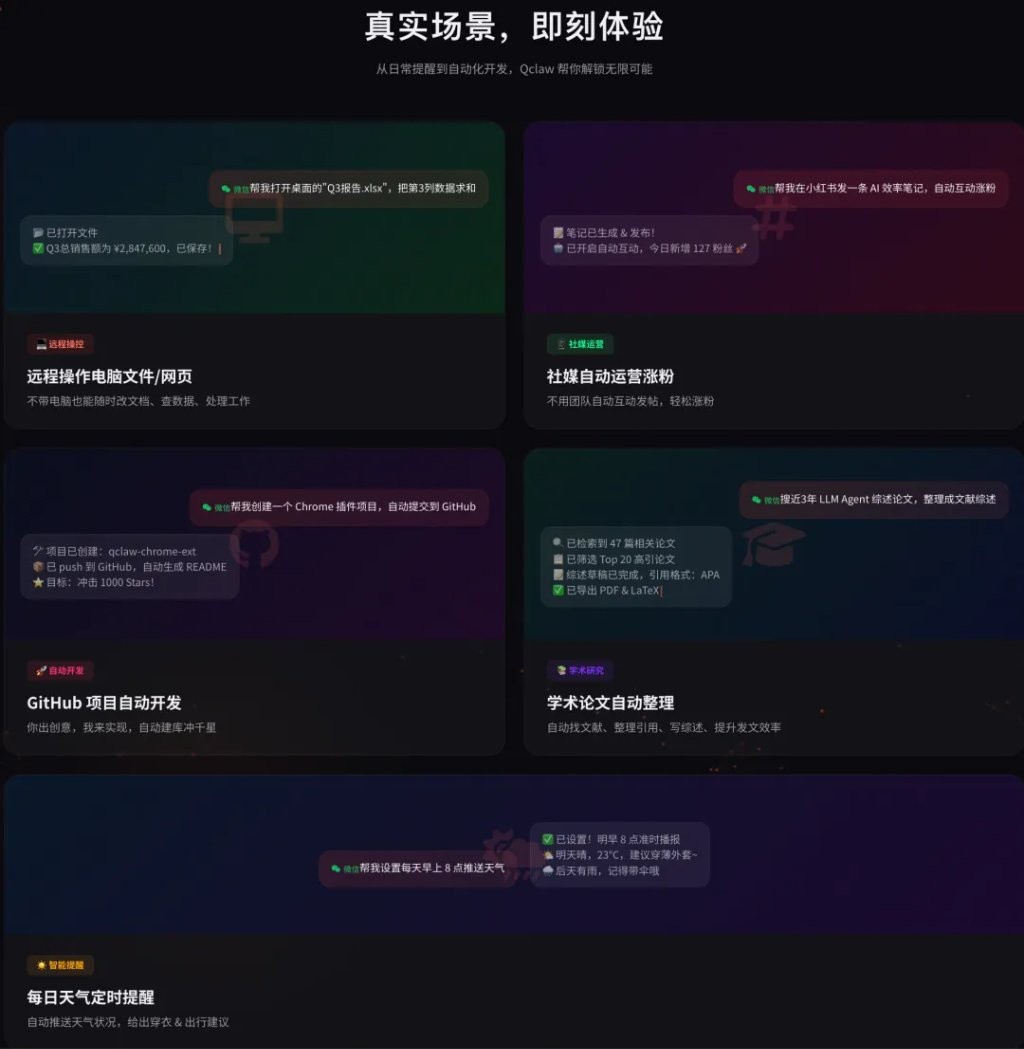
Common programming functions are also supported. You say, "Create a Chrome extension project and automatically submit it to GitHub," and it can create folders, write code, and push to the repository all in one go, with zero manual effort.
The mentor says, "Submit the review next week," but you haven't even looked at the paper title? Don't panic, tell it, "Search for review papers on LLM Agent from the last three years and organize them into a PDF," and it will handle the search, filtering, writing the review, and exporting the PDF, delivering the complete service directly to you.
In life, you may not have a partner, but you can have an AI that reminds you of the weather every morning at 8 AM, warns you to take an umbrella when it rains, and reminds you to wear more clothes when it gets cold, more punctual than your mom and more reliable than your partner—if you have one.
If this product officially launches, it will probably be one of the lowest-threshold OpenClaw connection solutions on the market. Moreover, it encapsulates complex Agent technology into a "lobster" that can be called upon anytime in WeChat Although QClaw has achieved "direct interaction with lobsters in personal WeChat," it is completely different from the OpenClaw integration of Feishu and WeChat Work.
Just this morning, WeChat Work officially announced the integration of OpenClaw with intelligent robots, which not only allows direct conversation but also supports quick data entry into smart spreadsheets through OpenClaw.

At the same time, Tencent's version of WorkBuddy has officially launched, fully compatible with OpenClaw's capabilities, and it can also integrate with QQ, Feishu, DingTalk, and other tools.
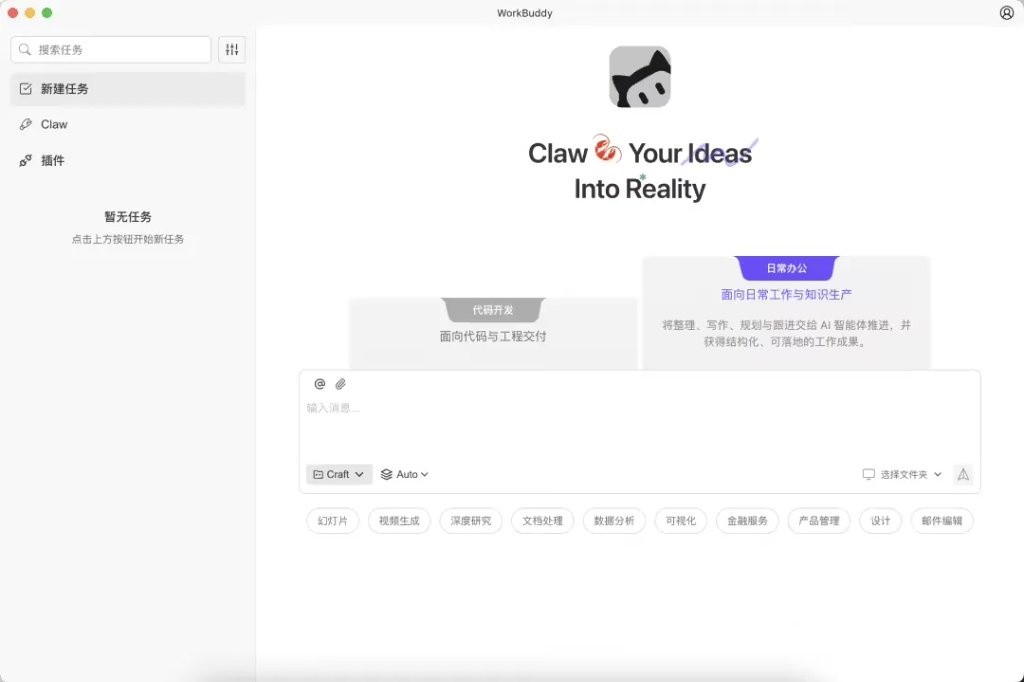
Tencent has released three lobsters in one day, and the speed of action is almost like they are competing to make a statement.
To be honest, it is not technically difficult for WeChat to integrate with lobsters. The real reason for the delay is well known to everyone—an application with 1.4 billion users, no matter how appealing OpenClaw is, cannot afford to loosen the strings on security and data even a little.
With greater capability comes a heavier burden; this matter cannot be rushed.
But regardless of how WeChat chooses, the competition for new AI entry points has quietly changed tracks.
OpenAI co-founder Andrej Karpathy sparked heated discussions with a comment under a post yesterday. His meaning was very straightforward and disruptive: future software will no longer be for humans but for AI entities.

What he shared was a long article by Box CEO Aaron Levie. It contains a judgment that can be described as "radical":
If your product cannot register accounts through an API and cannot allow intelligent agents to operate autonomously, then in the AI era, it is "approximately dead." Intelligent agents will replace humans as the "first users" of all software, and the logic of software design must leap from "API first" to "API only."

This statement sounds extreme, but if you think about it carefully, it hits the truth that the entire industry is most reluctant to face.
APPSO mentioned a viewpoint in last week's analysis of OpenClaw: Lobsters have given IM software a chance to become WeChat again. The key lies in how open a chat platform should be in the Agent era Just think about it, when a chat window can call any Agent to complete all tasks from booking tickets, writing code to running data analysis, it is no longer just a message pipeline—it is becoming a super interface. And the most suitable platform for this position has always been WeChat.
However, can an open ecosystem truly achieve that kind of "omnipotent" service depth without compromising security? To be honest, no one dares to guarantee that at the moment.
But this seed has already been planted, and you can feel that a brand new form is beginning to sprout.
Source: APPSO
