


For oil prices, apart from the Strait's reopening, "nothing else matters."

Deutsche Bank's latest research report points out that the oil price breaking through $100 per barrel means the market is pricing in over a month of disruption in the Strait; if it rises to $130-150, it corresponds to expectations of a three-month closure. The release from the Strategic Petroleum Reserve (SPR) and the exemption for Russian oil are merely drops in the bucket—daily release capacity of 3 million barrels is far from the gap of 17-20 million barrels. Trump has clearly stated that oil prices will not constrain military decisions, and the timeline for reopening the Strait becomes the answer to everything
Currently, the Strait of Hormuz has become the only variable that investors are closely monitoring, and the market has been pricing in the disruption for over a month.
According to the Chase Wind Trading Desk, Michael Hsueh, a commodity research analyst at Deutsche Bank, released the latest research report on March 9, 2026, with a core conclusion that is straightforward and unequivocal: When the Strait of Hormuz can safely reopen is the only decisive variable for the current oil price trend.
Whether it is the release of the Strategic Petroleum Reserve (SPR), exemptions for Russian oil, or policy tools like price caps, none can fundamentally reverse the oil price trend before the issue of reopening the strait is clarified.
Currently, market oil prices have surpassed $100 per barrel. According to Deutsche Bank's model, this means the market is pricing in a disruption in the strait that has lasted over a month. If oil prices rise to the range of $105-$115 per barrel, it corresponds to a market pricing of about two months of disruption; if it further rises to $130-$150 per barrel, it indicates market expectations of a closure lasting up to three months. The most critical operational logic at present is singular: closely monitor the timeline and safety conditions for the reopening of the strait.
Oil prices have exceeded the pricing for a one-month disruption, with further upside potential
The report points out that oil prices breaking through $100 per barrel have exceeded the previous pricing range of $80-$100 per barrel under the "ambiguous closure" scenario, indicating that the market has extended its expectations of disruption duration from one month to a longer period. $105-$115 per barrel corresponds to about two months of disruption, while $130-$150 per barrel corresponds to a three-month closure scenario.
From a downside scenario, if military escorts for commercial fleets can start around March 18 and allow commercial traffic to initially recover at 50% capacity, then reach 100% by early April, the actual disruption duration will be close to one month.
Under this assumption, Brent crude prices are expected to fall back to around $90 per barrel, depending on the market's assessment of the ongoing risk of attacks on tankers.
Trump clearly states that oil prices will not constrain military decisions; India's exemption for Russian oil is merely a drop in the bucket
An important observation from the report is that there seems to be no threshold for U.S. decision-makers that would constrain military actions due to high oil prices. According to Xinhua News Agency, in response to rising international oil prices, U.S. President Trump stated on social media on the 8th that for the "safety and peace of the United States and the world," this is just a "very small price to pay."
Additionally, U.S. Treasury Secretary Yellen has claimed that they are studying policy measures to stabilize oil prices, but the only substantive measure implemented so far is granting exemption permits to Indian refiners, allowing them to receive cargoes from Russian tankers that are already en route.
It is estimated that this exemption will increase India's imports from Russia in March to 33 million barrels, averaging about 1.1 million barrels per day, compared to an estimated 600,000 barrels per day in January, with an increase of about 500,000 barrels per day.
However, the report clearly states that this increase "would be significant at any other time," but in the current context of the disruption in the Strait of Hormuz leading to a global supply loss of 17-20 million barrels per day, its impact can be almost ignored. It is worth noting that the import pace in March may still be below the levels recorded by India's Ministry of Commerce and Industry in December of last year
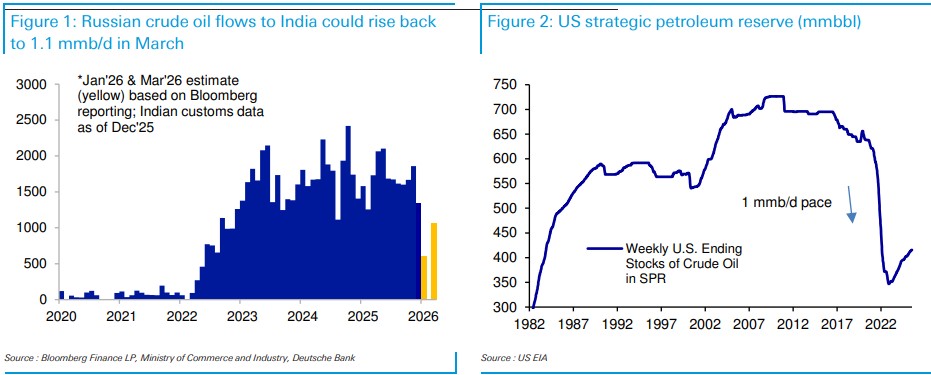
SPR Release: An Emotional Soothing Agent Rather Than a Fundamental Solution
The report gives a cautious evaluation of the effects of the SPR release. Treasury Secretary Janet Yellen stated that measures to stabilize the market will continue to be announced, and the G7 is reportedly discussing coordinated releases of emergency oil reserves.
However, Deutsche Bank analysis points out three fundamental limitations of the SPR release:
First, limited reserves. A large-scale release may instead trigger greater panic in the market over the depletion of supply reserves.
Second, supply lag. The Japanese government disclosed that the SPR release typically takes about a month (including the auction process); the U.S. Department of Energy stated that deliveries could begin as soon as 13 days after the announcement, but this depends on logistics arrangements.
Third, severely insufficient release rate. The peak SPR release in the U.S. in 2022 reached about 1 million barrels per day. Even assuming the U.S. could increase this to 1.5 million barrels per day, combined with an additional 1.5 million barrels per day from other IEA member countries, the total would only be 3 million barrels per day, far below the daily gap of 17-20 million barrels caused by disruptions in the Strait of Hormuz.
Therefore, the report believes that the SPR release, if not accompanied by a clear prospect of reopening the Strait, is at best a short-term emotional comfort rather than a substantive solution to supply and demand.
Additionally, the report emphasizes the technical difficulties of reopening the Strait. Military naval analysts previously judged that the U.S. military might provide military escort for commercial fleets no earlier than 10-14 days after mid-last week. This means the most optimistic time window for reopening the Strait could be from mid to late March.
The report finally proposes a potential accelerator for supply recovery: if the Strait of Hormuz reopens, OPEC member countries with idle production capacity, such as Saudi Arabia, the UAE, and Kuwait, may temporarily increase production to fill the previous supply gap. Deutsche Bank believes this move aligns with the interests of these countries—preventing high oil prices from causing lasting damage to demand while also achieving a short-term increase in revenue, but currently, there are no statements or signals from OPEC countries regarding this
