


Foreign Trade at the Beginning of the Year: A Shining Extraordinary Signal

In the first two months, China's foreign trade imports and exports started with double-digit growth, showing strong real performance. Despite the impact of the Spring Festival on short-term data, the export growth rate (21.8%) is only second to those in 2018 and 2021 in nearly a decade. The overseas capital expenditure cycle, regional market expansion, and adjustments to the photovoltaic export tax rebate policy are key factors supporting export growth. The recovery of manufacturing in major global economies has driven a rebound in external demand, particularly with outstanding export performance to Africa and ASEAN markets
The import and export in January and February have shone with double-digit growth, confirming the strong reality of foreign trade at the beginning of the year, but more importantly, how will this strong reality under the unexpected performance be interpreted? We believe that in addition to seasonal factors, the overseas capital expenditure cycle, regional expansion, and the rush for exports under the photovoltaic export tax rebate are three additional supports.
From a vertical perspective, despite the disturbance of the Spring Festival factor, compared to the historical same period, the export growth rate in January and February (21.8%) is only slightly lower than that of 2018 and 2021 in the past decade, remaining at a seasonal high; from a horizontal perspective, the high growth of our exports in January and February compared to major exporting countries like South Korea and Vietnam is also "not falling behind."
In our year-end report last year, "2026 China Macroeconomic Outlook: Ten Questions and Answers," we pointed out that this year's "export-in" is one of the core clues running through the macro economy, and the impressive performance of exports in January and February has initially confirmed this. However, under the shining data at the beginning of the year, to what extent can exports "advance" this year?
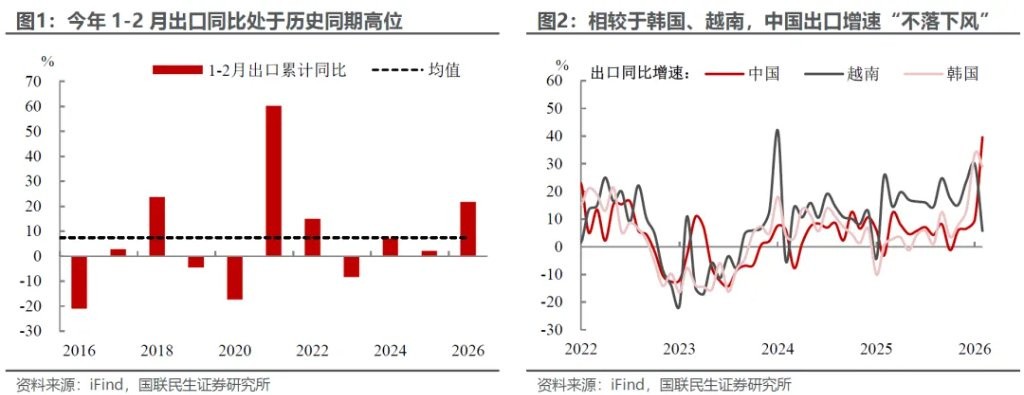
Behind the strong export performance at the beginning of the year, there is a short-term disturbance caused by the misalignment of the Spring Festival. From historical experience, manufacturers usually increase exports before the Spring Festival, therefore, a later Spring Festival date often raises the export performance in January and February while suppressing that in March. This year's Spring Festival was nearly 20 days later than last year, further driving the rush for orders by enterprises in January and February.
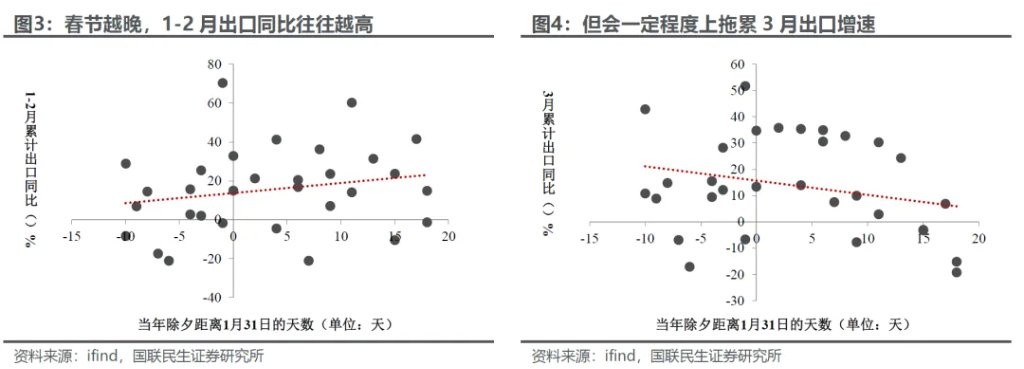
In addition to seasonal factors, what other unusual factors support the high growth of exports?
Firstly, the strong export performance is strongly mirrored by the overseas capital expenditure cycle. Since the beginning of the year, the manufacturing prosperity of major global economies has generally improved, with the global manufacturing PMI once jumping to 51.9%. Major economies such as the United States and the Eurozone have returned above the boom-bust line, and the trend of external demand warming is clear, which has significantly boosted our exports, as evidenced by the impressive performance of South Korea's exports at the beginning of the year. 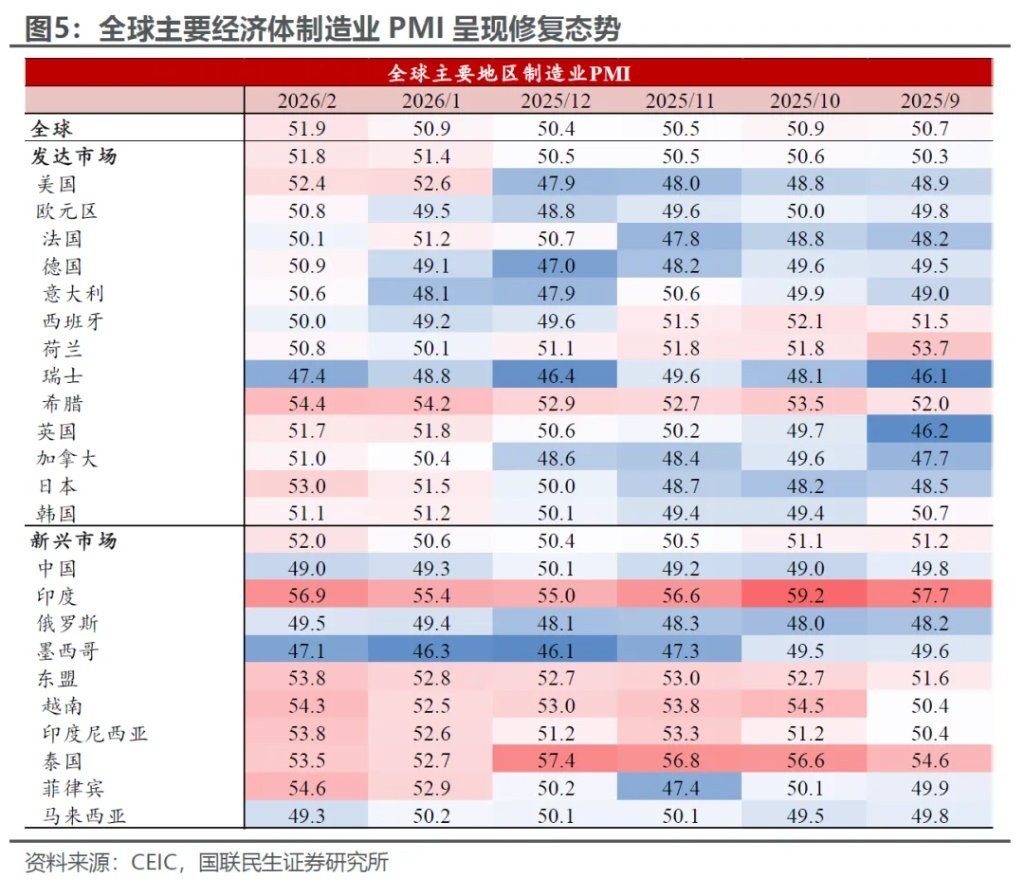
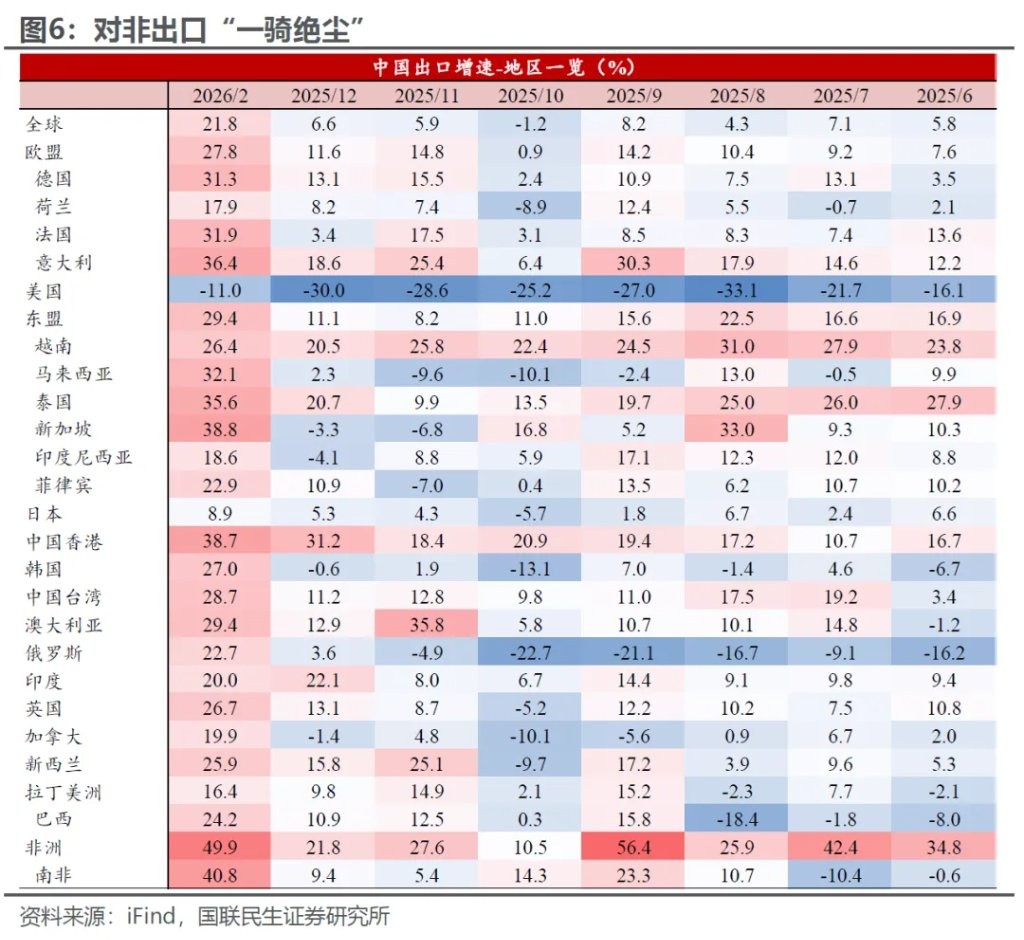
Secondly, corporate orders are accelerating their shift to emerging markets, with exports to Africa leading again. In January and February, the export growth rate to Africa approached 50%, slightly lower than the peak level in September last year, becoming an important growth pole for our exports; at the same time, re-export trade represented by ASEAN and Hong Kong, China, as well as the European market, maintained double-digit high growth, collectively forming the core driving force for exports at the beginning of the year;
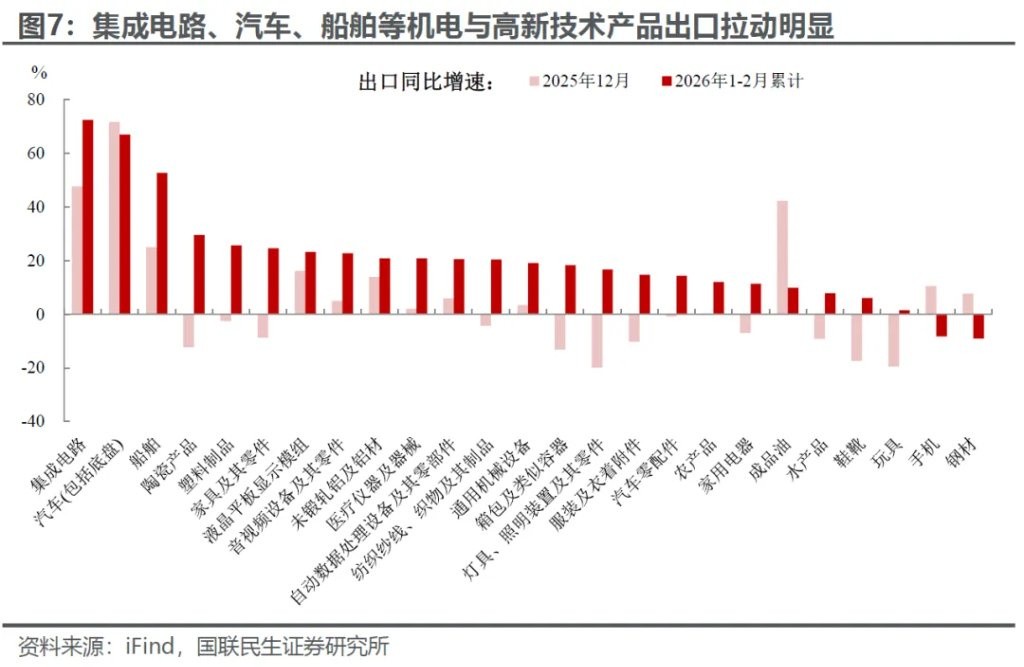
Thirdly, the cancellation of the photovoltaic export tax rebate may drive some industries to "rush for exports." Affected by the anticipated adjustment of the photovoltaic export tax rebate policy in April, companies have engaged in certain pre-shipment behaviors, leading to a significant increase in exports from related industries such as new energy vehicles, power electronics equipment, and plastic glass in January and February.
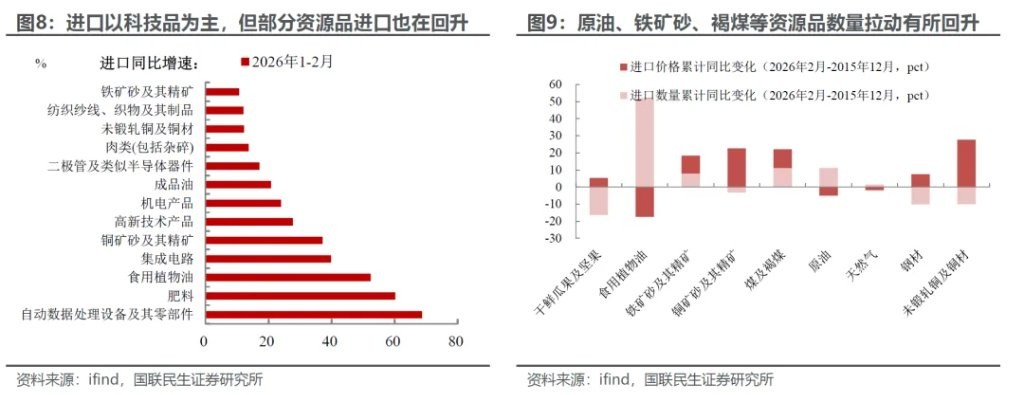
In contrast to the strong exports, imports are also "keeping pace," reflecting a certain recovery in domestic demand. Although the products with the highest import growth in January and February are still mainly high-tech products such as automatic data processing equipment and integrated circuits, as well as electromechanical products, which have higher technological attributes, the import growth of traditional domestic demand and resource products is also gradually warming. Moreover, in terms of volume and price, compared to last year, the year-on-year growth rate of imported quantities for most products such as iron ore, crude oil, and lignite has improved, not entirely driven by price, indicating a certain recovery in domestic demand, although the overall growth rate is still slightly weaker than exports.
Looking ahead, under the backdrop of stronger exports than imports, a high trade surplus pattern is expected to continue. This is likely to provide stable support for economic growth at the beginning of the "14th Five-Year Plan"; on the other hand, the high growth of the current account surplus will also provide solid fundamental support for the exchange rate, driving the appreciation of the Renminbi.
Risk Warning and Disclaimer
The market has risks, and investment requires caution. This article does not constitute personal investment advice and does not take into account the specific investment goals, financial conditions, or needs of individual users. Users should consider whether any opinions, views, or conclusions in this article are suitable for their specific circumstances. Investment based on this is at one's own risk
