"Storm is not over yet"! Goldman Sachs: CTA fully turns bearish, systematic selling pressure may reach the highest this year in the coming week

Goldman Sachs and JPMorgan Chase both issued warnings, indicating that the rebound in the U.S. stock market cannot conceal the underlying crisis. Goldman Sachs' model shows that the surge in volatility has triggered the CTA risk control mechanism. Regardless of market fluctuations, systematic funds are expected to net sell comprehensively in the coming week, with the scale of selling potentially reaching historical extremes. If the S&P 500 breaks below the mid-term pivot support, it will further ignite a new wave of selling. Meanwhile, market makers' Gamma exposure turning negative amplifies volatility, and liquidity depth is approaching the "liberation day" lows, putting the market in a high-risk zone
Despite Trump's signals of easing tensions in the Middle East briefly boosting risk sentiment, the latest trading desk warnings from Goldman Sachs and JPMorgan Chase indicate that the deep structural issues in the market are far from resolved, and the core contradiction of systemic selling pressure and insufficient position clearing is pushing the market towards a new round of high volatility.
Goldman Sachs' latest trading desk report warns that, due to recent market volatility, CTA (Commodity Trading Advisor) strategy funds have been forced to trigger risk control mechanisms. In the coming week to month, regardless of how the market unfolds, CTAs will become net sellers of stocks. Goldman Sachs specifically points out that the scale of selling expected in the coming week is projected to reach historical extremes since records began, meaning that algorithmic trading will become a major source of ongoing market losses.
Meanwhile, JPMorgan Chase's position intelligence team analysis indicates that although the market has experienced significant fluctuations recently, there has not been a complete "cleansing" deleveraging—where investors panic and sell at any cost, reducing positions to extremely low levels.
The report states that data shows current overall investor positions have only returned to neutral levels, far from historical clearing points. This structural risk implies that the market lacks sufficient "ammunition" to absorb potential selling pressure that may arise later. Therefore, JPMorgan Chase concludes that the recent rebound is more based on short covering and emotional recovery rather than the start of a new allocation cycle.
Analysts believe that as passive system traders (such as CTAs) become purely selling forces, while active management investors have not yet completed their position adjustments, the market still faces pressure for a second bottom after a short-term stabilization.
Goldman Sachs: CTAs are sellers in all scenarios
Goldman Sachs' latest models from the trading desk have issued multiple warning signals, indicating that the market is facing triple pressures of systemic selling pressure, ineffective hedging mechanisms, and liquidity exhaustion.
First, CTA selling pressure is at a record high, with key points on the verge of being triggered. Goldman Sachs' conditional CTA flow model shows that regardless of market movements, systemic funds will continue to net sell stocks in the coming week to month. Goldman Sachs emphasizes that the current estimated selling scale "is among the largest on record." If the S&P 500 index closes below the mid-term pivot support, it will trigger a new and more intense wave of selling from systemic strategies.
Second, market makers are amplifying volatility, with negative gamma exacerbating price swings. More concerning is that market makers' gamma exposure has dropped to its most negative level this year. This means that the hedging actions of market makers not only fail to stabilize volatility but also act as amplifiers of price movements—whether the market rises or falls, the negative gamma environment is expected to persist, significantly increasing the probability of the market entering a high volatility range.
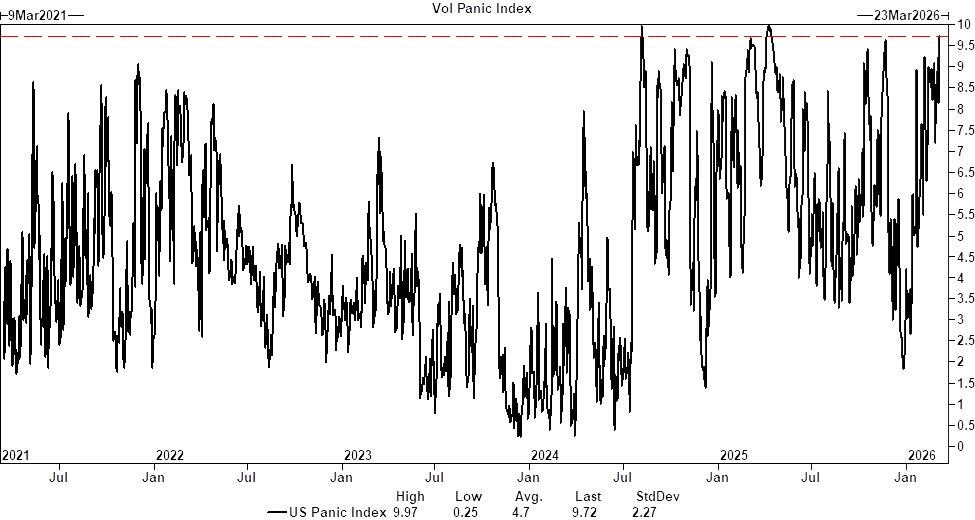
Furthermore, liquidity is approaching historical lows, and market confidence is at a breaking point. The liquidity aspect is also sounding alarms. The depth of E-mini futures contracts has fallen to levels seen before and after the "liberation day" crash. At the same time, Goldman Sachs' volatility panic index is nearing historical extremes, and risk appetite indicators have also fallen to levels seen during the "liberation day" period, indicating that market participants generally lack confidence in directional judgments.
JP Morgan: Positions Not Cleared, Limited Rebound Space
The latest assessment from JP Morgan's position intelligence team echoes that of Goldman Sachs.
On one hand, a technical rebound is expected, but it is difficult to change the structural dilemma. The team pointed out that the cumulative decline in positions over the past four weeks has triggered the "attractiveness" signal in their tactical position monitoring model, indicating the possibility of a technical rebound in the next two to four weeks. However, this short-term signal cannot conceal deeper concerns—the current market has not shown extreme de-risking behavior, and overall positions have only returned to neutral levels, which corroborates the market's stagnation since the outbreak of the Iran situation.
On the other hand, capital flows reveal vulnerabilities. Detailed data further undermined the foundation for a rebound: hedge fund buying behavior at the beginning of the week turned into selling from Wednesday to Thursday; retail capital flows at the individual stock level also shifted from net buying on Monday to neutral.
Meanwhile, the scale of deleveraging is limited (below 2 standard deviations), the turnover rate of hedge funds in the U.S. market is at a normal level, and recent ETF hedging demand has not shown sustained increases. JP Morgan concluded that the overall "pressure" signals remain limited, and the market lacks the rebound momentum after a thorough clearing.
It is worth noting that there is a significant divergence in the European market. JP Morgan's data shows that the turnover rate of European hedge funds surged to +2.4 standard deviations over the past week (Asia-Pacific at +1.7, North America only at +0.6). The institution pointed out that the last time such a significant regional divergence occurred was after the outbreak of the U.S. regional banking crisis in March 2023 and at the beginning of the Russia-Ukraine conflict in early 2022. Meanwhile, Europe has the strongest net selling pressure (-2 standard deviations), and the volatility index V2X's premium relative to VIX is at the 95th percentile level over the past five years.
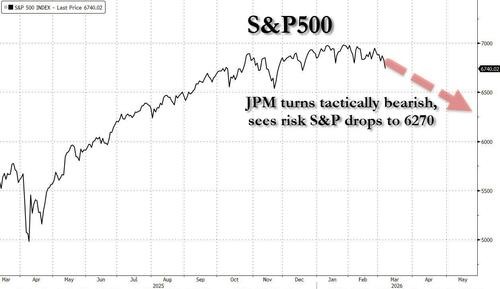
Against this backdrop, JP Morgan's market intelligence team has shifted to a tactical bearish stance, expecting the S&P 500 to potentially drop up to 10% from recent highs, with a target low of around 6270 points. The main risk factors cited by the team include: the ongoing uncertainty in the Middle East, positions not having undergone sufficient clearing, and systemic selling pressure not being fully released.
In summary, the core contradiction facing the current market, as assessed by both Goldman Sachs and JP Morgan, lies in the coexistence of potential easing expectations in geopolitical terms and structural pressures in technical and positional aspects. Under the multiple constraints of CTAs fully turning to short positions, a persistently negative Gamma environment, and insufficient liquidity depth, any directional price fluctuations could be amplified, and investors need to remain highly vigilant in the short-term high-volatility environment.