


History is always surprisingly similar: Can the optical fiber supercycle continue? Capacity expansion is the biggest concern
Currently, the demand for optical fibers is recovering, driving up prices. UBS believes that the industry experienced a similar scenario in 2017, where a significant expansion in production followed a price increase driven by rising demand. However, the actual pace of demand did not meet expectations, while production capacity was released as scheduled, leading to a sharp decline in the stock prices of optical fiber and related companies. Whether this cycle can lead to a different outcome largely depends on the level of self-discipline on the supply side
The optical fiber industry is at a familiar crossroads. The recovery in demand is driving price increases, and stock prices have rebounded significantly, mirroring the start of the upward cycle from 2017 to 2018.
However, history clearly records how that prosperity came to an abrupt halt under the pressure of overcapacity. Whether this cycle can lead to a different outcome largely depends on the level of self-discipline on the supply side.
According to the Chasing Wind Trading Desk, UBS's latest research report shows that the stock price of YOFC has continued to rise this year, highly correlating with the upward trend in spot prices for optical fibers.
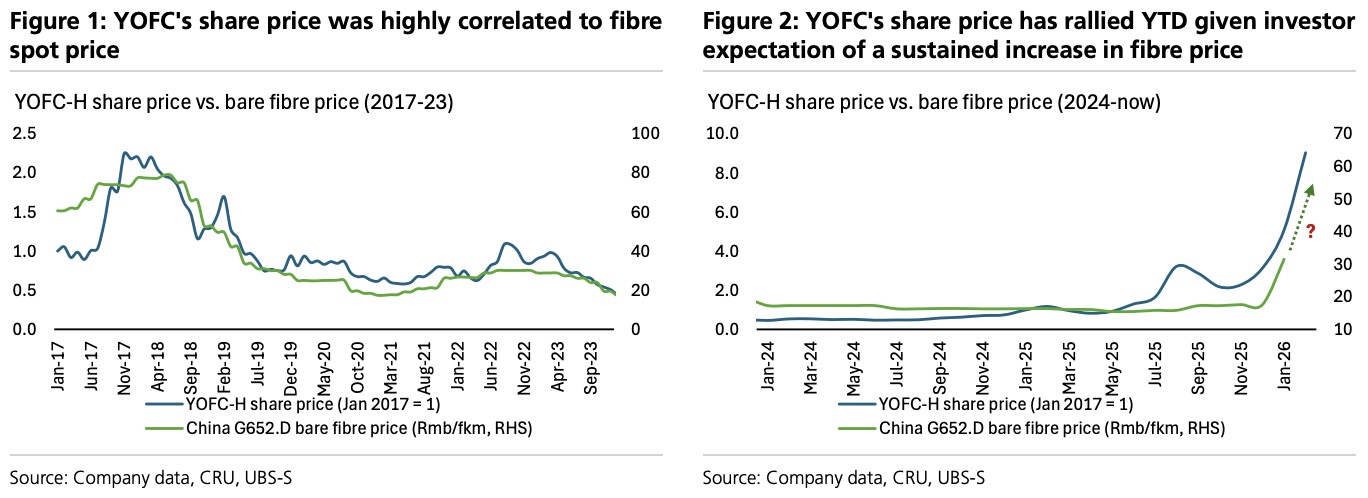
This round of price recovery began in the second half of 2025, with the core driving force coming from the tightening supply due to a surge in data communication demand, the recovery of overseas telecom demand, and the incremental demand brought by optical fiber drones.
UBS analyst Jasmine Huang maintained a "neutral" rating on YOFC in a report released on March 9, with a 12-month target price of RMB 140.
This cautious stance is backed by ongoing vigilance regarding the risks of capacity expansion—despite the absence of significant expansion announcements so far, this risk remains a Damocles sword hanging over the industry.
Historical Reflection: The Rise and Fall of the Last Cycle
Looking back at the upward cycle from 2017 to 2018, the core driving force behind the continuous rise in optical fiber prices was the large-scale construction of 4G networks and the deployment of fiber-to-the-home (FTTH), with the supply side relatively tight, leading to a simultaneous increase in prices and YOFC stock prices.
The turning point occurred around mid-2017. At that time, the industry collectively announced a large number of expansion plans, but due to strong demand growth, investors had limited concerns about potential supply excess.
However, the subsequent rollout pace of 5G demand was far below expectations, while large-scale capacity was basically delivered as scheduled by the end of 2018, leading to a dramatic reversal in the supply-demand pattern, and optical fiber prices subsequently plummeted, with YOFC stock prices also suffering a heavy blow.
This history clearly reveals a pattern: the stock price of YOFC is highly correlated with the spot price of optical fibers, and the core driving variable of price trends has always been the relative changes in supply and demand dynamics.
This Round of Recovery: Coexistence of Demand Drivers and Supply Constraints
Compared to the last cycle, this round of price recovery has different structural characteristics.
On the demand side, the sources of incremental demand are more diverse—the surge in data communication demand is the main engine, the moderate recovery of overseas telecom demand provides support, and optical fiber drones constitute a new source of increment.
On the supply side, after years of downward cycles, the overall capacity of the industry remains basically stable, and in some cases, even contracted. UBS predicts:
YOFC's revenue will grow significantly from approximately RMB 12.197 billion in 2024 to approximately RMB 14.087 billion in 2025, and further leap to approximately RMB 17.8 billion in 2026
The EBIT margin is expected to increase from 7.6% in 2024 to 10.1% in 2025, and reach 12.7% in 2026.
In terms of net profit, it is expected to recover from CNY 676 million in 2024 to CNY 936 million in 2025, and further increase to approximately CNY 1.58 billion in 2026.
Key Variable: The Pace and Timing of Capacity Expansion
The UBS report clearly states that whether the current price increase can be sustained depends critically on the speed and scale of capacity expansion. If the supply side maintains discipline, fiber optic prices are expected to operate within a healthy range; conversely, aggressive capacity expansion could trigger a new cycle of oversupply, replicating the history of 2018 to 2019.
Currently, UBS's channel research has not identified any significant capacity expansion announcements, believing that the current risks are still within a controllable range. At the same time, the harsh lessons from the previous cycle have made fiber optic manufacturers generally cautious, preferring to delay decisions on large-scale capital investments until the sustainability of demand is more fully validated.
However, UBS also emphasizes that aggressive capacity expansion remains one of the key downward risks that need to be continuously monitored.
Investor Discrepancies: A Consensus on Fundamentals Has Formed, but Expectations of Elasticity Remain Controversial
Since the fourth quarter of 2025, market attention to the fiber optic sector has noticeably increased. According to UBS observations, investors have a relatively consistent judgment on the improvement of the supply-demand pattern and the industry's bottoming out, but the focus of debate is concentrated on two levels:
First, how much profit elasticity can be brought about by the increase in fiber optic prices; second, whether aggressive capacity expansion will trigger a new cycle of oversupply.
Currently, there is no clear consensus on profit expectations among buyers—UBS predicts earnings per share of CNY 1.91 for 2026, while the market consensus is CNY 2.10; for 2027, UBS predicts CNY 3.04, while the market consensus is CNY 2.92.
With the recent price increases, profit forecasts from various institutions have generally been raised, providing some support for valuations, but stock prices still face high volatility at this stage, and the impact of market sentiment cannot be underestimated
