


Jensen Huang rarely posts: AI is an important force reshaping the world, a foundational infrastructure like electricity and the internet
Jensen Huang rarely writes personally, stating that AI is not just a model or application, but an infrastructure similar to electricity and the internet. He proposed that the AI industry is a "five-layer cake" infrastructure—energy, chips, infrastructure, models, and applications—and assessed that global AI infrastructure development is still in its early stages, with current investments only in the hundreds of billions of dollars, and future investments needing to reach trillions of dollars
On March 10th, NVIDIA CEO Jensen Huang rarely elaborated on the development logic of the AI industry in a personal signed article.
He pointed out that AI should not be understood as a single model or application, but as an emerging infrastructure system.
Artificial Intelligence (AI) is one of the most powerful forces shaping the world today. It is not just a smart application or a single model; it is an indispensable infrastructure, akin to electricity and the internet.
In his view, the AI industry is undergoing a level of technological infrastructure construction comparable to the Industrial Revolution. Currently, hundreds of billions of dollars have been invested globally, but the overall construction is still in its early stages.
Jensen Huang stated, AI is a “five-layer cake” infrastructure—energy, chips, infrastructure, models, applications, and requires trillions of dollars for construction.
AI is Transitioning from "Software" to Real-Time Generated Intelligence
Jensen Huang first explained the fundamental differences between AI and traditional software.
For the past few decades, software has essentially been “pre-written programs.” Developers write algorithms, and computers execute them according to rules. Data must be structured and queried through databases. AI has changed this model.
Jensen Huang wrote: “This is the first time in computer history that machines can understand unstructured information—images, text, sounds, and comprehend their meanings.”
More importantly, AI does not read answers from a database but generates intelligence in real-time.
He explained: “Every answer is newly generated, and each output depends on the context. Computers are no longer just executing instructions; they are reasoning.”
Since intelligence is generated in real-time, this forces the entire computing architecture to be redesigned.
The "Five-Layer Structure" of the AI Industry
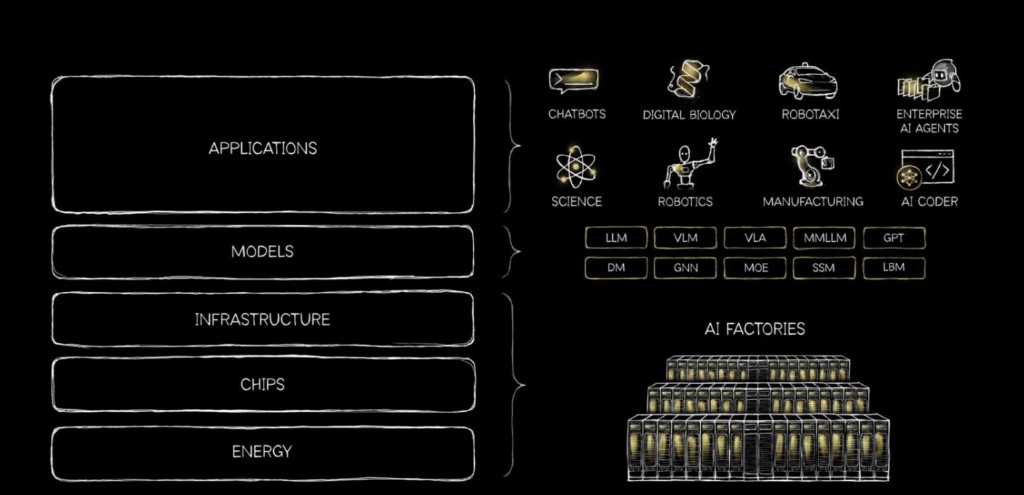
In the article, Jensen Huang proposed a structural framework for the AI industry: a five-layer technology stack—energy, chips, infrastructure, models, applications. He emphasized that there is a strong coupling relationship between these five layers.
Energy The most fundamental layer is energy. Real-time generated intelligence requires real-time generated electricity. Every generated token is the result of electronic movement, heat management, and energy conversion into computing power. Below this layer, there is no abstraction layer. Energy is the first principle of AI infrastructure and a hard constraint determining how much intelligence the system can produce.
Chips Above energy are the chips. These processors are designed to convert energy into computing power on a large scale and efficiently. AI workloads require massive parallel computing capabilities, high-bandwidth memory, and fast interconnect technologies. Advances at the chip layer determine the speed of AI scaling and the extent to which intelligence becomes affordable.
Infrastructure Above chips is the infrastructure. This includes land, power delivery, cooling systems, construction, networks, and systems that coordinate thousands of processors to operate as a single machine. These systems are the “AI factories.” Their original design intention is not to store information, but to create intelligence.
Models are built on top of infrastructure. AI models can understand various types of information: language, biology, chemistry, physics, finance, medicine, and the physical world itself. Language models are just one category among them. Currently, some of the most disruptive work is happening in the fields of protein AI, chemical AI, physical simulation, robotics, and autonomous systems.
Applications At the top level are applications, which is also where economic value is created. Drug discovery platforms, industrial robots, legal assistants, and autonomous vehicles fall into this category. Autonomous vehicles are AI applications embodied in machines; humanoid robots are AI applications embodied in bodies. They use the same technology stack but yield different results.
AI Infrastructure Construction is Still in Its Early Stages
In terms of industry scale, Jensen Huang provided a clear judgment.
He said, “ We have currently invested only a few hundred billion dollars, while in the future we will need to build infrastructure on the scale of trillions of dollars.”
Globally, chip factories, server assembly plants, and AI data centers are accelerating construction. Huang stated that this trend could become “one of the largest infrastructure constructions in human history.”
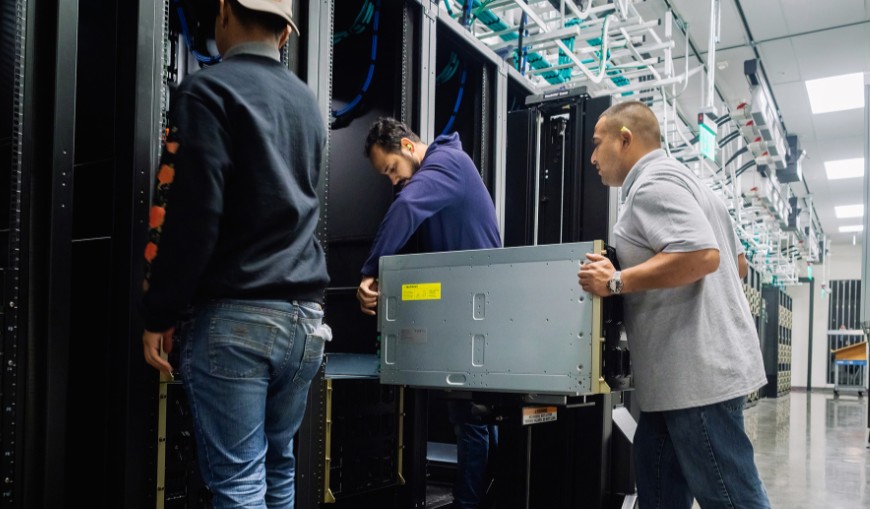
At the same time, this also brings new labor demands. The construction of AI data centers requires a large number of skilled workers, including electricians, plumbers, network engineers, and equipment installers.
He emphasized, “ Participating in this transformation does not necessarily require a PhD in computer science.”
Open Source Models Drive AI Industry Expansion
Huang also specifically mentioned the role of open source models in the AI ecosystem.
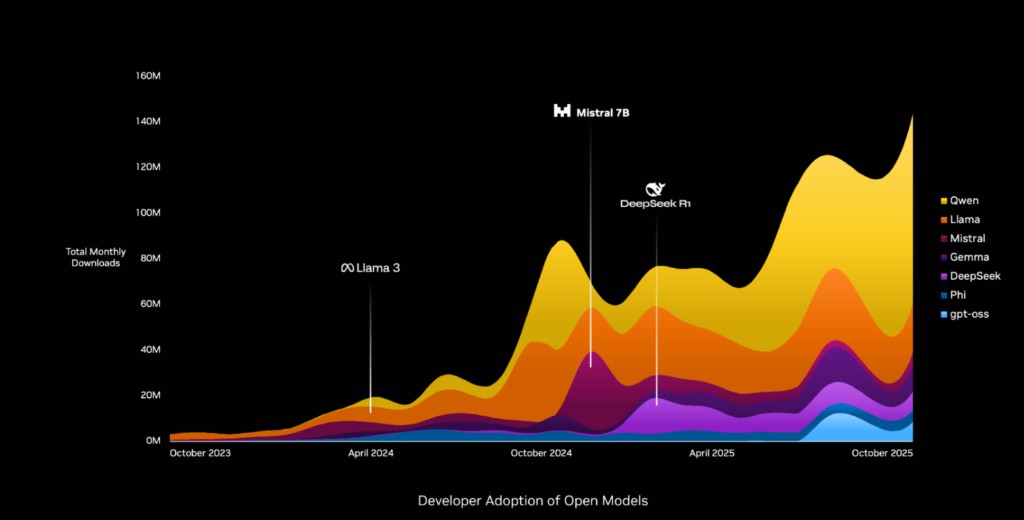
He pointed out that a large number of AI models globally are open, and companies, research institutions, and countries rely on these models to participate in AI development. When open source models reach an advanced level, they will drive demand across the entire industry chain.
He cited, “ DeepSeek-R1 is a typical example.”
After this model was made public, it promoted application development while also increasing the demand for training computing power, infrastructure, chips, and energy. In other words, a breakthrough in one model will pull down the entire industry chain.
The Impact of AI Goes Beyond the Software Industry
At the end of the article, Huang emphasized that AI not only changes the software industry but will also impact energy, manufacturing, labor structure, and economic growth methods.
He said, “ AI is an industrial-grade transformation that will change the way energy is produced, factories are built, work is organized, and economic growth models.” He believes that AI is still in its early stages. A large amount of infrastructure has yet to be built, and many talents have not yet been trained.
But the trend is already very clear: "AI is becoming the infrastructure of the modern world."
"AI is a 'Five-Layer Cake' Infrastructure"
March 10, 2026, Speaker: Jensen Huang
Artificial Intelligence (AI) is one of the most powerful forces shaping the world today. It is not just a smart application or a single model; it is an indispensable infrastructure, akin to electricity and the internet.
AI operates on real hardware, real energy, and a real economic foundation. It acquires raw materials and transforms them into intelligence on a large scale. Every company will use it, and every country will build it.
To understand why AI is developing in this way, we need to deduce from first principles and examine what fundamental changes have occurred in the field of computing.
From Pre-Recorded Software to Real-Time Intelligence For most of computing's history, software has been "pre-recorded." Humans write algorithms, and computers execute them. Data must be carefully structured, stored in tables, and retrieved through precise query statements. SQL became indispensable because it allowed that world to function properly.
However, AI has broken this model.
For the first time in history, computers can understand unstructured information. They can comprehend images, read text, listen to sounds, and understand their meanings. They can reason about context and intent. Most importantly, they can generate intelligence in real-time.
Every response is a brand new creation. Every answer depends on the context you provide. This is no longer software that retrieves pre-stored instructions; it is software that can reason and generate intelligence based on demand.
Because intelligence is generated in real-time, the entire underlying computing technology stack that supports it must be reinvented.
AI as Infrastructure When you look at AI from an industrial perspective, it can be broken down into a five-layer technology stack.
Energy The most fundamental layer is energy. Real-time generated intelligence requires real-time generated power. Every generated token is the result of electronic movement, heat management, and energy conversion into computing power. Below this layer, there are no abstract layers. Energy is the first principle of AI infrastructure and a hard constraint that determines how much intelligence the system can produce.
Chips Above energy are the chips. These processors are designed to convert energy into computing power on a large scale and efficiently. AI workloads require massive parallel computing capabilities, high-bandwidth memory, and fast interconnect technologies. Advances at the chip layer determine the speed of AI expansion and the extent to which intelligence becomes affordable
Infrastructure Above chips is infrastructure. This includes land, power delivery, cooling systems, construction, networks, and systems that coordinate thousands of processors to operate as a single machine. These systems are the "AI factories." Their original design intention is not to store information, but to manufacture intelligence.
Models Above infrastructure are models. AI models can understand various types of information: language, biology, chemistry, physics, finance, medicine, and the physical world itself. Language models are just one category among them. Some of the most disruptive work is currently happening in the fields of protein AI, chemical AI, physical simulation, robotics, and autonomous systems.
Applications At the top layer are applications, which is also where economic value is created. Drug discovery platforms, industrial robots, legal assistants, and autonomous vehicles fall into this category. Autonomous vehicles are AI applications embodied in machines; humanoid robots are AI applications embodied in bodies. They use the same technology stack but yield different results.
This is the "five-layer cake" of AI: Energy → Chips → Infrastructure → Models → Applications.
Every successful application strongly pulls on each layer beneath it, extending all the way to the power plants that sustain its operation.
We have only just begun this construction process. We have already invested hundreds of billions of dollars, but there are still trillions of dollars worth of infrastructure waiting to be built.
Looking globally, we see chip factories, computer assembly plants, and AI factories rising at an unprecedented scale. This is becoming the largest infrastructure construction in human history.
The workforce needed to support this construction is extremely large. AI factories require electricians, plumbers, pipeline assemblers, steelworkers, network technicians, installers, and operators. These are all high-skill, high-paying jobs, and there is currently a shortage. You do not need to have a PhD in computer science to participate in this transformation.
Meanwhile, AI is driving productivity improvements across the entire knowledge economy. Take radiology as an example; AI can now assist in reading scan images, yet the demand for radiologists continues to grow. This is not a paradox.
The core responsibility of a radiologist is to care for patients, and reading images is just one task in that process. As AI takes on more of the routine, repetitive work, radiologists can focus their energy on diagnostic judgment, communication, and patient care. This improves hospital efficiency, allowing them to serve more patients, which in turn will lead to hiring more staff.
Productivity creates capacity, and capacity brings growth.
What has changed in the past year? In the past year, AI has crossed an important watershed. Models have become good enough to provide practical value on a macro scale. Reasoning capabilities have improved, hallucinations have decreased, and the accuracy of fact grounding has significantly increased. For the first time in history, applications built on AI are beginning to generate real economic value
The applications in drug discovery, logistics, customer service, software development, and manufacturing have already demonstrated a strong product-market fit. These applications powerfully drive the demand across every technological layer beneath them.
Here, open-source models play a crucial role. Most models in the world are free. Researchers, startups, large enterprises, and even entire countries rely on open-source models to participate in the advanced AI wave. When open-source models reach the cutting edge, they change not only software but also activate demand across the entire technology stack.
DeepSeek-R1 is a powerful example. By enabling a strong inference model to be widely used, it accelerates the deployment of applications while also increasing the demand for its underlying training, infrastructure, chips, and energy.
What this means is that when you view AI as an indispensable infrastructure, its profound impact becomes clear.
AI began with large language models based on the Transformer architecture. But it is far more than that. This is an industrial revolution that reshapes the way energy is produced and consumed, how factories are built, how work is organized, and how economic growth occurs.
The reason for building AI factories is that intelligence is generated in real-time; the reason for redesigning chips is that efficiency determines the speed of intelligent scaling; energy becomes central because it sets the absolute upper limit of intelligent capacity; applications are accelerating their deployment because their underlying models have crossed a watershed and can ultimately provide practical value in large-scale scenarios.
Every layer is mutually reinforcing with others.
This is why the scale of this infrastructure construction is so vast. This is why it can simultaneously touch so many industries. This is also why it will not be limited to a single country or a single field. Every company will use AI, and every country will build it.
We are still in the early stages. Most of the infrastructure has yet to be built, most of the workforce has yet to be trained, and most opportunities have yet to be discovered.
However, the direction is already very clear.
AI is becoming the underlying infrastructure of the modern world. And the choices we make now—how fast we build, how broadly we engage, and how responsibly we deploy AI—will ultimately shape the future of this era.
The original text can be found here: https://blogs.nvidia.com/blog/ai-5-layer-cake/
