


Tencent fully launches the "Lobster Counterattack"

Analysis of the counterattack path
Authors: Song He, Huang Yu
On March 11, Tencent announced the launch of SkillHub, a Skills community optimized for Chinese users, based on the OpenClaw (Lobster) official open-source ecosystem, creating a localized configuration service platform that is compatible with its official community's skill ecosystem.
This is just another footnote in Tencent's large-scale counterattack in the AI field surrounding the OpenClaw ecosystem within just six days.
Starting from 10 a.m. on March 6, 2026, Tencent arranged engineers at the North Square of its headquarters in Nanshan District, Shenzhen, to initiate a free installation service for OpenClaw, with users lining up in a long queue that wound all the way to the other side of the road.
Even more surprising was that a day later, during the group meeting of the Guangdong delegation at the National People's Congress, Gao Wen, an academician of the Chinese Academy of Engineering and director of the Pengcheng Laboratory, made a remark that brought a knowing smile to the audience—"Raising lobsters is so popular that even Ma Huateng didn't expect it."
Ma Huateng may not have expected it. However, Tencent's response speed has indeed exceeded the general expectations of the market.
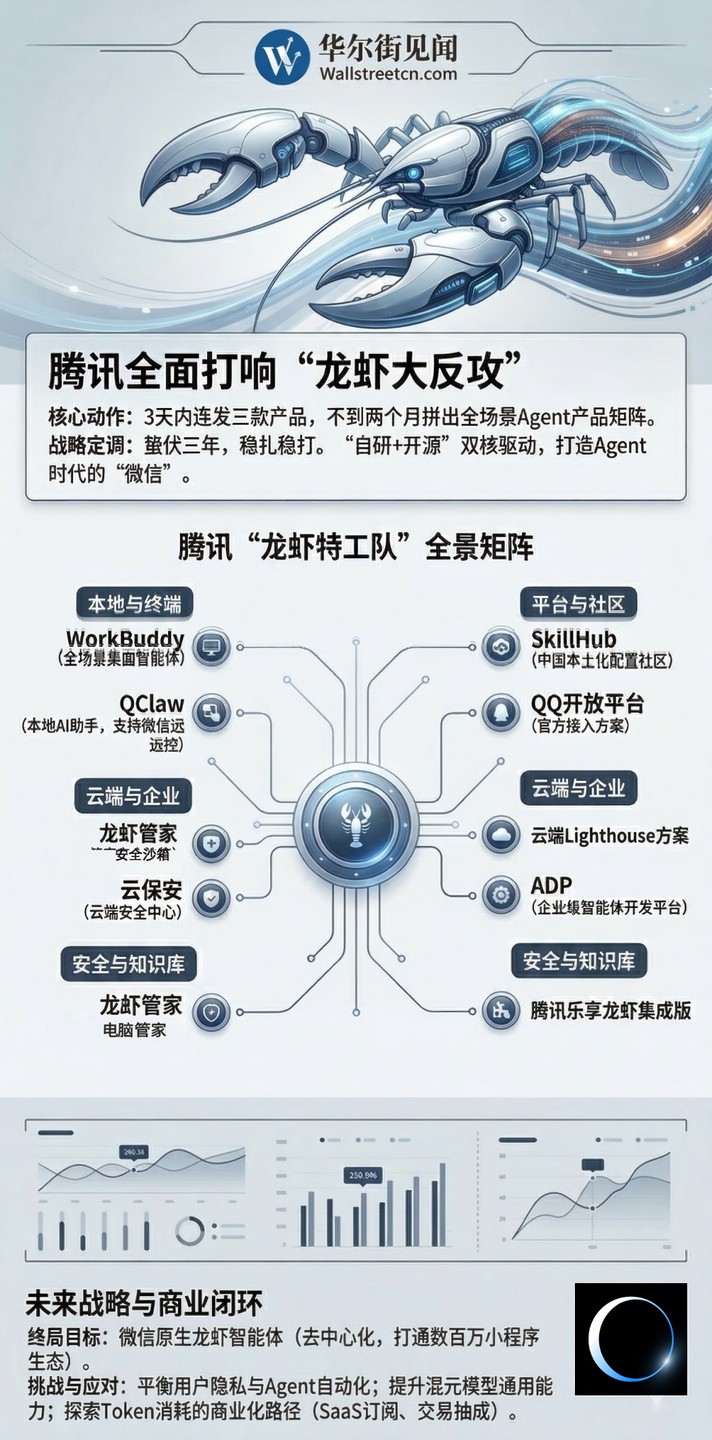
Just three days later, on March 9, Tencent launched three lobster products at once: the self-developed all-scenario desktop intelligent agent WorkBuddy—zero deployment, zero configuration, ready to use in the browser; the quietly initiated internal testing of the local AI assistant QClaw based on OpenClaw—one-click installation on both Windows and Mac platforms, supporting remote control of local computers and fully localized data via WeChat; and the comprehensive integration of OpenClaw into the QQ open platform's official solution.
On March 10, Tencent's official account collectively referred to these products with a vivid name—"Lobster Special Forces."
If we also include the previously launched Tencent Cloud Lighthouse cloud solution, which has surpassed 100,000 OpenClaw users, the enterprise-level intelligent agent development platform ADP, Tencent Computer Manager's AI security sandbox "Lobster Butler," the cloud AI Agent security center "Cloud Security," and the lobster integrated version of Tencent's Lexiang Knowledge Base.
From individuals to enterprises, from local to cloud, from security to knowledge—within less than two months, Tencent has forged a comprehensive Agent product matrix covering all scenarios.
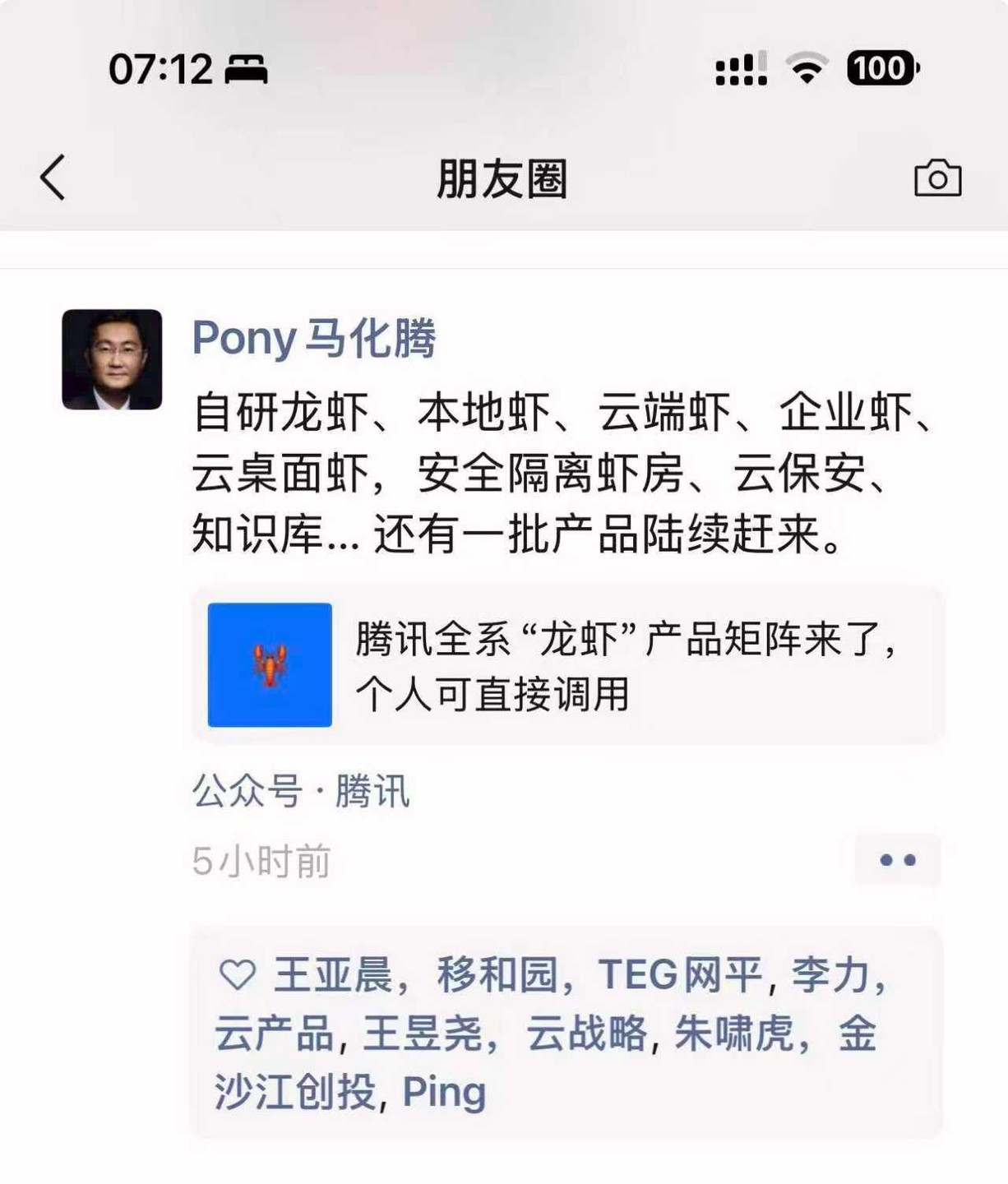
As Ma Huateng stated in his social media post: "Self-developed lobster, local lobster, cloud lobster, enterprise lobster, cloud desktop lobster, security isolation lobster room, cloud security, knowledge base... and a batch of products are on the way."
This is an unannounced counterattack, and its drama lies in the fact that just a few months ago, the market was mocking Tencent as the "old Tencent stock" of the AI era.
However, all current actions and plans are far from the endpoint of Tencent's AI strategic deployment.
From the current lobster matrix to the future WeChat Agent, in a certain sense, this counterattack by the 50 trillion internet giant has just begun
The Giants' Match Point
To understand Tencent's counterintuitive large-scale entry into the Agent space, it may be necessary to first examine its "slow half-step" at the starting phase of the AI era, which was not very favorable.
In May 2023, when the battle of the hundred models was in full swing, Ma Huateng unexpectedly stated at the shareholder meeting that Tencent was not in a hurry to finish early and showcase half-finished products. For the industrial revolution, taking out the light bulb a month earlier is not that important in the long run.
This statement sounds quite grand, but the market did not buy it.
In 2024, Doubao quickly captured the 2C AI application market through traffic tilt from Douyin and other feed streams, along with a quick product experience, until its daily active users surpassed 100 million in the second half of the following year; in early 2026, Alibaba's Qianwen attempted to occupy users' minds with the demand for "helping users get things done," fully integrating with Taobao, Alipay, Fliggy, Amap, and other Alibaba ecosystem chains in January. Baidu Intelligent Cloud also embraced the OpenClaw open-source ecosystem early on, launching one-click deployment services on February 3, just before the Spring Festival.
In contrast, Tencent's Hunyuan large model lagged behind ByteDance and Alibaba in C-end data, and the promotion of Yuanbao through the WeChat social chain experienced excessive user disturbance.
Even during the Spring Festival, despite spending 1 billion yuan on promotions, which briefly pushed daily active users over 50 million, it still faced skepticism that spending money to buy traffic could not buy loyalty.
An insider close to Tencent told Wall Street Journal that compared to large language models, Tencent has also invested more energy into the development of multimodal large models, which has led to Hunyuan large language model not appearing in the industry's top tier.
Thus, a harsh comparison is presented: Tencent, with its two super entrances of WeChat and QQ, totaling over 1.5 billion monthly active users, has been outpaced by ByteDance and Alibaba in AI applications.
Investors began to feel anxious. After Tencent's stock price reached a high of HKD 683 in October 2025, it began a multi-month stepwise decline, eventually falling to HKD 560 in early 2026, with its market value once dropping below HKD 5 trillion.
Meanwhile, the label "tech old-timer stock" began to circulate on social media—implying that Tencent's fundamentals are too stable, and its innovation is too slow, resembling a "retired elder" that can only rely on past achievements in the AI era.
Ma Huateng was not unaware of this issue.
At the employee meeting on January 26, 2026, he rarely faced the criticism of "slow actions." He admitted that Tencent's initial slow response was due to various business departments prioritizing their own scenarios to layout AI, leading to an overall slow pace, and it wasn't until the end of 2024 that the Yuanbao team completed its integration from TEG to CSIG. He also announced that Tencent had restructured its entire AI R&D team—bringing in former OpenAI senior researcher Yao Shunyu as Chief AI Scientist in December 2025, and establishing the AI Infra Department, AI Data Department, and Data Computing Platform Department.
However, he also left a thought-provoking remark: "Every enterprise has different genes and physical conditions; Tencent's style is to proceed steadily." He emphasized that the only area worth significant investment for Tencent at present is AI. Tencent's AI strategy is a dual-core strategy of "self-research + open-source"—"this is similar to our past development in the gaming field, where we have always balanced self-developed games and agency-operated games, ultimately providing the best user experience." "In retrospect, this statement has actually laid the groundwork.
Tencent has never rejected open sourcing at the AI model level—first fully integrating DeepSeek-R1, resulting in a more than 20-fold increase in daily active users for Yuanbao, propelling it into the top three in the country; shortly after, OpenClaw became a sensation, with Tencent Cloud Lighthouse launching a one-click deployment template on January 28, even ahead of Alibaba Cloud and Baidu Cloud.
The so-called 'half a beat slow' may just be Tencent waiting for a battlefield it truly excels in to emerge.
A detail about the explosive popularity of OpenClaw that is easily overlooked is that this framework first appeared under the name Clawdbot at the end of 2025, initially making hardly any waves. The real market explosion occurred after the release of Claude Opus 4.5—same framework, same code, but with a stronger underlying model, which finally made the effect valid.
It is worth noting that in 2024, there were several similar Agent projects, none of which gained traction; but this time, the agent seems to finally be supported by the model.
The entry barrier for OpenClaw is no longer a secret: the configuration is too complex for ordinary users to set up. Configuring the Node.js environment, handling various error messages, and connecting the API permissions for Feishu or WeChat Work—each step is a challenge for non-technical users.
This is precisely the battlefield Tencent excels in.
Looking back at Tencent's product history over the past twenty years, there is a consistent logic: it may not be the original creator of technology, but it almost always leads in 'turning complex technology into products that everyone can use.' QQ did this, WeChat did this, WeChat Pay did this, and mini-programs did this as well.
In the game of lobsters, Tencent has also chosen this path, not as the original creator of the underlying model, but as the largest productization platform of the Agent era.
Tan Dai, president of Volcano Engine, once judged: 'The main body of the PC era is the Web, the mobile era is the APP, and the AI era is the Agent.' If this judgment holds, what Tencent needs to do is become the 'app store' and 'WeChat' of the Agent era.
In the face of external doubts, Ma Huateng, at Tencent's 2026 employee conference, opened with a 'calming pill' for the internal team, emphasizing the need to maintain composure and focus on their own pace. He stated: 'Every enterprise has different genes and physical conditions; Tencent's style is to proceed steadily.'
Clearly, after 'lying low' for three years, Tencent will accelerate its AI strategy in 2026. An insider revealed that there are internal expectations to see more significant moves from Tencent in AI within the year.
The Future of WeChat Agent
As the outside world has seen, Tencent launched a precise layered matrix named 'Lobster Special Forces' around lobsters this March. This product matrix not only covers novice users but also targets hardcore developers and large enterprises, striving to break through the usage barriers of 'lobsters.' But while everyone is focusing on the lobster product matrix, the real big move is actually hidden beneath the surface.
At the 2025 annual performance meeting, Ma Huateng, when answering analysts' questions about the Agent strategy, said a crucial statement: "Everyone can create a general-purpose intelligent agent, but at the same time, there is also a type of intelligent agent that can exist within WeChat and its unique ecosystem. I believe these are two different products."
He further explained: For general-purpose intelligent agents, Tencent is creating this capability in AI-native products like Yuanbao and Ima, which may initially only provide quick answers to questions, then gradually incorporate reasoning chains and long-chain reasoning, and later be able to perform more complex automated tasks. "But there isn't much difference from other intelligent agents offered by our peers."
What truly excites Ma Huateng may be the intelligent agents within WeChat.
The WeChat ecosystem indeed has unique components—social graphs, communication and community capabilities, content ecosystems, including official accounts, video accounts, and millions of mini-programs within WeChat.
"These mini-programs actually involve various information and the ability to conduct transactions and operations across many different vertical applications. Therefore, compared to other more general intelligent agents, this will be very unique. This is a highly differentiated product for Tencent," Ma Huateng has said.
This statement carries significant weight. It means that Tencent's top management has clearly defined WeChat's Agent as a strategic product independent of general AI assistants, rather than simply adding an AI feature to WeChat.
However, the Agent transformation of WeChat is far more complex than the outside world imagines.
At the employee meeting in January 2026, Ma Huateng's attitude towards WeChat's AI transformation seemed conservative: "The AI toolkit may not be something everyone likes; in the future, we will continue to adhere to decentralization, considering user needs and privacy security in planning WeChat's intelligent ecosystem." He also specifically pointed out that for the WeChat business group, "more time and patience should be given, and actions should be taken after careful planning."
This "caution" is backed by deep logic.
WeChat's 1.3 billion monthly active users are the most scarce asset in China's internet, covering nearly every Chinese person's social relationships, payment behaviors, information consumption, and life services.
A wrong product decision could lead to irreversible loss of user trust. The "restraint" philosophy established during Zhang Xiaolong's era—avoiding excessive commercialization and not forcefully pushing features—is the fundamental reason why WeChat has succeeded in dominating the mobile internet after the IM competition with QQ.
But the Agent era poses a fundamental challenge to this philosophy.
The core capability of an Agent is "doing work for you"—it needs access to your contacts, read your messages, invoke your payment accounts, and operate your favorite mini-programs. This creates a natural tension with WeChat's long-standing emphasis on "user privacy first."
This may delineate a red line for Tencent's own Agent path—WeChat's Agent transformation must proceed within a safe and controllable framework.
Therefore, gradual testing before taking the plunge may have become the path Tencent must currently follow Tencent has a long-validated product logic: new features and new forms are first tested on QQ, and once mature, they are gradually implemented on WeChat.
The deployment rhythm of Lobster is precisely a replication of this sequence.
The first step is the full opening of QQ. On March 7th, the QQ Open Platform officially opened the OpenClaw official access to individual users, allowing users with zero programming background to create AI robots. QQ's young user base has a high acceptance of new technologies and is willing to experiment, making it the most natural early user group for Agents. Compared to Feishu, which requires creating self-built applications, and DingTalk, which requires setting up testing organizations for access processes, the threshold for QQ to "nurture lobsters" is clearly much lower.
The second step is the detour tactic of QClaw. The WeChat Open Platform has never officially opened the robot API for individual WeChat users.
All personal WeChat robot solutions on the market are non-official "barbaric access" methods such as protocol reverse engineering and hooking, which carry the risk of account bans and compliance issues. The curve of QClaw lies in its ability to connect with personal WeChat through the "WeChat Customer Service" entry of WeChat Work—Lobster runs on the user's own computer, while WeChat only acts as a command window.
This is a compromise solution of "cloud and local isolation," allowing users to converse with Lobster within WeChat without requiring WeChat to officially open the underlying API.
If QClaw retains the direct connection feature to personal WeChat after its official launch, it will be the first official access of an Agent robot in WeChat's history.
The third step is the real endgame: the native Lobster intelligent agent in WeChat. Although this path has not been officially confirmed, multiple media reports indicate that Tencent is planning to directly embed Agent products in WeChat in the form of chat dialogue boxes, connecting millions of mini-program ecosystems to complete everyday tasks such as hailing a ride, ordering takeout, making appointments, and booking tickets, with the product expected to launch between mid-2026 and the third quarter.
Challenges Remain
The WeChat Agent in development is not without challenges.
First, the primary obstacle it faces comes from the front end, with the biggest potential enemy being WeChat itself.
WeChat products have long been known for their "restraint," as Zhang Xiaolong has repeatedly expressed caution against excessive functionality.
Every major feature iteration of WeChat, from Moments to WeChat Pay to mini-programs to Channels, has undergone lengthy internal discussions and extremely cautious gray testing.
This culture ensures the product quality and user trust of WeChat, but it also means that when facing rapidly changing technological trends, it will naturally lag behind competitors by one or two positions.
Pony Ma's evaluation of the WeChat business group at an employee meeting—"How to combine our characteristics to illuminate new technologies and continuously upgrade requires more time and patience, and to plan before taking action."
This is both a reassurance to external anxieties and a form of protection for the WeChat team. However, the window of opportunity left for WeChat is not infinite.
If the WeChat Agent cannot be implemented for a long time, users may gradually get used to completing those "do things for me" tasks in Doubao or Qianwen. Once habits are formed, even if WeChat later launches a better Agent, the migration cost will become an obstacle Tencent may use QClaw and other lobster-like product clusters to "informally test the waters" to measure the true strength of user demand. The user behavior data accumulated by these products is likely to directly influence the timing and manner of WeChat's official integration of Agents.
To some extent, QClaw is also a real-time survey for a "WeChat Agent feasibility report."
Second, the backend model capabilities are also a pressing shortcoming that needs to be improved.
Although the self-developed Hunyuan large model maintains a leading position in the multimodal field, in terms of general language capabilities, the ones that first occupy more user minds are still Doubao, Qianwen, and DeepSeek.
Tencent currently adopts a "self-developed + open-source" dual-core strategy. Tang Daosheng clearly stated at the annual performance meeting: Tencent's AI strategy is a multi-model strategy of "core technology self-research + actively embracing open source." On one hand, it steadfastly promotes the full-chain self-research of large models, and on the other hand, it actively embraces advanced open-source models, allowing users to freely choose for different scenarios. WorkBuddy is compatible with domestic models like Kimi and MiniMax, and QClaw also supports custom model integration.
The cleverness of this strategy lies in "not putting all eggs in one basket"—not insisting that self-developed models excel in all dimensions, but rather providing users with the "best model routing" through product-level integration.
However, the risks are also clear: if Tencent cannot possess a sufficiently strong self-developed general model, it will forever be an "assembler" rather than a "core supplier" in the Agent ecosystem, and a large portion of the profits from APIs and Tokens will be divided among the underlying model vendors.
Ma Huateng stated in the Q3 2025 financial report: "We continue to upgrade the team and technical architecture of the Hunyuan foundational model. As the Hunyuan capabilities continue to improve, our investments in promoting the popularization of Yuanbao and our efforts to develop AI agent capabilities within WeChat will bring more positive progress."
In 2024, Tencent's R&D investment reached 70.69 billion yuan, and in the first three quarters of 2025, it has accumulated to 61.98 billion yuan, a year-on-year increase of about 22%. Liu Chiping revealed that capital expenditures in 2025 are expected to account for a "low double-digit percentage" of total revenue—implying it could approach the hundred billion level.
Money has been invested, but catching up on model capabilities takes time. Yao Shunyu—Tencent's chief AI scientist who joined from OpenAI—whether he can achieve a leap in general capabilities for Hunyuan within the next 12 to 18 months will be one of the key variables determining the success or failure of Tencent's Agent strategy.
Third, balancing the costs of Agents with WeChat's commercialization is destined to be a long-term question that Tencent needs to answer.
It is well known that running a complex task on OpenClaw may trigger thousands of model calls. A research report from Guolian Minsheng Securities once compared Tokens to "the energy of the Agent era"—"raising lobsters" is not a one-time investment, but a long-term expenditure.
If Tencent wants to massively promote Agent capabilities to 1.3 billion users on WeChat, the Token consumption will be astronomical In the short term, relying on advertising to share costs and using business growth to "subsidize" AI investments may be Tencent's pragmatic approach at present. Ma Huateng clearly stated in the Q3 earnings call: "AI is not a cost; it is the growth engine for all our businesses."
In Q3 2025, AI-driven precise advertising targeting propelled marketing service revenue to a year-on-year increase of 21% to 36.2 billion yuan, maintaining double-digit growth for twelve consecutive quarters. AI has made the advertising "money printing machine" operate more efficiently—this may be the primary source of funding for Agent investments in the short term.
However, in the long run, the business model of Agent still needs to cover the enormous and unavoidable Token expenses behind it.
According to an analysis by a person close to Tencent, there may be three paths to solve the cost commercialization issue: first, Token consumption fees, direct charges for cloud deployment, but the probability of charging 2C users is relatively low; second, transaction commissions from mini-programs, where WeChat can charge a channel fee for every transaction completed by Agent in mini-programs; third, enterprise-level SaaS subscriptions, where the ADP platform charges enterprise clients. For example, the user scale of OpenClaw on Tencent Cloud Lighthouse has surpassed 100,000 and continues to rise, with developers calling the core multiple times refreshing historical peaks—the cloud-based "selling shovels" business logic is beginning to take shape.
The Final Battle
Perhaps all current actions need to revisit the fundamental first principles:
What does this lobster counteroffensive mean for Tencent?
On the surface, this is a giant quickly following the open-source Agent trend. However, when viewed over a longer time scale, this may mark Tencent's transition from a "social platform company" to an "intelligent infrastructure company."
In the PC internet era, the entry points were browsers and search engines. In the mobile internet era, the entry points were apps and app stores. In the Agent era, the entry point will be intelligent agents embedded in daily communication tools—there is no need to open any app; just say a word in the chat box, and AI will complete everything for the user.
Whoever owns the largest chat box will have the ultimate entry point in the Agent era.
In the Chinese market, this largest chat box is undoubtedly WeChat.
Ma Huateng mentioned in the earnings meeting: "AI is still in its early stages of development. Just like when the second industrial revolution arrived, the emergence of power plants, power grids, and light bulbs were all in the earliest applications; the later emergence of more electrical appliances and even the internet benefited from the development of this ecosystem." His point is: we are still in the stage of making light bulbs.
However, Deloitte predicts that the Agentic AI field is growing at an annual rate of 43%, far exceeding other AI tracks. A report from CB Insights shows that since 2023, the number of mentions of "Agent" in earnings call meetings of listed companies has increased tenfold. Silicon Valley venture capital guru Vinod Khosla also predicts that 2026 will be the year when Agents truly mature and have a visible impact The era of light bulbs may soon come to an end, and when the era of electrical appliances arrives, those who hold the largest power plants and the densest power grids will be the ultimate winners.
From entry to closure, there are countless obstacles to overcome in between. Can the model's capabilities support the accurate execution of complex tasks? Can the security system reassure users to hand over operational permissions? Will the extremely cautious culture of openness within WeChat make way for Agents?
These questions will always need to be validated through Tencent's step-by-step probing, attacks, and repeated positive and negative feedback from users.
But one thing has already changed.
In early March 2026, when those who flew in from Hangzhou and rushed in from Hong Kong lined up, waiting for Tencent engineers to install that red little crayfish for them, one signal was already clear enough: AI is no longer a toy for geeks, nor a concept for investors. It may be flowing into the computers, phones, and even lives of every ordinary person.
Tencent may be standing at the estuary of this river
