


Has the market misjudged Tencent's AI situation? JP Morgan: Integrating into existing workflows is the real battleground for AI in China

JP Morgan believes that the market is overly focused on early product data such as daily active users, underestimating Tencent's ability to embed AI into its existing ecosystem and protect its entry position. Tencent does not need to have the industry's best foundational model to occupy a favorable position in the AI competition. By empowering its advertising business, content creation, and enterprise subscriptions with AI, Tencent's profit certainty far exceeds that of independent AI applications
The market's concern about Tencent lagging in the AI race is fundamentally misjudged according to JP Morgan. In its latest report on March 12, it pointed out that the key to China's AI landscape is not the download rankings of chat applications, but whether AI can be deeply integrated into users' existing workflows, which is precisely Tencent's advantage.
JP Morgan maintains an "overweight" rating on Tencent Holdings, with a target price of HKD 750 (corresponding to 21 times the expected price-to-earnings ratio for 2026). The report believes that the recent significant decline in Tencent's stock price is mainly due to the market's excessive concerns about its lagging AI layout, thus creating a buying opportunity.
Tencent does not need to win in the competition of large models; it can achieve tangible value through AI in existing high-profit businesses such as advertising, content creation, and enterprise software, and the related profit paths are far more reliable than the unproven subscription model of independent AI applications.
JP Morgan also specifically mentioned Tencent's recently launched AI agent product QClaw, believing its strategic significance lies in extending WeChat from a communication and discovery interface to a task orchestration interface—users can directly initiate control of their local computers and automate workflows through WeChat chat.
The market has misjudged the difficulty of core risks occurring
JP Morgan believes that the market's pricing framework for Tencent's AI situation has fundamental flaws. The core narrative currently focused on by the market (who owns the most advanced foundational models, who leads in downloads of independent AI applications) does not constitute Tencent's real risk.
The report points out that the substantive issue investors are concerned about is: can independent AI assistants permanently replace WeChat and become the default "intent entry" for Chinese consumers? JP Morgan believes that the difficulty of this entry migration is severely underestimated by the market.
High-frequency consumer transactions and content consumption in China are structurally embedded in complex workflows. For emerging independent AI applications to achieve bulk entry replacement, they must overcome multiple systemic frictions such as payment integration, closed-loop fulfillment, account identity, and regulatory compliance.
Specifically, WeChat has a total of 1.41 billion monthly active users as of June 30, 2025, covering communication, payment, search, content, and e-commerce closed loops. Independent AI applications currently lack the transactional infrastructure and user trust base to compete with it.
JP Morgan assesses that even if competitors achieve initial scale through aggressive subsidies, their retention rates and end-to-end task completion rates are still insufficient to shake WeChat's entry position.
QClaw: From communication interface to task orchestration layer
JP Morgan views Tencent's newly launched QClaw as an important product sample for understanding its AI strategic direction, but also clearly delineates the boundaries of market interpretation.
The core positioning of QClaw is: as a local AI agent, it runs on the user's PC or Mac, and through binding with WeChat, allows users to remotely control their desktops using natural language via mobile WeChat, executing practical tasks such as file operations, browser control, email handling, form filling, and workflow automation.
JP Morgan emphasizes that investors should not misinterpret QClaw as a fully functional social intelligent assistant within the WeChat application—it currently does not natively aggregate chat records, proactively contact contacts, or serve as a general social landscape AI layer The strategic significance of QClaw lies in: extending WeChat's functional boundaries from information communication and content discovery to external task execution orchestration, thereby increasing user dependence on the WeChat ecosystem, expanding the range of tasks controlled by Tencent, and creating long-term monetization options for enterprise software, cloud services, and workflow integration.
Multi-path Execution: No Need for Model Hegemony
Another core judgment from JP Morgan is: Tencent does not need to possess the industry's best foundational model to occupy a favorable position in the AI competition.
The report points out that the rise of open-weight models has significantly lowered the threshold for acquiring foundational AI capabilities. This allows Tencent to adopt a pragmatic multi-path execution strategy—primarily using self-developed models (such as the T1 inference model) in appropriate situations while flexibly integrating the best external models, rather than pursuing self-sufficiency with a single model.
JP Morgan believes that in actual workflows, users judge AI based on task stability, low latency, security, and reliability, rather than model benchmark rankings.
Tencent focuses its resources on deepening AI's embedding in high-frequency distribution networks, rather than merely chasing benchmark leadership, which is more sustainable in terms of cost-effectiveness and execution risk control.
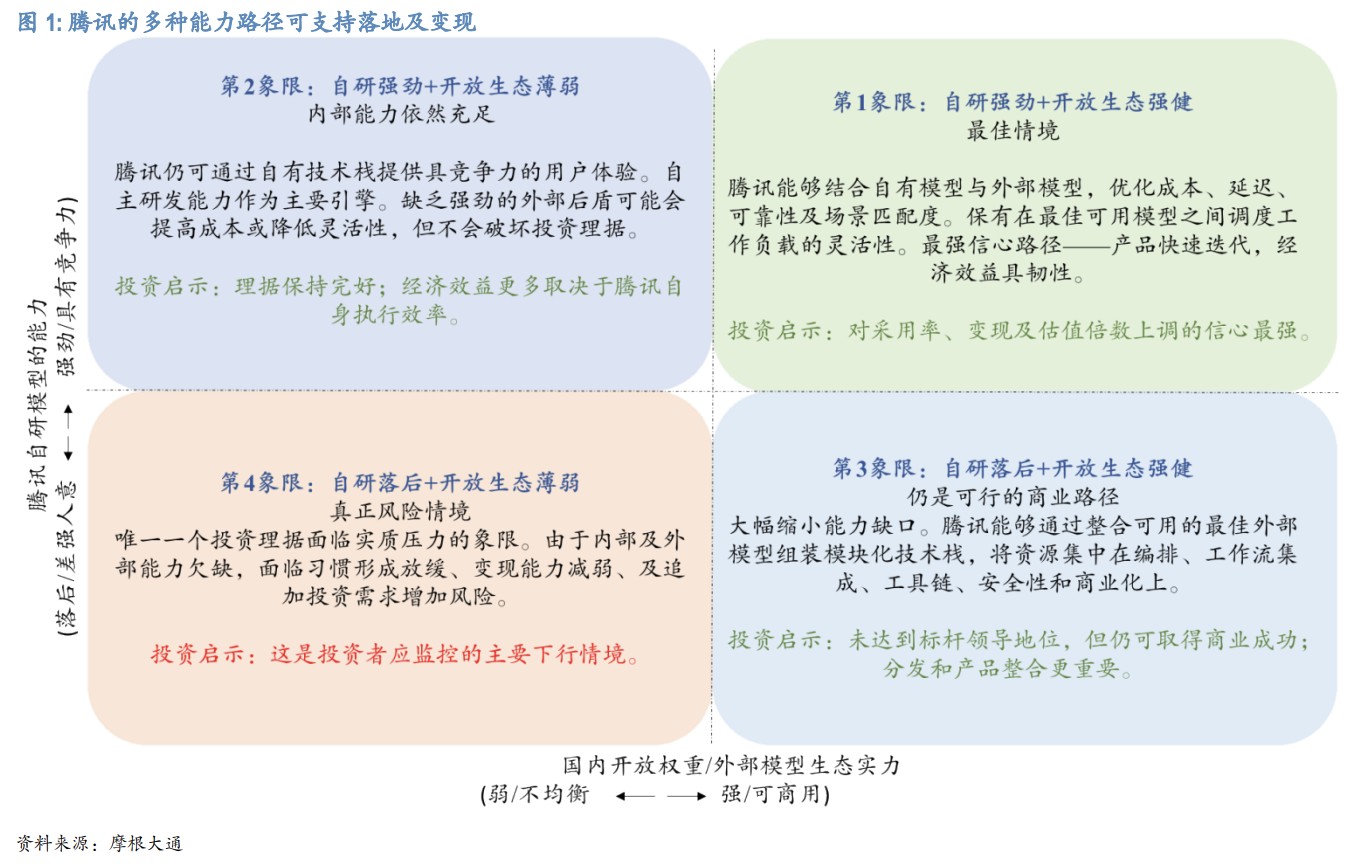
AI Empowering Advertising Business, Content Production Efficiency, and Enterprise Software Conversion
JP Morgan advises investors to adjust their valuation framework, shifting the anchor from early product indicators like daily active users of AI applications to operational improvements in Tencent's existing high-profit businesses, as its profit path is more reliable than the unverified subscription model of independent AI applications.
The report expects Tencent's AI upward potential to first manifest in three major areas:
First, advertising business: AI enhances ad ranking, push, and conversion rates, with Tencent's marketing service revenue reaching 121 billion yuan in 2024, a year-on-year increase of 20%;
Second, content production efficiency: AI assists in video account content creation and summary generation;
Third, enterprise software conversion: Improvement in the paid conversion rates of products like WeChat Work and Tencent Meeting.
JP Morgan notes that Tencent's revenue will reach 660 billion yuan in 2024, with profits attributable to equity holders at 194 billion yuan, and capital expenditures of 77 billion yuan in 2024. By the first half of 2025, capital expenditures have already reached 47 billion yuan, mainly to support AI-related businesses.
The enormous cash generation capability allows Tencent to continuously invest in AI infrastructure while subsidizing the promotion costs of AI features with monetization from mature businesses like advertising, a structural advantage that independent AI applications find difficult to replicate.
