Daiwa Asset: For every 10% increase in Brent oil prices, the overall net profit of Japanese companies declines by 1-2%

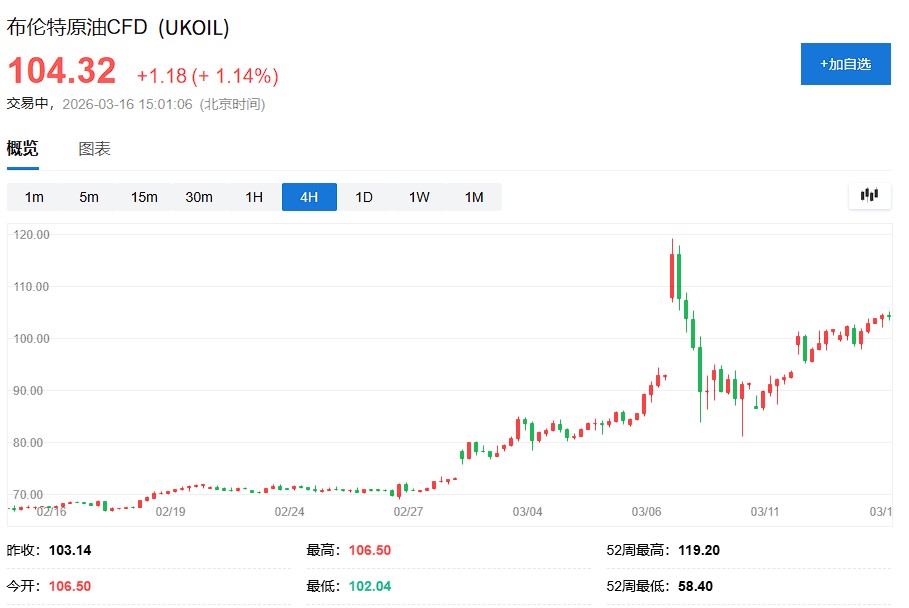
Daiwa Asset Management warns that the current oil price is around $104 per barrel, an increase of over 50% compared to last year's average, putting pressure on corporate profits. The market's expectations for double-digit profit growth for Japanese companies in the next fiscal year are being revised down to single digits or even negative growth, directly threatening the core logic that supported a 15% rise in the Topix index. The impact of oil prices will also be transmitted through both cost and demand channels, affecting real wages and consumption
The surge in oil prices is shaking the foundation of Japan's corporate profit recovery. As the conflict in Iran escalates, Brent crude oil prices have risen more than 50% compared to last year's average, and analysts warn that rising energy costs will substantially erode profits for Japanese companies.
On March 16, Bloomberg reported that Kazunori Tatebe, Chief Strategist at Daiwa Asset Management, pointed out that for every 10% increase in Brent crude oil prices, the overall net profit of Japanese companies will decline by 1% to 2%.
Currently, Brent crude is priced at about $104 per barrel, and Japan relies almost entirely on imported oil, making this price level a heavy burden on its economy.

Shingo Ide, Chief Equity Strategist at NLI Research Institute, stated that investors previously expected Japanese companies to achieve double-digit profit growth in the next fiscal year, but as oil prices surge sharply, the market is beginning to reassess, with the most optimistic scenario seeing growth drop to single digits and the most pessimistic scenario predicting a decline in profits.
Analysts point out that this shift in expectations directly threatens the core logic that has driven the Topix index up 15% over the past six months, outperforming markets in the U.S. and Europe.
Oil Price Shock: Direct Pressure on Japanese Corporate Profits
Japan is one of the major economies most reliant on oil imports, making fluctuations in energy costs particularly directly impactful on corporate profits.
Daiwa Asset Management's calculations show that for every 10% increase in Brent crude oil prices, the net profit of Japanese companies will correspondingly decline by 1% to 2%. Currently, Brent crude is about $104 per barrel, which has cumulatively risen over 50% compared to last year's average, indicating that corporate profits are under considerable pressure.
Mamoru Shimode, a strategist at Resona Asset Management, warned that if the conflict in Iran continues beyond April—when many Japanese companies will begin to announce their annual results—corporate management may lean towards issuing more conservative performance forecasts, further dampening market sentiment.
It is noteworthy that strong profit expectations have been one of the core supports for the rise of the Japanese stock market over the past six months.
During this period, the Topix index has risen 15%, surpassing major indices in the U.S., Europe, and China, with fiscal stimulus expectations and corporate reform processes also playing significant roles, but the outlook for profit growth has always been the key driving force.
However, the continued rise in oil prices is shaking this logic. Shingo Ide pointed out that the market's expectations for double-digit profit growth for Japanese companies in the next fiscal year are gradually being revised down to single-digit growth or even profit declines.
Strategists such as Hikaru Yasuda from SMBC Nikko Securities further noted in a report released on Monday that industries such as electronics, transportation equipment, and banking, which are expected to contribute significantly to profit growth in fiscal 2026, may also face dual pressures from a softening U.S. labor market and a slowdown in AI data center investments. If the profitability of the aforementioned industries declines, the overall profit outlook for Topix will face further downward revision risks.**
Chain Reaction: Cost Transmission and Demand Shrinkage Overlap
According to reports, the impact of rising oil prices on Japanese companies is not limited to raw material costs.
Shingo Ide stated, "It's not just the rise in raw material prices; transportation costs will also increase, and a slowdown in the global economy may suppress demand."
He added that Japan's real wages have just turned positive after 13 months, and if oil prices remain high, real wages may fall back into negative growth, "making it difficult for a wide range of industries to remain unaffected."
This means that the impact of rising oil prices will transmit to corporate profits through both cost and demand channels, thereby affecting residents' consumption capacity and creating broader economic pressure.
However, the report also noted that despite the increasing risk signals, some strategists remain relatively cautiously optimistic about the profit outlook for Japanese companies.
Shoji Hirakawa, Chief Global Strategist at Tokai Tokyo Smart Lab, pointed out that historically, significant stock market declines triggered by oil prices usually occur when crude oil prices double or more, and the Federal Reserve is simultaneously raising interest rates.
"Currently, the year-on-year increase in oil prices is about 50%, and demand remains robust, so the upward trend in Japanese corporate profits is unlikely to reverse."
Nomura Securities predicts that if the year-on-year increase in crude oil prices remains in the range of 20% to 30% until the fiscal year ending March 2027, the expectation of double-digit growth in Japanese corporate profits is still likely to be maintained