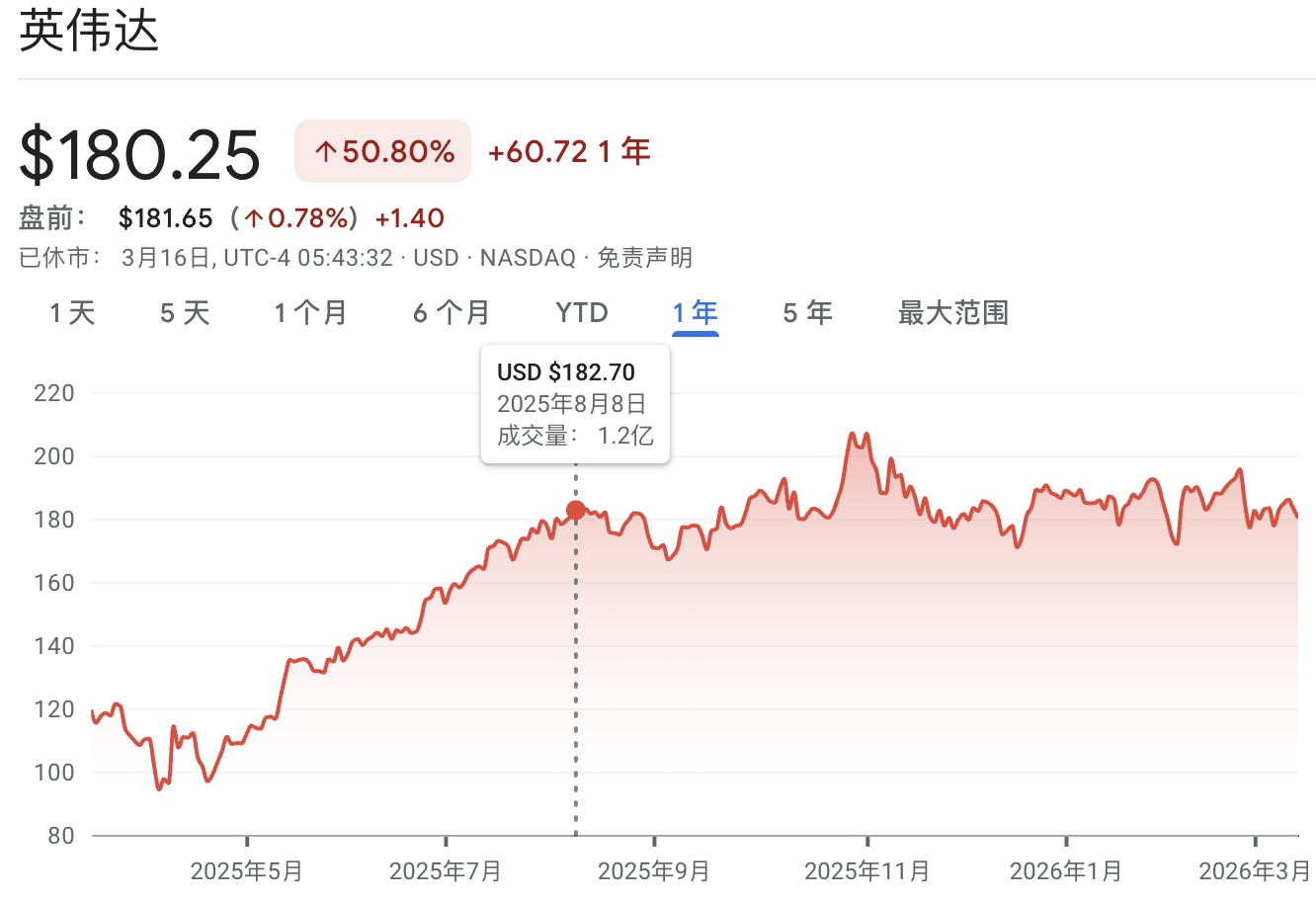
NVIDIA's stock price has been stagnant for months; can the GTC opening tonight turn the tide?

Bank of America believes that the market's concerns about the sustainability of AI capital expenditures are the core reason for NVIDIA's continued valuation pressure. Even if the sales outlook at GTC meets expectations, as long as it is accompanied by specific details, it can support a temporary recovery in the stock price. UBS cautiously points out that relying on this conference to trigger a "change in investment logic" style stock price surge is "difficult to foresee."
NVIDIA is at a critical juncture: most analysts are optimistic about its fundamentals, but the stock price has performed flat this year, and market doubts remain. The annual GTC conference opens this week, providing the AI chip giant with the best opportunity to reignite investor confidence.
What investors are most concerned about is the company's strategic layout for inference chips, the latest planning of the chip roadmap, and the supply outlook for wafers, memory, and optical devices. This information will directly impact the market's judgment on whether NVIDIA can continue to lead in the wave of AI spending.
Bank of America believes that the market's concerns about the sustainability of capital expenditures from hyperscale cloud vendors, combined with geopolitical uncertainties, are the core reasons for NVIDIA's continued valuation pressure. Even if the sales outlook at GTC aligns broadly with consensus expectations, as long as it includes specific details on supply and demand visibility, it would be sufficient to support a temporary recovery in the stock price.
However, UBS, while optimistic about NVIDIA's fundamentals, points out that relying on statements from this conference to trigger a "change in investment logic" style stock price surge is "difficult to foresee." Nevertheless, the firm also acknowledges that the contrast between NVIDIA's impressive earnings expectations and its discounted valuation is in a state that "seems difficult to sustain."

Behind the Lackluster Stock Price: Valuation "Normalization" and Growth Expectation Discrepancies
After a cumulative increase of 22,000% over ten years, NVIDIA's stock price has stagnated this year, leading some investors to question whether its next phase of growth can continue the previous momentum.
From a valuation perspective, NVIDIA is currently trading at 17 times the expected earnings for the next fiscal year, below the overall valuation level of the S&P 500 index. According to FactSet data, of the 70 analysts covering NVIDIA, 93% give it a buy rating, with an average target price of about $267.
Free cash flow expectations indicate that NVIDIA's free cash flow for the current fiscal year (ending January 2027) is expected to grow by 85% compared to the previous year, reaching over $178 billion, with a significant acceleration in growth compared to the previous fiscal year. If these expectations are met, it will set a historical record for global corporate free cash flow.
It is expected that by the next fiscal year, this figure will further rise to $233 billion. However, the current forecast range has a discrepancy of $98 billion between the high and low ends, reflecting the market's considerable uncertainty regarding NVIDIA's future earnings.
Core Highlights of GTC: Entering the AI Inference Market
Wall Street Insight previously published an article noting that the most noteworthy aspect of the GTC conference is NVIDIA's strategic shift from training to inference and its adjustments in supply chain layout. It may announce a significant entry into the AI inference market by integrating Groq technology; on the foundry side, it may introduce Samsung for the first time to break TSMC's monopoly, with OpenAI expected to become one of the first major customersBank of America Securities expects that NVIDIA will showcase a new generation of product lineup at the GTC keynote speech, with key highlights including a language processing unit (LPU) rack system integrated with Groq technology, a new generation of high-speed switches, and co-packaged optics (CPO) solutions, along with the possibility of launching a customized x86 processor in collaboration with Intel.
In recent years, AI chip spending has primarily focused on training scenarios, which heavily rely on the large-scale parallel computing capabilities of GPUs. This explains why NVIDIA has dominated the AI infrastructure market with GPU technology initially designed for gaming graphics rendering.
However, the decoding scenarios in the inference process have created a demand for non-GPU dedicated chips. To address this gap, NVIDIA spent approximately $20 billion last year to acquire the language processing unit (LPU) technology and related talent from the private company Groq. Groq specializes in designing dedicated chips for inference decoding scenarios.
Outsiders expect Jensen Huang to elaborate at this year's GTC on how NVIDIA will integrate LPU into its chip portfolio to comprehensively cover the three application scenarios of training, pre-filling, and decoding, while also resisting competitive pressure from self-developed chips by large-scale cloud vendors.
Capital Expenditure Wave: Investment in AI Infrastructure Continues to Rise
NVIDIA's performance outlook largely depends on the continued ramp-up of AI infrastructure investments by large-scale cloud vendors such as Amazon and Microsoft.
Taking Amazon as an example, its capital expenditures have remained in the range of $50 billion to $60 billion annually from 2021 to 2023, and this year, that figure is expected to surge to $190 billion, with almost all incremental spending directed towards AI infrastructure construction, including a significant procurement of NVIDIA chips.
Barclays released a forecast last week stating that the overall capital expenditure in the AI sector will peak at approximately $1 trillion by 2028, after which it will "moderately decline." The bank also believes that the market's consensus expectation for large-scale cloud vendors' capital expenditures in 2028 is underestimated by about $300 billion.
Market Reactions to GTC: Divergence on Wall Street
There is a divergence of opinion on Wall Street regarding whether this year's GTC can lead to a substantial breakthrough in stock prices.
Bank of America believes that the market's concerns about the sustainability of capital expenditures by large-scale cloud vendors, combined with geopolitical uncertainties, are the core reasons for the continued pressure on NVIDIA's valuation. Even if the sales outlook at GTC aligns broadly with consensus expectations, as long as it includes specific details on supply and demand visibility, it would be sufficient to support a temporary recovery in stock prices.
While UBS is optimistic about NVIDIA's fundamentals, it points out that relying on the statements from this conference to trigger a "change in investment logic" style stock price surge is "difficult to foresee." However, the bank also acknowledges that the contrast between NVIDIA's impressive earnings expectations and its discounted valuation is in a state that "seems unsustainable."
In other words, the market does not doubt NVIDIA's fundamentals but is waiting for a clear signal that can dispel doubts and reshape expectations. Jensen Huang's speech this week will be the most important opportunity in the near term