


This oil price shock is different! The U.S. shale oil has completely "laid flat," and the largest supply buffer has disappeared
UBS warns that the current round of oil price shocks is far more destructive than that from 2011 to 2014. The shale oil, once a "shock absorber," has essentially failed—investment elasticity has significantly shrunk, and supply-side expansion cannot be replicated. More troubling is that the current year-on-year increase in oil prices is approaching 100%, combined with a weak labor market, tightening household liquidity, and high inflation pressures, multiple headwinds leave the U.S. economy almost without buffer, and the net impact may be severely underestimated
The current oil price shock is fundamentally different from the high oil price cycle from 2011 to 2014, as the shale oil industry's responsiveness to price signals has significantly weakened, and the most important supply-side buffering mechanism for the U.S. economy no longer exists.
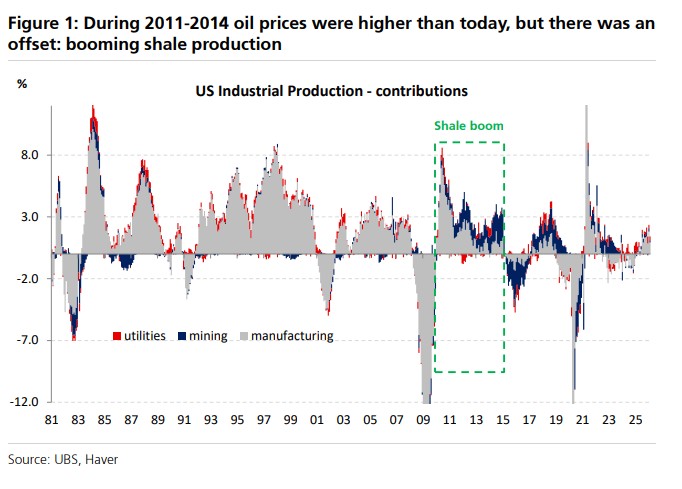
According to the Wind Trading Desk, UBS economist Arend Kapteyn pointed out in a report on March 19 that although the average price of Brent crude oil was about $110 per barrel (equivalent to approximately $145 at current prices, about 23% higher than the current spot price) during 2011 to 2014, the U.S. GDP growth rate still maintained above 2%. The key reason was that the booming shale oil industry provided a strong hedge. Now, this buffer has essentially disappeared, making it more difficult to offset the net impact of the current rise in oil prices on the U.S. economy.
The report emphasizes that the destructive nature of the current oil price shock is also reflected in the speed of price increases—if the current oil price level persists, the year-on-year increase will approach 100%, far exceeding the peak annual increase of no more than 55% during 2011 to 2014. At the same time, the current U.S. labor market is weaker, household liquidity is tighter, and inflationary pressures are sharper, with multiple adverse factors compounding, making it more difficult to offset the erosion effect on consumer income.
Shale Oil Was the "Shock Absorber" for the U.S. Economy
In the early 2010s, the U.S. shale oil revolution was in its explosive phase, and its supporting role for the economy cannot be ignored. According to the UBS report, in early 2010, the mining sector (mainly the oil and gas industry) accounted for about 14% of industrial production value. By 2012 to 2013, this sector contributed to more than half of the total growth in U.S. industrial production, and at certain times, it almost contributed all of the industrial output growth.
It was this strong supply-side expansion that provided robust support for the U.S. economy while oil prices were high—losses in consumer purchasing power due to high oil prices were partially offset by job growth, capital expenditure, and industrial output growth driven by the shale oil investment boom.
Investment Elasticity in Shale Oil Has Significantly Decreased
After the oil price collapse in 2015 to 2016, U.S. mining output rebounded from a low base, but the investment intensity and drilling density in the shale oil industry have never recovered to pre-2014 levels. The UBS report points out that oil production still responds to prices at the margin—through increased completion numbers, improved capacity utilization, and enhanced production efficiency—but overall investment elasticity has significantly decreased.
In other words, if the market views the current oil price as a temporary phenomenon, the U.S. is unlikely to see any supply-side expansion response driven by shale oil similar to that of 2011 to 2014, and thus cannot offset the erosion of actual consumer income caused by rising oil prices.
Multiple Headwinds Compound, Making Current Shock Harder to Digest
The UBS report lists several key differences between the current macro environment and the previous high oil price cycle. First, the current U.S. labor market is weaker than during 2011 to 2014; second, household sector liquidity is tighter, with limited buffer space to withstand external shocks; Thirdly, the inflation shock is more severe, and the rapid rise in oil prices has a stronger transmission effect on overall prices.
These factors together imply that, in the absence of a shale oil supply-side expansion to hedge against it, the net drag effect of this round of rising oil prices on U.S. economic growth may far exceed the judgments derived from the market's simple analogy to historical experiences from 2011 to 2014
