


"Paradigm Shift" is Here! Security in Soaring Oil Prices – New Energy!
Since the escalation of the Middle East conflict in late February, leading battery and energy storage companies such as CATL and BYD have outperformed international oil giants, highlighting the market's long-term bet on energy transition. Huaxin Securities points out that energy security has become a key pricing theme for the medium to long term, with countries accelerating their shift towards 'independent control + diversified alternatives,' creating strategic opportunities in renewable energy generation, energy storage, and grid equipment
The escalating situation in the Middle East has unexpectedly become a powerful catalyst for global clean energy investment. Since the US-Iran conflict, the stock prices of three leading Chinese battery and energy storage companies have comprehensively surpassed those of international oil giants, reflecting the market's deep-seated bet on the long-term transformation of the energy structure.
Since the outbreak of the conflict in late February, the stock prices of CATL, BYD Company Limited, and Sungrow Power Supply Co., Ltd. have risen by 20.76%, 15.35%, and 20.14%, respectively. During the same period, despite a cumulative increase of 47% in international oil prices, the stock price gains of ExxonMobil, Chevron, Shell, and BP have all significantly lagged behind those of the aforementioned Chinese companies.
Concerns over energy security are reshaping investors' asset allocation logic. Huaxin Securities believes that the current Middle East conflict has escalated from a geopolitical event to a systemic shock to the global energy supply system, making the logic of energy security the main theme for medium to long-term pricing. Li Shuo, Director of the China Climate Center at the Asia Society Policy Institute (ASPI), stated that recent attacks on liquefied natural gas infrastructure in the Gulf region have profoundly revealed the inherent systemic risks of fossil fuels.
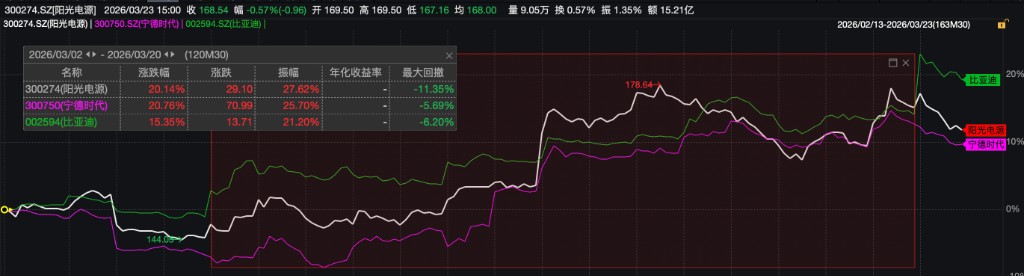
Energy Security Becomes the Long-Term Pricing Theme
The core impact of this conflict has moved beyond short-term oil price fluctuations to a systemic reassessment of the "security attributes" of the global energy system.
The Strait of Hormuz handles approximately 20% of the world's oil and gas transport. The concentrated exposure of its vulnerability constitutes a fundamental shock to the traditional "low cost + high efficiency" globalized energy allocation model. Huaxin Securities points out that uncertainty in energy supply is transmitting from oil to natural gas, electricity, and even industrial product prices, elevating energy issues from a single resource constraint to a core variable in macroeconomics.
Asian economies highly dependent on Middle Eastern energy imports are particularly at risk. Approximately 95% of Japan's and 70% of South Korea's crude oil imports come from the Middle East, and 20% of South Korea's natural gas imports also originate from the region. If the Strait of Hormuz were to be blockaded long-term, these countries' economies would suffer severe shocks, directly negatively impacting their GDP.
Li Shuo stated that recent attacks on liquefied natural gas infrastructure in the Persian Gulf highlight the "inherent risks of fossil fuel dependence." He warned that East Asian countries, which are most dependent on imported liquefied natural gas from the Middle East, will face immeasurable economic shocks despite being geographically distant from the conflict zone.
The Energy Paradigm is Shifting
In the face of energy security threats, national policy orientations have clearly shifted towards "independent control + diversified alternatives," encompassing increasing domestic energy supply, strengthening strategic reserves, and accelerating the development of new energy systems. This shift is reshaping global capital expenditure directions and directly driving a revaluation of the clean energy sector.
Neil Beveridge, Head of Bernstein's Energy Research, predicts that China, as the world's largest oil importer, will further strengthen its "comprehensive electrification" strategy. He noted that other major Asian economies, such as Japan and South Korea, will also accelerate their deployment of clean energy and clean fuels. "This fundamentally changes the entire energy paradigm," he said, "even if the war ends next month... there is no going back."
From a demand fundamentals perspective, the increasing proportion of renewable energy generation directly drives the demand for grid-scale energy storage. According to forecasts by the research firm Mobility Foresights, the market size for grid-scale energy storage in China alone is expected to grow significantly from USD 48 billion last year to USD 199 billion by 2032. Furthermore, the rapid expansion of data centers is another significant driver of battery energy storage demand.
"Energy Independence and Control" Becomes the Investment Theme, with Three Key Areas Facing Strategic Opportunities
Under the dominant logic of energy security, Huaxin Securities believes that "energy independence and control" will become the core investment theme for the next several years, identifying three key directions.
In terms of renewable energy generation, under the combined pressures of external energy shocks and carbon neutrality goals, renewable energy sources like wind and solar possess both cost advantages and strategic value, serving as a critical path to reducing import dependency. The average installation demand for related sectors is expected to systematically increase, with a significant rise in strategic priority.
Regarding energy storage, as the energy structure transitions to renewables, the issues of volatility and instability in power supply become prominent. Coupled with the "supply guarantee" demand during extreme supply shocks, the strategic importance of energy storage in peak shaving, backup, and emergency support continues to strengthen, with potential improvements in business models and profitability.
In the realm of grid and power equipment, whether for large-scale integration of new energy sources or for redundant regional energy security configurations, higher levels of power transmission and distribution capacity and intelligent dispatching systems are required. Huaxin Securities believes that investment in ultra-high voltage transmission, distribution network upgrades, and digital grids is poised to enter an accelerated cycle, with related companies directly benefiting from the accelerated construction of new power systems.
