


Goldman Sachs on Meta's Layoffs, Spending Cuts, and Model Release Delay: Not "Winter Budget Cuts," but "Swapping Old for New"
Market panic over Meta's layoffs and spending cuts is seen as a passive contraction under AI capital expenditure pressure. Goldman Sachs refutes this, calling it an active strategic restructuring that reallocates resources from inefficient legacy assets to high-value AI computing power demand, which is expected to open up room for long-term EPS upside
Amid widespread external concerns over Meta's layoffs, reduced investment in Reality Labs, and delayed release of its foundational models, Goldman Sachs offers a different interpretation: This is not a passive contraction under the pressure of AI investment, but a strategic restructuring that actively reallocates resources from inefficient legacy assets to high-value computing power demands, thereby creating space for long-term EPS upgrades.
According to recent reports from multiple media outlets, Meta's management may be advancing three major initiatives: large-scale layoffs and personnel structure adjustments, compression of expenses in the Reality Labs division, and postponement of the public release of the latest foundational models from its Superintelligence Lab. As the news continues to unfold, Meta's stock price has fallen by approximately 20% since January 29th, the day after its fourth-quarter earnings report, while the S&P 500 index has only dropped about 7% in the same period.
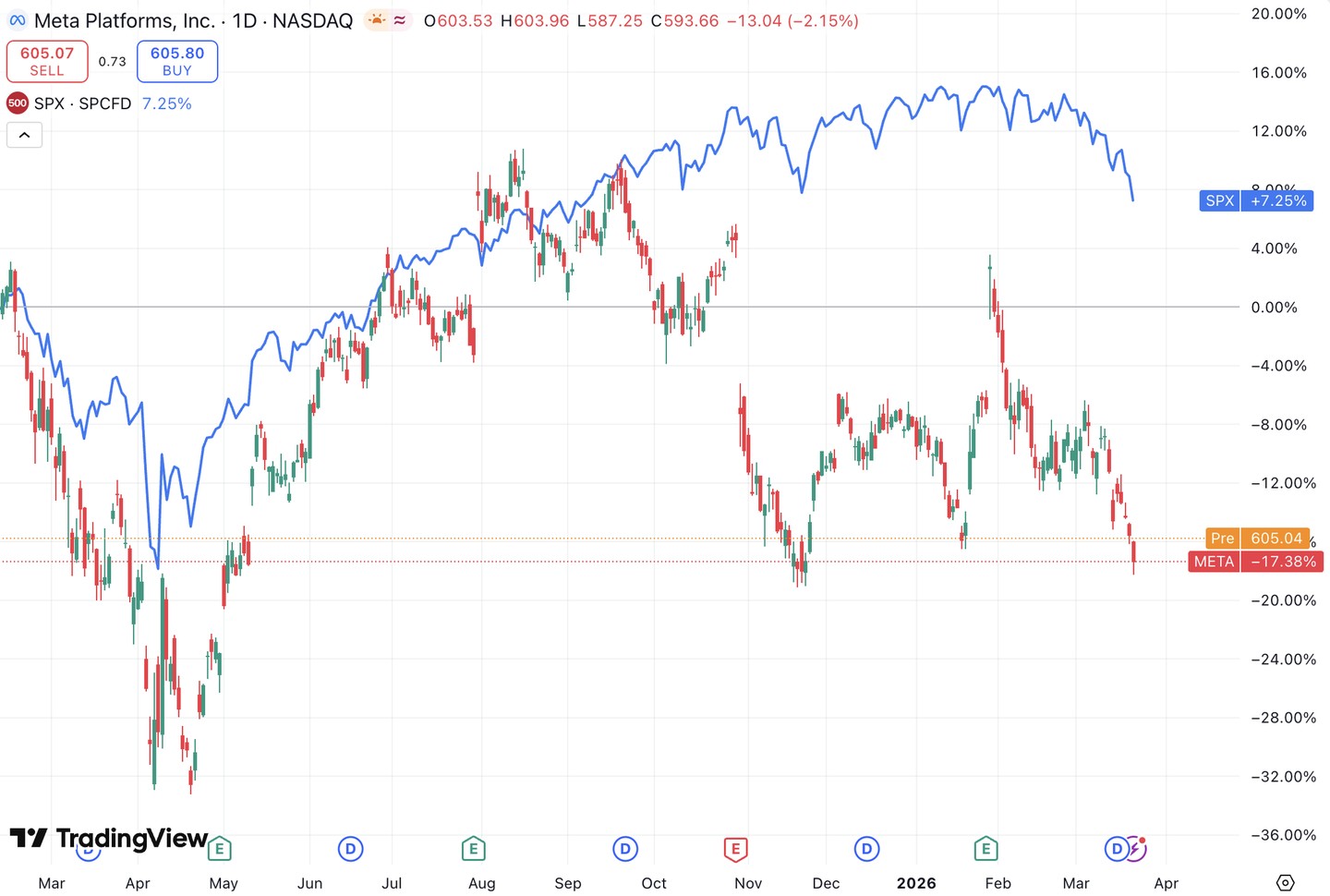
Goldman Sachs analyst Eric Sheridan's team noted in their research report on March 22nd that none of the aforementioned three initiatives substantially exceed the forward guidance framework provided by management during the most recent earnings call.
A more critical assessment is that any cost-saving measures should be viewed as Meta's company-wide rebalancing of efficiency and growth—the freed-up resources will primarily be directed towards AI growth investments centered around computing power demands. The firm also stated that if these measures are implemented, Meta is expected to return to its usual rhythm of "conservative guidance at the beginning of the year, with continuous full-year earnings upgrades."
Goldman Sachs maintained its Buy rating and 12-month price target of $835 for Meta. The firm quantified the potential impact of cost optimization on EPS through three scenario analyses, with the core conclusion being: Meta's existing cost structure possesses ample flexibility, and the measures to rebalance efficiency and growth have the capacity to continuously drive positive EPS revisions.
Layoffs: Adjusting Personnel Structure, Not Overall Scale
According to Reuters, Meta is planning large-scale layoffs.
In Scenario One, Goldman Sachs conducted a quantitative assessment: assuming a 15% year-over-year decrease in total employees by the end of 2026, with a 5% recovery in growth for each of 2027 and 2028, while non-depreciation and amortization expenses per person grow by approximately 6% annually. Under these assumptions, compared to Goldman Sachs' baseline forecast, Meta's GAAP EBIT and earnings per share in 2026 would see a boost of over 10%, with the uplift in 2027-2028 exceeding 20%.
Goldman Sachs emphasized that the essence of this scenario is not simply compressing personnel numbers, but reflects a structural transformation trend that has become increasingly apparent in the industry since mid-December 2025: companies are generally combining personnel adjustments with a shift towards AI and machine learning computing roles.
In other words, Meta's layoffs are closer to a "talent swap"—replacing existing positions with technically skilled personnel possessing stronger AI backgrounds—rather than a contraction of overall scale. Goldman Sachs thus characterizes this as a proactive talent structure reorganization, rather than a reduction driven by passive cost pressure.
Reality Labs: Abandoning Horizon Worlds, Not the Entire Spatial Computing Track
According to Bloomberg, Meta plans to adjust core products within the Reality Labs division, which some have interpreted as Meta's complete withdrawal from this business segment.
Goldman Sachs believes this interpretation is biased and, citing several subsequent official statements from Meta, points out that the core of this adjustment is to reduce investment in legacy VR products like Horizon Worlds, while the company remains highly committed to its broader vision of spatial computing, and its strategic direction has not changed.
In Scenario Two's quantitative analysis, Goldman Sachs assumes an annual reduction in Reality Labs' expenses by approximately high single-digit to low double-digit percentages, with 10% of the savings being reinvested in the business. This scenario's potential boost to GAAP earnings per share from 2026 to 2028 falls within the low to mid-single-digit percentage range, indicating moderate elasticity but a clear positive direction.
Goldman Sachs' assessment is that Meta's move essentially involves deprioritizing traditional VR within Reality Labs to channel more resources towards AI integration and augmented reality (AR).
Foundational Model Delay: The Timeline Was Always Expected
The New York Times reported that the public release of the latest foundational models from Meta's Superintelligence Lab may be postponed.
In response, Goldman Sachs stated that this timeline has never exceeded their expectations. Considering that the Superintelligence Lab was established in mid-2025 and has been operational for less than a year, compared to leading model institutions like Google DeepMind, OpenAI, and Anthropic, which have been deeply involved for many years, Meta will require at least 9 to 12 months to showcase initial results in the public domain.
Goldman Sachs reiterated its anchor on Meta's management's public statements: the release of foundational models and the implementation of AI strategic pillars (such as computing power deployment, agent products, etc.) will primarily occur in the second half of 2026 through 2027, with the first batch of models being just the beginning, and will undergo continuous iteration and evolution over several years.
The firm believes that measuring the progress pace of Meta's Superintelligence Lab based on its founding time and applying market expectations for OpenAI and Anthropic inherently creates a benchmark deviation.
Three Scenario Calculations: Different Paths to Unlocking EPS Elasticity
In its report, Goldman Sachs constructed three "blue-sky scenarios" to quantify the potential impact of different cost optimization paths on profitability, explicitly stating that these are not baseline forecasts and actual results are subject to multiple variable influences.
Scenario One (adjusting personnel scale and per capita costs) shows the most significant boost, with a potential EPS increase of over 10% in 2026 and exceeding 20% in 2027-2028.
Scenario Two (cutting Reality Labs expenses) offers relatively limited elasticity, with EPS boosts for the three years falling within the low to mid-single-digit percentage range.
Scenario Three (zero growth in non-D&A operating expenses over the next three years) has the largest theoretical elasticity, potentially leading to an EPS boost of over 30% in 2026 and an upward space of approximately 40% to 50% in 2027-2028. However, Goldman Sachs classifies this as the least probable scenario—key constraints include persistent salary inflation for AI and machine learning positions, and continued growth in the company's total employee count over the long term.
Goldman Sachs points out that Meta's existing cost structure possesses ample profit elasticity, and any management initiatives aimed at balancing efficiency and growth investments have the capacity to continuously drive upward revisions in EPS expectations over the coming years, rather than downward pressure.
