


Copper Prices Break Out! First Weekly Gain Since U.S.-Iran Conflict, Gold Rebounds 4% Intraday, Still Down for Four Weeks
China's significant inventory drop has boosted demand expectations, seen as the main driver for LME copper's rise this week. Most LME industrial metals saw gains this week, with LME tin climbing nearly 6%. Gold futures recorded their longest weekly losing streak in nearly three years. Gold's safe-haven appeal is being questioned, with central bank sales adding to pressure. However, Deutsche Bank raised its year-end gold price target to $5000/oz, believing recent pullbacks are unsustainable
As the conflict in the Middle East continues into its fourth week, commodity markets showed divergence this week – industrial metals stabilized and rebounded, while gold, despite a sharp intraday rally, could not shake off its downward trend.
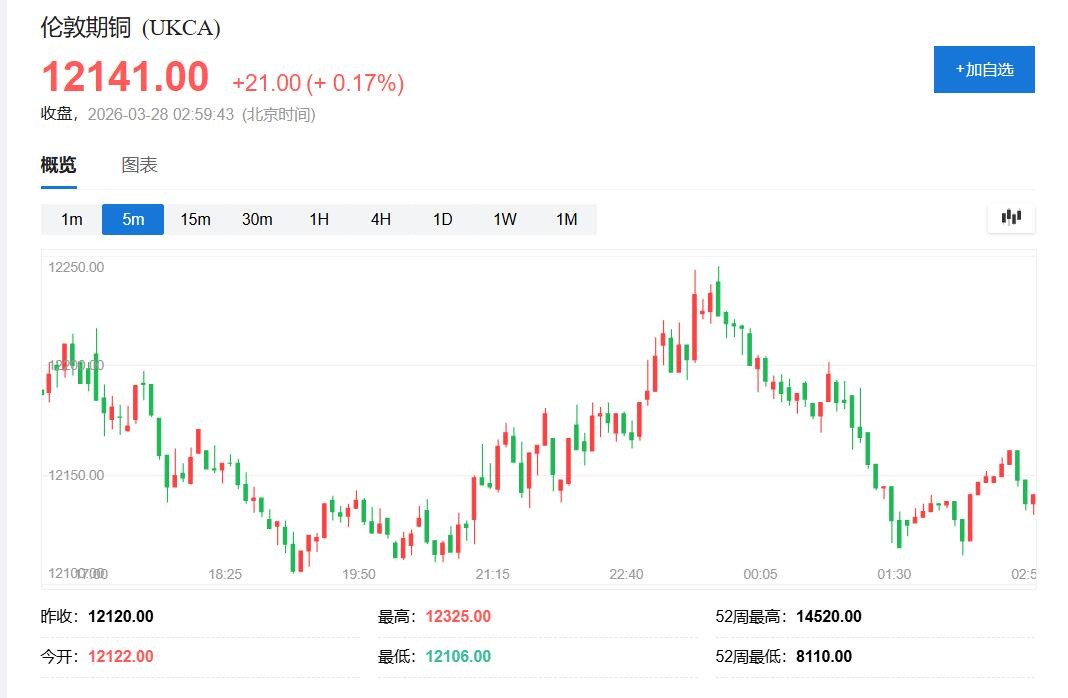
LME copper rose more than 2% this week, marking its first weekly gain since the outbreak of the U.S.-Iran conflict, driven primarily by a sharp drop in Chinese inventory and a subsequent warming of demand expectations.
On Friday morning, as U.S. stocks hit new daily highs, spot gold climbed above $4554.90, up nearly 4.1% intraday. The main contract for New York gold futures rose to $4552.10, up slightly over 4% intraday.
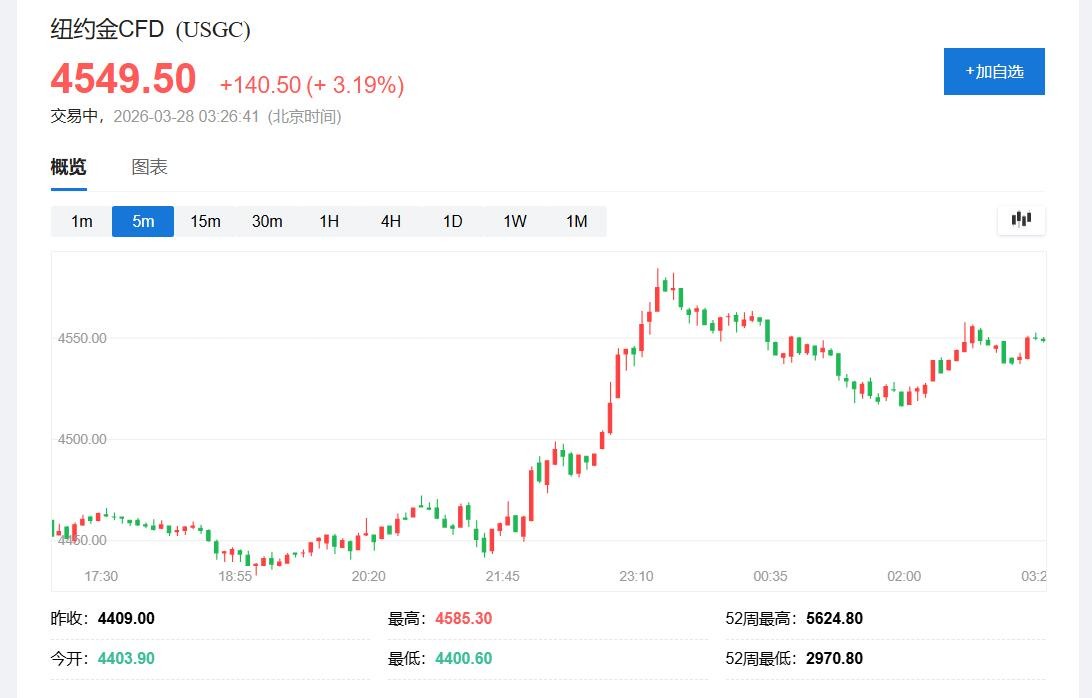
However, due to a sharp plunge of over 10% on Monday, the front-month futures contract still ended the week down nearly 2%, extending its losing streak to four weeks, the longest weekly decline in nearly three years.
As Trump once again postponed the deadline for strikes against Iran, the market harbored some expectations for de-escalation. However, Iran rejected the U.S.'s 15-point ceasefire proposal, and missile exchanges between the two sides continued, indicating that tensions have not fundamentally eased. Oil prices remained above $110 per barrel, and persistent inflationary pressures further compressed the Federal Reserve's room for interest rate cuts – the market has fully priced in no rate cuts until 2026.
Most Industrial Metals Rose Weekly, LME Tin Up Nearly 6% for the Full Week
Base metals traded on the London Metal Exchange (LME) largely recovered their losses this week.
LME copper recorded its first weekly gain since the outbreak of the U.S.-Iran conflict, a stark contrast to its three consecutive weeks of declines. LME copper futures closed at $12195 per ton, up $48, or nearly 0.4%, with a cumulative gain of 2.22% for the week.
LME tin was the standout performer on Friday, with LME tin futures closing at $45788 per ton, up $1663, or nearly 3.77%, marking a new high since March 17. The weekly gain was 5.8%, leading all base metals. Its weekly gain also led all base metals.
LME aluminum rose 2.52% for the week, and LME zinc gained 1.57%, both hitting over-a-week highs for multiple consecutive days. LME nickel closed slightly up by 0.98% for the week but fell for the second consecutive day on Friday. LME lead remained flat for the week.
The strong performance of aluminum has a specific background – the Strait of Hormuz is effectively blockaded, cutting off about 9% of global aluminum supply. Reports indicate that Japanese buyers agreed to pay the highest aluminum procurement premiums in 11 years this week, a cost pressure expected to be passed on to downstream manufacturers, further exacerbating inflation.
Recovery in Chinese Demand Supports Copper Prices
The core driver for the copper price rebound this week came from demand signals from China.
According to reports, copper inventories on the Shanghai Futures Exchange recorded the largest weekly drop this year, and the second-largest single-week decline in history. Analysts believe that the previous sharp fall in copper prices triggered restocking demand from manufacturers, leading to an upturn in orders.
However, market sentiment has not fully warmed up. Harry Jiang, a trader at Zhongji Ningbo Group, stated that although the U.S. has mentioned some negotiation possibilities, tensions have hardly eased at all, and "many traders are taking a wait-and-see attitude."
The uncertainty surrounding the Middle East situation remains the primary macroeconomic factor suppressing industrial metals. The conflict continues to push up energy and fertilizer prices, fueling global inflation expectations and dampening economic growth prospects, thereby pressuring industrial demand outlooks.
Gold Futures Record Longest Weekly Losing Streak in Nearly Three Years
Gold rebounded during intraday trading on Friday but failed to reverse the week's losses.
The front-month COMEX March gold futures contract closed at $4492 per ounce, up 2.66%, with a weekly decline of 1.72%. This marks the longest losing streak since April 18, 2023, with a cumulative loss of 14.12% over the past four weeks.
Daniel Pavilonis, a senior market strategist at RJO Futures, views this pullback as a buying opportunity: "The market has fallen sharply... prices have broken below the 200-day moving average... this is a rare buying opportunity." He expects gold prices to rise slowly in the coming weeks and stated that once the situation in Iran eases, the market will see a good opportunity for risk appetite recovery.
Gold's Safe-Haven Appeal Questioned, Central Bank Sales Add Pressure
This unusual movement in gold prices has prompted Wall Street institutions to deeply reflect on its safe-haven properties.
Saxo Bank analysts noted in a research report that this price action indicates that "in the context of supply-driven macroeconomic shocks, gold has transformed into a source of liquidity, behaving more like a risk asset, moving in tandem with overall market pressures, and failing to provide traditional safe-haven support."
Carsten Menke, an analyst at Julius Baer, pointed out that central bank gold reserve sales are adding extra pressure on gold prices. He mentioned that Turkey has sold about 54 tons of gold to support the Lira since the outbreak of the Iran war, and Poland is also considering sales. Menke emphasized that passive selling is more concerning than active rebalancing because it lacks controllability, and expects short-term volatility to remain high.
Despite this, some institutions maintain a long-term optimistic outlook for gold.
Deutsche Bank has raised its gold price forecast, increasing its year-end target from $4900 per ounce to $5000 per ounce, believing that the recent pullback is unsustainable. The bank expects the Iran war to end in the spring, at which point market expectations for Fed rate hikes will cool down, and predicts that the Federal Reserve will resume rate cuts later this year, with cumulative cuts of about 75 basis points by mid-next year.
