


Trump’s Penchant for Weekend Moves Leaves Wall Street Wary of Over-the-Weekend Positions
Trump's habit of releasing major updates over the weekend has profoundly impacted Wall Street's trading behavior. From pressuring the Strait of Hormuz to announcing a pause in military action, his dramatic weekend maneuvers have triggered sharp market volatility on Mondays, making traders generally reluctant to hold large positions over the weekend. Deutsche Bank's "Pressure Index" suggests that Trump tends to make impactful decisions when market pressure peaks; this index has now reached its highest level since he took office
Trump’s habit of using the weekend to release major developments has forced Wall Street to adapt.
Last Saturday, Trump announced that Iran must reach an agreement within 48 hours or face a series of devastating strikes on utilities and other infrastructure. However, by Monday, Trump had paused the plan, stating a suspension of strikes on energy facilities for five days. Following the announcement, Brent crude oil plunged by over 14% at one point on Monday.
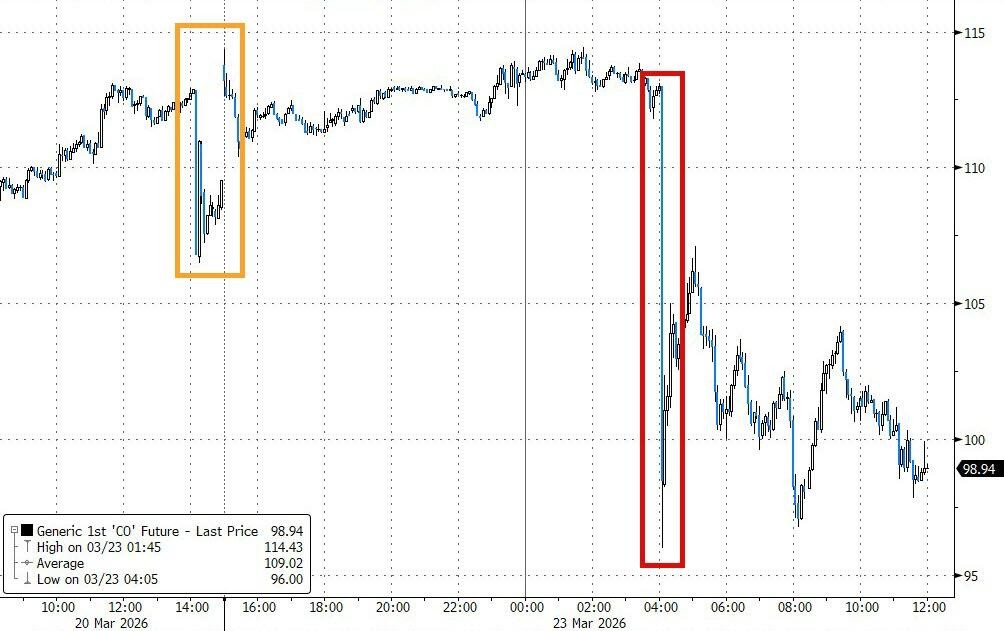
(Brent crude oil futures plummeted 14% at one point on Monday)
By Thursday this week, after the US stock market closed, Trump again announced an extension of the deadline to April 6. On that day, spot crude oil's gains reversed, and risk assets rebounded briefly, but the market seemed to become increasingly "immune" to Trump's verbal interventions, and asset prices soon returned to their intraday trends.
On Friday, Wall Street News mentioned that as the situation further escalated, WTI recovered all its losses for the week. US stocks slumped this week, with the Dow falling over 10% from its yearly high, joining the NASDAQ Composite Index in a correction phase.
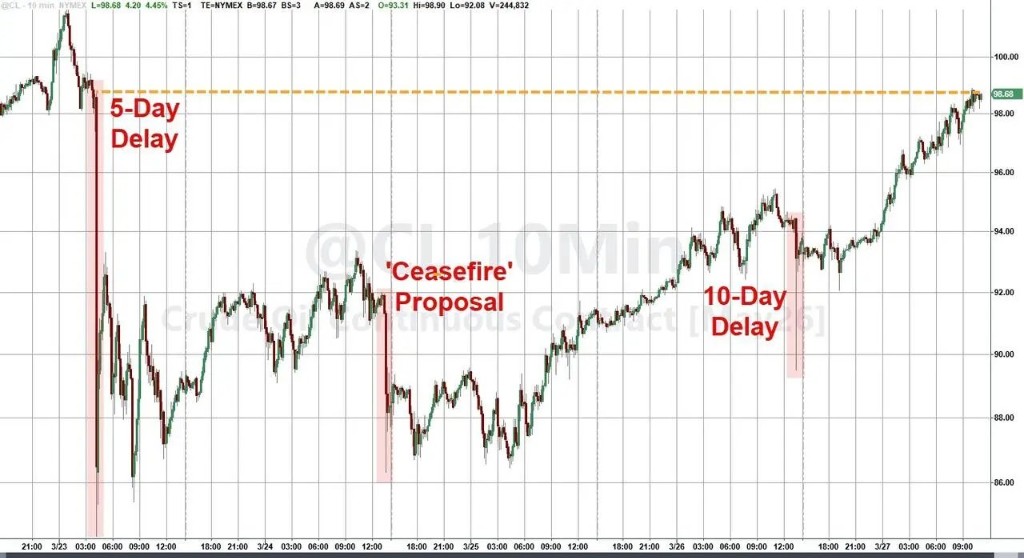
Trump's series of actions during market closure periods have had a substantial impact on market trading behavior. Traders in the equity, fixed-income, and commodity markets are now generally unwilling to hold large positions before the weekend to hedge against potential sharp fluctuations at Monday's opening.
Kathy Jones, Chief Fixed Income Strategist at Charles Schwab, stated this week:
Going into the weekend with a position of any size could lead to a very difficult Monday morning.
Weekend Moves Become a Fixed Pattern
Summarizing Trump's actions over the past period, he consistently prefers to take significant action on Saturdays.
Last June's airstrikes on Iran, the forced intervention against Venezuelan President Maduro this year, and the latest military actions against Iran all occurred on Saturdays or throughout the weekend, during which major markets, including foreign exchange, are closed.
White House spokesperson Kush Desai denied in an email statement that the timing of military actions was linked to market closures. He stated:
The notion that the timing of these military actions is dictated by when the stock market is closed, rather than by intelligence advice and when it is operationally most conducive to mission success, is beyond preposterous and could only be believed by someone who has never planned a toddler’s birthday party.
An unnamed White House official was also quoted as saying that the coincidence of so many major moments falling on weekends is purely accidental.
However, Trump's penchant for dramatic action and his past habit of operating outside of market trading hours have reshaped the interaction dynamics between Wall Street and Washington.
As the reality of the Strait of Hormuz closure becomes increasingly severe, his ability to reassure the market with optimistic rhetoric is gradually weakening. Even if Trump announces a 10-day suspension of military action, there is no guarantee that this commitment will be sustained.
Market Pressure Index Hits New High Since Trump Took Office
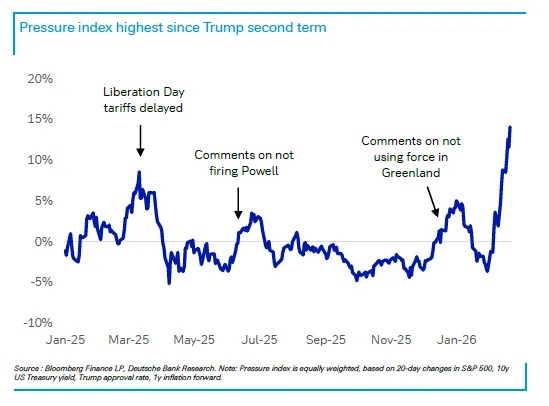
An analytical framework constructed by Deutsche Bank strategists indicates that Trump tends to make his most impactful decisions when market pressure is at its greatest.
The bank's "Pressure Index" weighs four indicators: the performance of the S&P 500 and US Treasury yields, inflation expectations, and Trump's approval ratings.
Data shows that the index peaked significantly last spring when Trump announced a delay in "reciprocal tariffs," last summer when he clarified he had no intention of firing Federal Reserve Chairman Jerome Powell, and earlier this year when he threatened not to use force to seize Greenland.
Currently, the index has risen to its highest level since Trump's inauguration in January 2025.
Meanwhile, there is evidence that Trump's weekend actions do have a significant impact on Monday's opening.
Taking the EUR/USD currency pair and the S&P 500 index as examples, the frequency of large gaps between Monday's opening price and Friday's closing price is increasing, leaving investors with little time to quickly close out losing positions.
Risks of Escalation Cannot Be Underestimated
Despite this, the market still has no consensus on what this pause in action truly means.
Wolfe Research analyst Tobin Marcus dubbed Trump's latest move "Schrödinger's TACO" and warned in a Monday research note that as Trump sends more Marines to the region, the possibility of seizing the key Iranian oil export hub of Kharg Island is increasing, and the risk of escalation remains high.
Marcus wrote:
When this force arrives, Trump will face a choice: back down, escalate, or muddle through. We believe this decision will not be easy, but we think investors must take the possibility of escalation seriously.
Trump's continuous ambiguous signals regarding the Middle East situation led former US Deputy Secretary of State Wendy Sherman to state in the media:
This might just be a delaying tactic until we deploy our troops, but if that's the case, the US will face a protracted siege, and the President will no longer be able to manipulate the market every Saturday and Monday morning.
Josh Lipsky, Chairman of the Atlantic Council's GeoEconomics Center, holds a more cautious view. He stated:
I believe that the market, and all of us, should anticipate further volatility on weekends in the future.
However, Josh Lipsky also warned against over-interpreting any regular patterns.
