


Goldman Sachs Head of Hedge Fund Coverage: Almost All Institutions I Contact Are Bearish, Those Familiar with Spot Commodities Are More Concerned; The Longer Iran Drags On, the More the Market Leans Toward Short-Term Investments
Goldman Sachs Hedge Fund Coverage Head Pasquariello warns: market participation is more difficult than ever, with downside risks still outweighing the upside. He points out that the longer the conflict in Iran persists, the more likely it is to evolve into a growth panic. With tail risks elevated, he suggests investors simplify risk exposure and increase cash holdings, waiting for the situation to clear before adding positions
Market participation is more difficult than ever in the current situation, with downside risks still outweighing the upside.
Tony Pasquariello, head of Goldman Sachs' hedge fund coverage, pointed out in a recent report that the geopolitical conflict triggered by the situation in Iran has become the primary source of market noise, with game-play intensity across various trading strategies significantly increased.
He warned that downside pressure remains higher than upside, and he suggests investors simplify their risk exposure and modestly increase cash holdings to be prepared to add positions at any time once the situation clarifies.
Pasquariello stated that this conflict is one of the largest oil supply shocks in history, yet the limited decline in US stocks so far is itself a cause for vigilance.
He cited a colleague's statement that "the market is increasingly leaning toward 'shorting time'" — the longer the conflict drags on, the easier it is for the market to evolve into a genuine growth panic rather than merely a supply-driven inflation shock.
Tactical Long and Short Cases Coexist, but Risks Still Skew to the Downside
Pasquariello also outlined the tactical long and short logic of the current market.
Long arguments include:
Almost everyone in the professional trading circles he contacts holds a bearish stance, and market sentiment indicators have fallen sharply;
CTA systematic strategies have significantly reduced long positions;
Large index shorts have been established;
RSI for the S&P 500 and Nasdaq 100 have fallen to their lowest levels since April last year;
The outline of an Iranian negotiation framework is emerging.
Short arguments include:
There has been no true capitulation selling outside of short-term funds;
The performance of the global bond market is equally unsettling;
The intensity of the conflict has not eased within the critical 48 to 72-hour window;
Practitioners in the spot commodity markets are conveying more pessimistic signals.
Pasquariello's comprehensive judgment is: Technicals are tending toward balance, but the broader set of risks still leans toward negative outcomes; gap-up and gap-down jumps will continue, and while the risk-reward ratio is not yet clear, intuitively, downside asymmetry still dominates.
Spot Commodity Practitioners Are More Worried
Pasquariello's observations during a business trip to Europe further reinforced his cautious stance. He noted that those with the deepest understanding of physical commodities are more concerned than generalized investors.
The current conflict has caused severe and sustained disruptions to the physical flow of oil, natural gas, and refined products, and has triggered a series of policy restrictions, including export bans, fuel rationing, and mandatory work-from-home requirements. For corporate operations, this means rising inflationary pressures and an increasingly strong negative impact on economic growth.
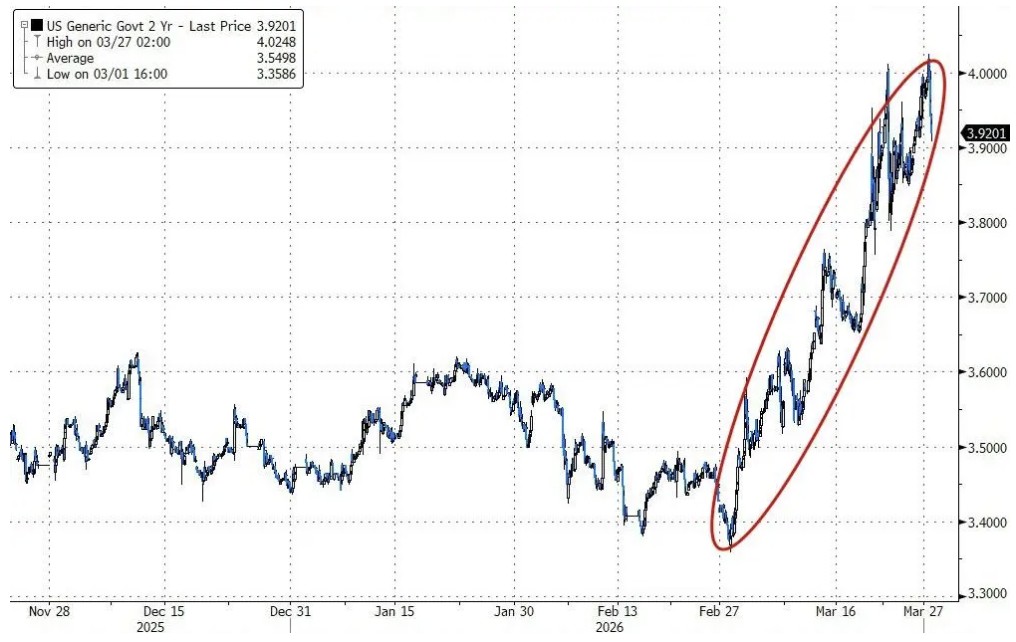
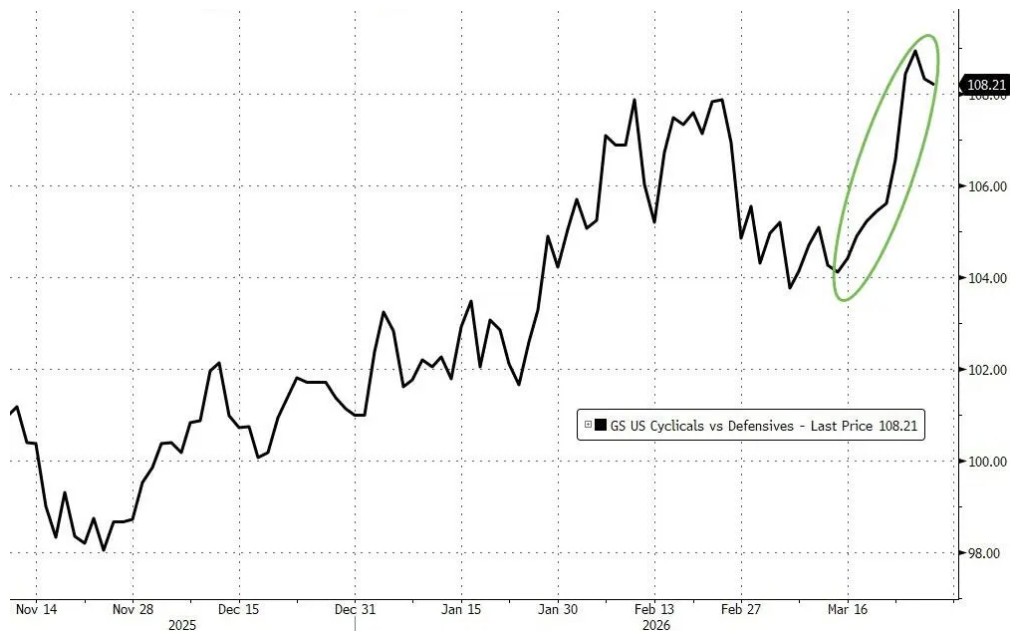
The mainstream pricing logic in the market currently is to view this situation as a supply-driven inflation shock rather than a major growth shock. This judgment is reflected in the sharp drop in global front-end interest rates and the relative outperformance of cyclical stocks over defensive stocks.
He recalled history, noting that the S&P 500 once fell 19% from its February 2024 peak to its April low, the VIX once surged above 65 in the summer of 2024, the BKX index plummeted 35% during the SVB crisis, and the Nasdaq 100 fell 33% throughout 2022.
"The damage caused by this round of shocks has not yet reached a similar magnitude," he believes, though this does not mean the risks have been fully released.
European Stocks See Fund Outflows, Asian Stocks Show Relative Resilience
In Europe, Goldman Sachs prime brokerage data shows that European stock long positions accumulated over the past year are being rapidly liquidated. Goldman Sachs has lowered its Eurozone GDP forecast for 2026 to about half of the pre-conflict level and expects the European Central Bank to raise interest rates once each in April and June.
Asian markets have shown clear resilience. Taking South Korea as an example, despite continuous selling by foreign investors and a sudden pullback in US memory chip stocks, the KOSPI is still up about 29% for the year.
The Japanese market, under pressure from high commodity exposure, still recorded a gain of about 1% for the TOPIX index this week. Pasquariello stated that based on client feedback, South Korea and Japan are the two markets among all current options where investors' medium-term confidence is most fully retained.
Tail Risks Remain High, Suggesting Increased Cash Holdings
Pasquariello summarized all the above judgments in four words: Tail risks are high.
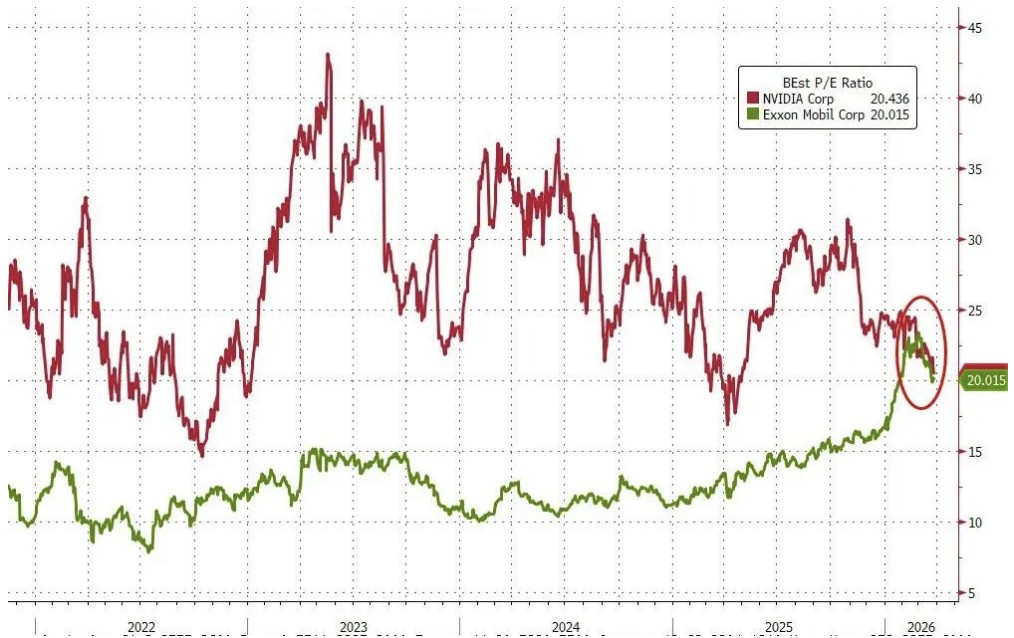
He used the convergence of the forward P/E ratio trends of Nvidia (NVDA) and Exxon Mobil (XOM) as a footnote to the era, believing that this signal itself explains the deep changes in the current market structure.
"I still believe there is no reason not to simplify risk, modestly increase cash holdings, and be prepared to quickly increase investment at the end where the situation clears—I know it's easier said than done," Pasquariello wrote.
