


The strongest repair line after the chaos of war emerges! The "AI computing power team" led by NVIDIA is gearing up for a fierce attack
As the global stock market enters a window for a rebound from oversold conditions, chip stocks such as NVIDIA and Broadcom are favored. Oppenheimer points out that these stocks, due to their earnings certainty and high beta characteristics, may become the core force of the market's counterattack. Analysts believe that if the situation in the Middle East eases, and oil prices and interest rates decline, chip stocks will rebound quickly, especially those related to AI computing power
According to the Zhitong Finance APP, Wall Street financial giant Oppenheimer recently released a research report stating that NVIDIA (NVDA.US), Broadcom (AVGO.US), Monolithic Power Systems (MPWR.US), and Marvell Technology (MRVL.US) remain the preferred stocks of this investment institution in the global semiconductor sector. This Wall Street financial giant cited the logic of "performance certainty + high beta attributes" for the oversold rebound, as well as the continuous global expansion of artificial intelligence spending as the core basis for its long-term optimism about these preferred semiconductor stocks.
Recently, several senior analysts on Wall Street have indicated that when the global stock market enters an oversold rebound window or when there are clear signs of easing in the geopolitical situation in the Middle East, chip stocks that have historically outperformed the market and have been largely mispriced by the market are likely to become one of the core forces leading the market's counterattack and valuation recovery. They may even be the main engine driving a significant rebound in the Nasdaq 100 index, the "bellwether of tech stocks," provided that international oil prices and long-term government bond yields decline simultaneously. The underlying logic is that high beta chip stocks are most sensitive to the chain of "geopolitical easing - oil price decline - reduced interest rate pressure," so once risk appetite recovers, they often rebound first and most strongly.
Among the broadly defined chip stock sector, the sub-sector dominated by NVIDIA and Broadcom, which is closely related to AI computing infrastructure, has the most optimistic performance growth prospects and is the most sensitive and responsive to the market rebound logic, with the most vigorous rebound amplitude. In other words, in a "risk-easing rebound" scenario, chip stocks related to AI computing are likely to be one of the market's core bullish directions.
Jan de Bruijn, the head of the emerging market equity fund Robeco Emerging Stars Equities, which has outperformed 96% of its peers in the past year, recently stated that focusing on high-performance and advanced process chip stocks related to artificial intelligence provides the best risk hedging tool against the prolonged prospects of the Iran war. This fund manager noted that 40% of the fund's risk exposure is concentrated in storage chips and cutting-edge advanced process chip themes, and chip giants closely related to artificial intelligence will maintain strong pricing power and fundamental expansion potential even in economic downturns or periods of severe volatility in global financial markets.
As model scale, inference links, and multimodal/agentic AI workloads drive exponential expansion in computing resource consumption, tech giants' capital expenditure is increasingly inclined to concentrate on AI computing infrastructure under the explosive demand for AI computing. Global investors continue to anchor the "AI bull market narrative" around NVIDIA, Google TPU clusters, and AMD's new product iterations and AI computing cluster delivery expectations as one of the most certain investment narratives in the global stock market. This also means that investment themes closely related to AI training/inference, such as power supply, liquid cooling systems, and optical interconnect supply chains, will continue to rank among the hottest investment camps in the stock market, following leaders in AI computing like NVIDIA, AMD, Broadcom, TSMC, and Micron, even amid uncertainties in the geopolitical situation in the Middle East According to the latest analyst expectations compiled by institutions, Amazon, along with Google's parent company Alphabet, Facebook's parent company Meta Platforms Inc., Oracle Corporation, and Microsoft, is expected to reach a cumulative artificial intelligence-related capital expenditure of approximately $650 billion by 2026. Some analysts believe that overall spending may exceed $700 billion, indicating that the year-on-year increase in AI capital expenditure could exceed 70%. Notably, these five major American tech giants are expected to invest about $1.5 trillion in building an enormous AI computing infrastructure from 2023 to 2026; in contrast, their cumulative investment during the entire historical period before 2022 was about $600 billion.
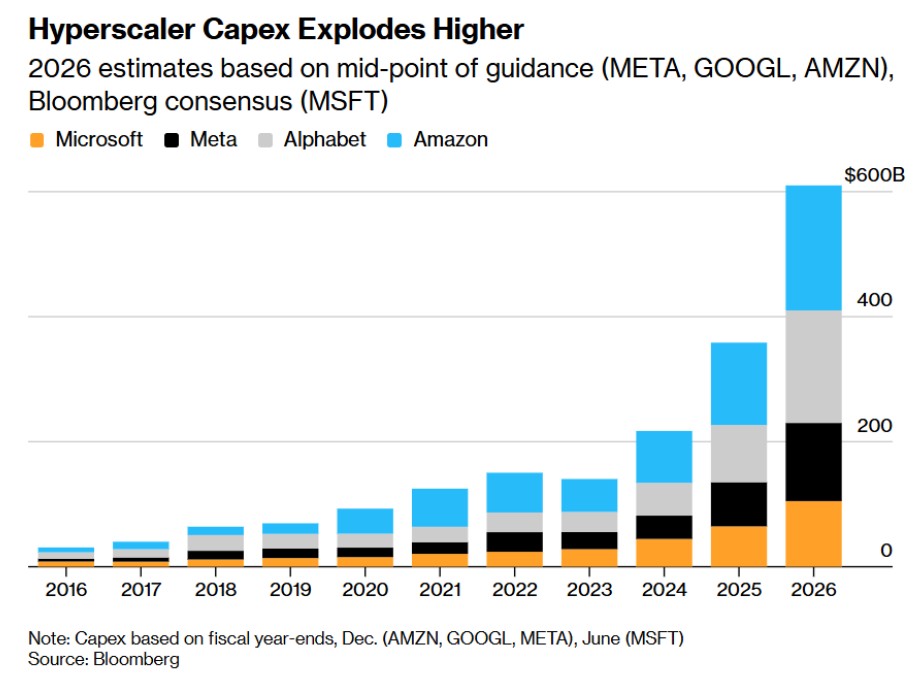
According to Wall Street giants Morgan Stanley, Citigroup, Loop Capital, and Wedbush, the global investment wave in AI infrastructure, centered around AI computing hardware, is far from over and is merely at the beginning. Driven by an unprecedented "storm of demand for AI inference computing power," this round of global AI infrastructure investment, expected to last until 2030, could reach as high as $3 trillion to $4 trillion.
The AI Arms Race is in Full Swing! Oppenheimer Long-Term Focus on Four Chip Stock Kings
"Last week, we visited several companies in the Asian semiconductor supply chain," wrote Rick Schafer, an analyst from Oppenheimer, in a report sent to clients. "The AI computing arms race is still advancing at full speed, and the demand for AI computing infrastructure from cloud service providers is virtually unconstrained and far exceeds supply, a situation that is expected to continue until after 2027. The supply tightness related to AI computing infrastructure spans multiple dimensions, with the most obvious being advanced wafer manufacturing, advanced packaging, and high-end HBM storage systems. Delivery times are still being extended. With nearly endless AI demand fiercely absorbing supply, chip prices associated with AI computing infrastructure are generally rising and are likely to be passed on to more large customers."
Therefore, analyst Schafer stated that he prefers chip companies that can provide "structurally strong growth, thus significantly outperforming throughout the cycle." Furthermore, analyst Schafer noted that the dedicated integrated circuits focused on AI (i.e., AI ASICs) are still being ramped up, led by Google's tensor processing units (i.e., TPU AI computing chip clusters). He also pointed out that to support the growth trend of large language model parameters, "multiple large projects" are continuously increasing, while the participation of relevant market players is also on the rise Schafer stated that many of the orders announced today may not start generating actual revenue until mid-2028. This is due to a series of challenges and issues brought about by NVIDIA's AI GPU power cabinets and Google's dominant AI ASIC cabinet connection systems, as well as other issues related to high-speed connections within data centers, including the differences between traditional architectures and new architectures.
When talking about NVIDIA, Schafer mentioned that the number of AI server cabinets based on the Grace Blackwell and Vera Rubin architectures is conservatively expected to exceed 75,000 this year. He also anticipates that the average selling price of Vera Rubin will be 50% or more higher than that of Grace Blackwell, with a conservative selling price for each AI power cabinet unit potentially approaching $7 million.
In addition, Schafer added that compared to the Grace Blackwell 200 or the more advanced GB300 series, Vera Rubin has higher requirements for power management systems (up to five times that of the former), which may allow Monolithic Power to benefit continuously and on a large scale. NVIDIA, Broadcom, and Marvell Technology are considered the three biggest winners in the global AI power infrastructure arms race, especially as NVIDIA's valuation has recently compressed to near or even below the S&P 500 level, showing stronger recovery resilience compared to other chip stocks.
Other conclusions from the Oppenheimer research and visits include: the shortage of server CPUs has not significantly impacted traditional server growth; cloud service providers and NVIDIA still prefer copper cable technology benchmarks for interconnection whenever possible, but will firmly use Co-Packaged Optics (CPO) in "certain necessary scenarios"; and cloud giants led by Google are widely adopting active copper cables.
Schafer also observed a series of impacts brought about by the shortage of storage chips, noting that the smartphone and PC markets have been hit the hardest.
Analyst Schafer stated that although the market generally expects the smartphone market to "decline overall," the low-end and mid-range markets are "the first to be hit," with smartphone shipments in China declining nearly 20%. In contrast, as storage prices continue to rise, the performance of Apple's (AAPL.US) flagship smartphones has been "more resilient." Additionally, Schafer believes that the PC market size is expected to decline by 11% this year, although higher-priced AI PCs may offset some of the weak PC sales trend.
The AI Agent Super Wave is Coming Strong! Driving Continuous Explosive Growth in AI Power Demand
With the focus on agent-based AI workflows, Agent AI/Agentic AI is taking center stage in the digital world, and 2026 may become the year of the AI agent explosion, which means that the demand for AI power infrastructure globally will continue to show explosive growth.
The concentrated emergence of AI agents capable of autonomously executing tasks, such as Anthropic's Claude Cowork and OpenClaw, in 2026 is not coincidental; it essentially represents the first simultaneous intersection of five curves: "model capabilities, tool protocols, development frameworks, inference costs, and terminal context capabilities." At the application layer of AI, AI agents are likely to become the most dominant business interface, as they directly translate "intelligence" into "action," which also means that AI is advancing from "being able to answer" to "being able to execute, collaborate, and complete extremely complex multi-step tasks."
The urgent demand from enterprises to improve efficiency and reduce operational costs has recently greatly accelerated the widespread application of two core categories of AI application software—generative AI applications and AI agents. Among them, AI agents are likely to be the ultimate trend in AI applications for the next decade, as their emergence signifies that artificial intelligence is evolving from an information assistance tool to a highly intelligent productivity tool. According to the latest research from MarketsandMarkets, the AI agent market is expected to reach USD 53 billion by 2030, indicating a compound annual growth rate (CAGR) of 46% starting from 2025.
The latest research from Omdia shows that global semiconductor industry revenue is expected to surge by over 30% in 2026, breaking through the historic milestone of USD 1 trillion for the first time. This strong growth is primarily driven by the robust demand for AI training/inference computing power, which is significantly boosting data center storage chips, AI GPUs/AI ASICs, and data center server CPUs.
In the broader chip sector, the AI chip/AI computing power infrastructure chain represented by NVIDIA and Broadcom has been the most sensitive, fastest reacting, and often the most elastic group to market rebound logic in recent years, as they possess the strongest performance certainty, the clearest AI capital expenditure mainline, and significant valuation recovery space after previous pullbacks. Oppenheimer continues to list NVIDIA, Broadcom, Monolithic Power, and Marvell as preferred semiconductor stocks, reflecting that the market still views the extremely tight supply and structural growth of AI computing power infrastructure driven by AI agents as the core mainline of the semiconductor sector
