The Next Test for the U.S. Treasury Market: Rising War Costs
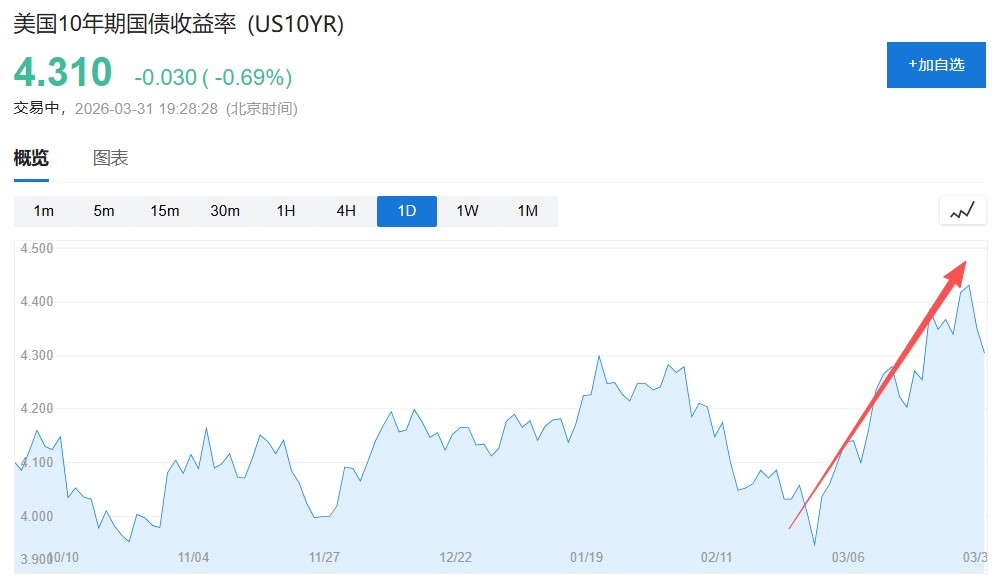
The U.S. Treasury market faces new challenges as inflation triggered by the war in Iran pushes bond yields higher. Rising fiscal costs of war could see the U.S. fiscal deficit leap from nearly 6% of GDP to 8% or more. Analysts warn that the market has not fully priced in the potential fiscal risks, and the bond market reaction could be severe. The Pentagon's request for over $200 billion in war appropriations, combined with potential tariff refunds, further exacerbates fiscal pressure. In the short term, market expectations for Fed rate cuts are cooling, leading to selling pressure concentrated in the short end of the bond market, while long-term yields are also rising
The inflationary shock from the war in Iran has already pushed up U.S. Treasury yields, and as the possibility of continued conflict rises, the bond market is facing another threat—the continuously increasing fiscal cost of war.
Analysts warn that if defense spending for an extended war, tariff refunds, and potential economic stimulus measures are added together, the U.S. fiscal deficit could jump from its current level of nearly 6% of GDP to 8% or even higher. This prospect poses a new hidden danger to the already strained bond market—the S&P U.S. Aggregate Bond Index has already fallen 0.6% in the first quarter of this year.
The current mainstream expectation on Wall Street still leans towards a short-term end to the conflict, believing that oil prices and fiscal pressure will subsequently ease. However, some analysts point out that the market has not yet fully priced in the potential fiscal risks, and once actual legislation progresses, the bond market reaction could be more intense.
Fiscal Gap May Widen Significantly, Yield Curve Already Shows Pressure Signals
The U.S. fiscal situation was already precarious before the first strike against Iran on February 28th of this year. The national debt has reached a record $39 trillion, and net interest payments are projected to exceed $1 trillion in the current fiscal year.
War spending further exacerbates this pressure. The Pentagon is requesting over $200 billion in supplementary appropriations from Congress for the war in Iran, in addition to the already signed $900 billion defense budget for fiscal year 2026. Meanwhile, the Supreme Court ruled that the President cannot impose tariffs under emergency powers, which could force the government to refund approximately $175 billion to importers. Although authorities stated they will impose alternative tariffs under other legal authorizations, uncertainty remains about whether revenue shortfalls can be compensated.
Andrew Husby, a senior economist at BNP Paribas, stated that considering the factors above, the U.S. deficit "could easily rise from nearly 6% to close to 8% or even higher," a trend that bond investors would not welcome.
Selling pressure in the bond market is currently concentrated in the short end, reflecting the market's continued cooling expectations for near-term Federal Reserve rate cuts. However, long-term yields are also rising; the 10-year Treasury yield approached 4.5% this month for the first time since last summer, and some Treasury auctions have seen weak demand.

Bill Campbell, a portfolio manager at DoubleLine Capital, stated that "all these little costs seem to be accumulating." He warned that if the 30-year Treasury yield rises from its recent 4.95% to 5.25%, "it will be a big problem," potentially prompting the Treasury to reduce long-term bond issuance and increase the supply of short-term Treasury bills instead.
Market Has Not Fully Priced Fiscal Risks
Despite the presence of risk signals, the market has not yet significantly repriced the U.S. fiscal outlook. Andrew Husby pointed out that the market might be waiting for actual legislation to take shape before reacting more strongly, stating, "There isn't a lot of additional fiscal risk that's truly being priced in right now."
Dirk Willer, Head of Macro and Asset Allocation Strategy at Citigroup, believes the biggest risk is: if inflation persists, the Fed cannot cut rates, fiscal spending expands simultaneously, coupled with potential balance sheet reduction by the Fed, then "the voice of fiscal factors may return again to a greater extent," forming a more significant shock to the bond market.
Analysts point out that compared to long-term fiscal concerns, the more pressing threat comes from the possibility of the Federal Reserve shifting towards interest rate hikes and the continued escalation of geopolitical risks.
Robert Tipp, Chief Investment Strategist and Head of Global Bonds at PGIM Fixed Income, warned that a "the other shoe dropping" scenario would be if economic growth continues, inflation remains high, and the Federal Reserve shows a tendency towards or even implements rate hikes this year.
Christian Hoffmann, Head of Fixed Income at Thornburg Investment Management, noted that geopolitical shocks over the years have ultimately proven manageable, training investors to habitually underestimate risks. "We might be at a tipping point right now where that pattern is broken."
Meanwhile, Mike Cudzil, a portfolio manager at PIMCO, holds a relatively optimistic view, believing that the oil price shock will eventually drag down economic growth, thereby preventing rate hikes and creating room for the Fed to cut rates later this year, leading to a decline in yields. PIMCO has increased its holdings in long-term bonds in several developed markets based on this judgment.
Risk Disclosure and Disclaimer
Markets involve risks, and investment requires caution. This article does not constitute personal investment advice, nor does it consider the specific investment objectives, financial situation, or needs of individual users. Users should consider whether any opinion, view, or conclusion in this article is appropriate for their specific circumstances. Investment based on this is at the user's own risk.