


Narrative Drives Everything: China's AI Newcomers Enter Era of Extreme Volatility as Retail Investors Flock In!
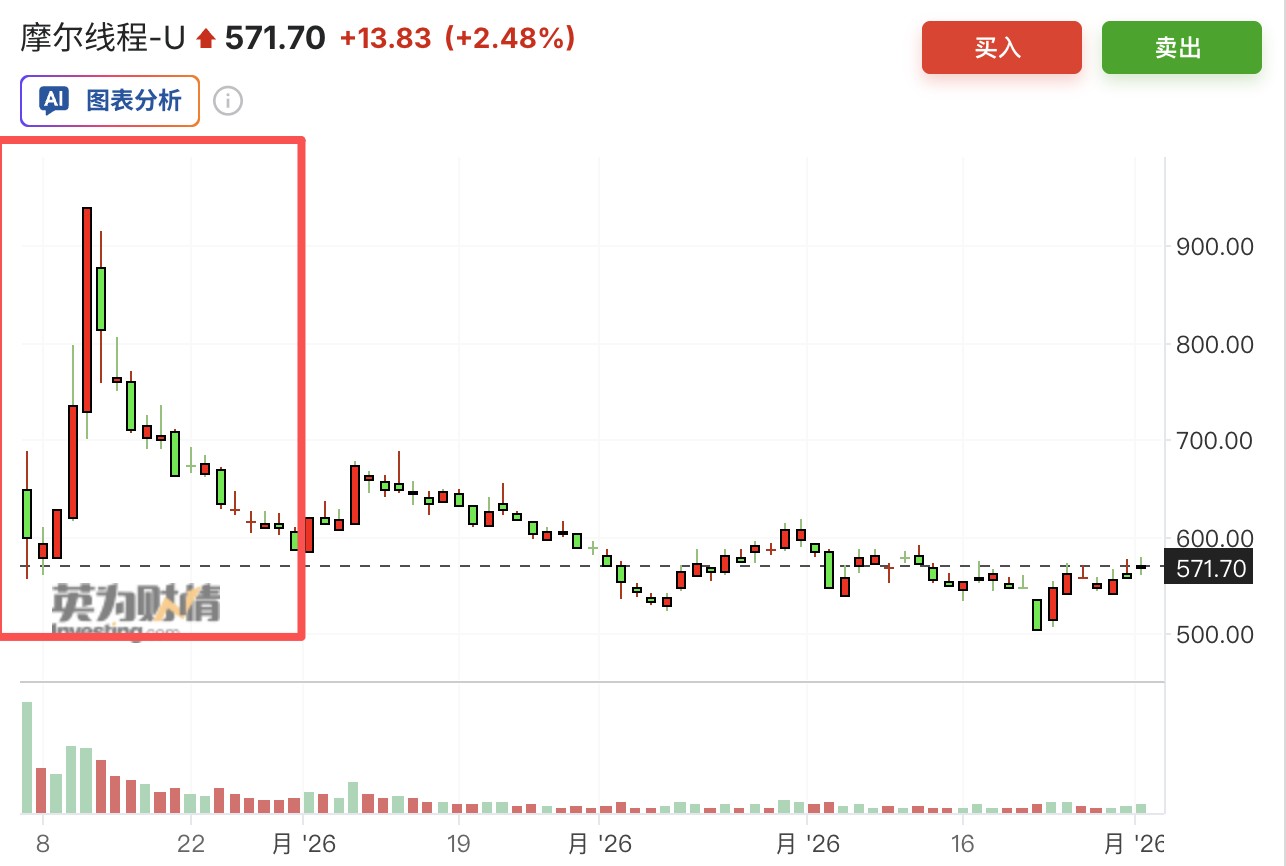
Chinese AI new stocks are experiencing extreme volatility: Moore Threads surged 700% in five days before nearly halving, while MiniMax has gained over 500% in the six months since its listing. Retail investors are flocking to the AI narrative amid low institutional ownership, with sentiment dominating pricing. Professionals point out that these companies are not yet profitable, making valuations difficult to quantify; they offer high potential but low certainty, and volatility is expected to persist
Emerging Chinese artificial intelligence stocks have become one of the most volatile sectors in Asian equity markets. Driven by the AI narrative frenzy, retail capital is dominating pricing while institutional ownership remains low—a combination that is pushing these stocks into zones of extreme volatility.
Measured by 90-day annualized volatility, half of the ten most volatile stocks among Asian companies with market capitalizations exceeding $10 billion are from recently listed Chinese AI firms.
Moore Threads once surged over 700% in five trading days before nearly halving; AI large model developer MiniMax Group Inc. has risen more than 500% cumulatively since its listing in January this year.
As some companies advance their inclusion into the Stock Connect trading mechanism, access for mainland investors is about to open. Given the natural preference of mainland investors for momentum trading, volatility in these stocks may further intensify, posing significant risks to investors engaging in FOMO buying.
Retail Dominance in Pricing, Extremely Thin Institutional Holdings
Chinese stocks, especially those listed in Hong Kong, have historically seen speculative volatility, but the current shock in AI stocks has structural roots: the near absence of institutional investors.
Exchange data shows that institutions requiring disclosure hold only about 9.3% of MiniMax's shares, with the rest held by individuals and investors not subject to disclosure requirements.
Among the five most volatile stocks in Asia, the average institutional ownership is only 13%. In contrast, Tencent Holdings and Alibaba Group have institutional ownership of approximately 50%.
This weak institutional base means that stock prices are driven almost entirely by sentiment and capital flows rather than being anchored to fundamentals. In March this year, MiniMax's average daily price swing reached 14 percentage points, while Zhipu's intraday high-low spread was 13 percentage points. Alibaba's figure for the same period was only 3.6%.
Token Demand Frenzy Ignites Market, Losses Remain a Concern
The core narrative driving this speculative wave is the market's bet on an explosion in demand for "tokens." Tokens measure the quantity of data units processed by AI models and serve as the basic unit for generating outputs such as text. Investors are beginning to believe that token service providers like MiniMax and Zhipu will be the most direct beneficiaries of this demand surge.
This expectation is not entirely without fundamental support. According to Bloomberg Intelligence forecasts, revenue growth for MiniMax and Zhipu is expected to exceed 150% year-on-year in 2028, benefiting from the direct monetization of token usage.
MiniMax's latest AI product, MiniMax M2.7, ranks third in the popular models tracked by OpenRouter, surpassing models from DeepSeek and Alibaba.
However, behind the stellar product performance lie heavy losses. MiniMax reported a net loss of $1.9 billion for the full year last year; Zhipu's net loss in 2025 widened by 60% year-on-year. Despite this, Zhipu's stock price rose 35% intraday on Wednesday, and MiniMax was up 13%. Investors are choosing to ignore the losses, betting on the future realization of token demand and pricing power.
"Unproven Business Models," Professionals Warn of FOMO Buying Risks
Facing this frenzy, market professionals remain cautious.
"The valuations of all these new AI stocks are almost entirely built on their AI roadmaps," said Jasmine Duan, Senior Investment Strategist at RBC Wealth Management Asia:
"FOMO buying carries risk, as some companies' business models have yet to be proven, and changes can be quite rapid."
Luo Jing, Investment Director at Value Partners Group, pointed out that computing power infrastructure remains a decisive factor in China's AI landscape, and existing industry leaders still hold strategic advantages in the long-term competition.
Daniel So, Senior Trading Strategist at Goldhorse Capital Management, said that given the uncertainties in the long-term outlook, his clients tend to adopt shorter holding periods when dealing with companies like MiniMax and Zhipu. He stated:
"They are not profitable, their valuations are hard to quantify, they have high potential but low certainty, and volatility will persist."
