


Tesla's automotive business is under pressure, becoming the "new normal." The market no longer focuses on sales but waits for Musk's "next PPT."
Tesla delivered approximately 372,000 vehicles in the past three months, a year-on-year increase of 11%, but still one of the lowest quarterly delivery volumes in recent times. Despite Musk's hopes to bet on AI in the future, car sales are becoming increasingly difficult. Analysts expect sales to fall below recent peak levels, with weakening global electric vehicle demand and a lack of tax incentives causing sales growth to slow down, becoming the "new normal." Tesla is gradually phasing out low-production models and facing intensified competition. Investors are paying attention to demand performance in the absence of tax incentives
Zhitong Finance APP noted that although Musk is very eager to bet Tesla's (TSLA.US) future on AI, he still needs to raise funds for these ambitions through car sales—which are becoming increasingly difficult.
According to a survey of analysts, Tesla may have delivered about 372,160 vehicles in the past three months. While this figure represents an approximate 11% increase compared to the same period last year, it remains at a lower level compared to the company's recent quarterly totals.
Sales earlier last year were affected by multiple factors: first, the strong backlash triggered by Musk during the Trump administration, and second, production halts due to updates on Tesla's most popular model, the Model Y.
Analysts expect sales to fall far below the peak quarterly levels the electric vehicle manufacturer has seen in recent years, when Tesla's deliveries once approached 500,000 vehicles.
As global demand for electric vehicles weakens and the U.S. market currently lacks federal tax incentives for plug-in vehicles, Tesla is increasingly shifting its focus towards artificial intelligence, autonomous driving, and robotics, with slowing sales growth potentially becoming the "new normal" for Tesla.
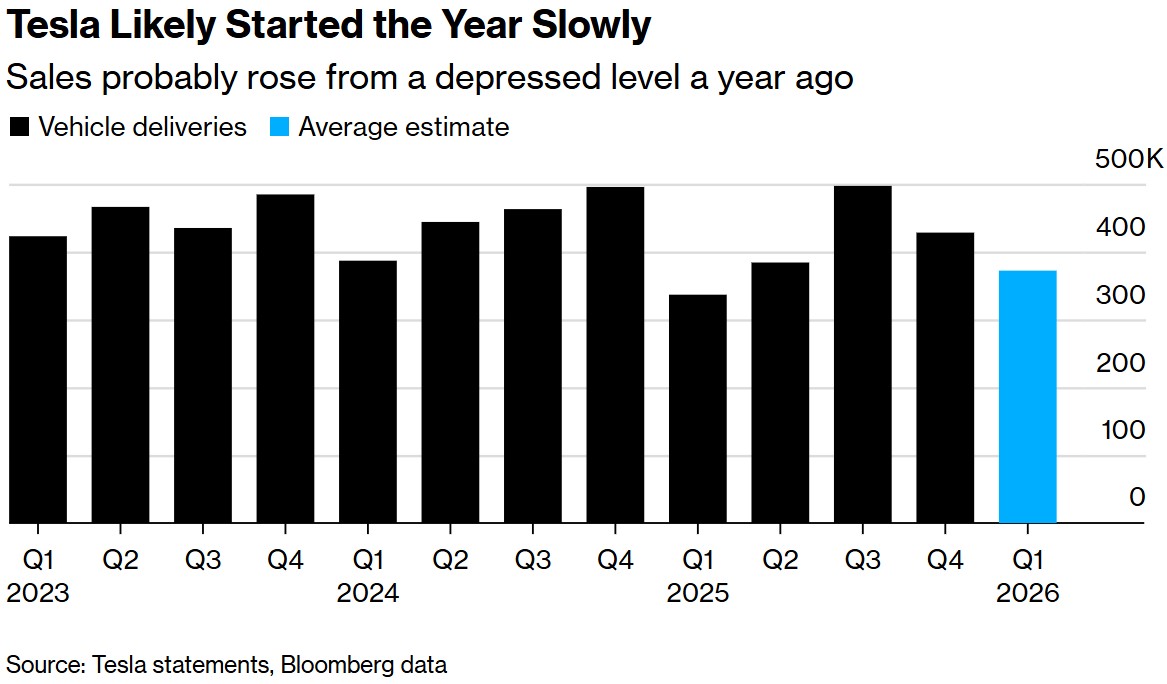
Tesla's delivery start this year may be relatively slow.
Tesla is also gradually phasing out the low-volume luxury electric models, the Model S and Model X, further narrowing its aging product line, while facing an increasing number of global competitors.
Gene Munster, managing partner at Deepwater Asset Management, stated, "If they can prove that data remains stable without tax credits—at least in terms of delivery volumes they can achieve that—I think that would be a win."
Munster pointed out that investors will focus on the data during this period to gauge how demand is performing without these tax incentives.
At the beginning of this year, Tesla's sales in Europe have stabilized, although still at low levels. In the Chinese market, its start has seen significant improvement, with preliminary data from the China Passenger Car Association (CPCA) showing a 91% surge in exports from its Shanghai factory in February.
Enthusiasm for Musk's future business plans had driven Tesla's stock price to a historic high in December, which then retraced some gains at the beginning of this year.
Investors are increasingly inclined to overlook car sales data, prioritizing signs of progress in Tesla's autonomous taxi (Robotaxi), Cybercab, and Optimus robot projects instead. As long as the electric vehicle business can maintain stability or moderate growth, it is beneficial enough to support Musk's growing ambitions in artificial intelligence.
Garrett Nelson, senior vice president of equity research at CFRA, stated that he is watching whether the company can deliver on those ambitious products and timelines. He is also observing Tesla's plans to increase capital expenditures "The focus is not on delivery volume, but on a more macro level, such as the release of Terafab and the 'spending frenzy' that Tesla is currently undergoing," Nielsen said. "Concerns about this explosive growth in spending are indeed affecting market sentiment towards the company."
