


UBS: Fiber Optic Price Surge Has Spread Globally
China's G652.D bare fiber spot prices have surged over 400% since May 2025, surpassing previous cycle highs for the first time. Simultaneously, similar products in the European market have seen a 136% month-on-month increase from January, with the US market also strengthening, indicating a tightening global supply. UBS believes that leading Chinese fiber optic cable manufacturer YOFC's profitability has entered an upward revision cycle, with the core issues now being the sustainability of the price rebound and the extent to which spot price increases can be passed on to the company's profits
Global fiber optic prices are experiencing a new wave of sharp increases, with the rally spreading from the Chinese market to Europe and the US. Surging data center demand and tightening upstream preform supply are driving this price cycle, significantly improving the earnings outlook for industry leader YOFC.
According to the Wind trading desk, UBS's latest research report, citing the latest data from industry research firm CRU, shows that China's G652.D bare fiber spot price reached RMB 83.40 per fiber kilometer (approximately USD 12.07) in March 2026, a sharp 165% increase month-on-month from January and a staggering 418% year-on-year surge. This price represents a cumulative increase of over 400% since May 2025, surpassing the previous cycle high of RMB 78.80 per fiber kilometer for the first time. Meanwhile, prices for similar products in the European market also rose 136% month-on-month from January, with the global supply tightening trend becoming increasingly apparent.
UBS analysts Jasmine Huang and Sara Wang believe that YOFC's profitability has entered an upward revision cycle, and they have significantly raised the company's earnings forecasts for 2026 to 2028, projecting earnings per share to reach RMB 4.98 in 2026, far exceeding the market consensus expectation of RMB 1.85.
China's Fiber Optic Prices Hit Record Highs, Surpassing Previous Cycle Rally
According to CRU's bi-monthly report, China's G652.D bare fiber spot price recorded RMB 83.40 per fiber kilometer in March 2026, a year-on-year increase of 418% and a month-on-month increase of 165% (from January 2026). This marks a further acceleration from the 92% year-on-year and 79% month-on-month increases reported in January 2026.
This price level signifies that China's G652.D bare fiber has seen a cumulative increase of over 400% since May 2025, surpassing the previous cycle high of RMB 78.80 per fiber kilometer for the first time and setting a new historical record.
Notably, since January 2026, the price of China's G652.D bare fiber has exceeded that of comparable products in Europe. According to UBS reports, the last time this occurred was in November 2018, when the massive deployment of FTTH in China and the construction of 4G networks jointly drove explosive growth in fiber optic cable consumption.
Price Rally Spreads to Europe and US, G657.A1 Fiber Also Strengthens
The increase in fiber optic prices is no longer confined to the Chinese market. CRU data shows that the price of European G652.D bare fiber reached EUR 7.94 per fiber kilometer (approximately USD 9.1) in March 2026, a 136% month-on-month increase from January and a 159% year-on-year increase, indicating that supply tightening effects are spreading globally.
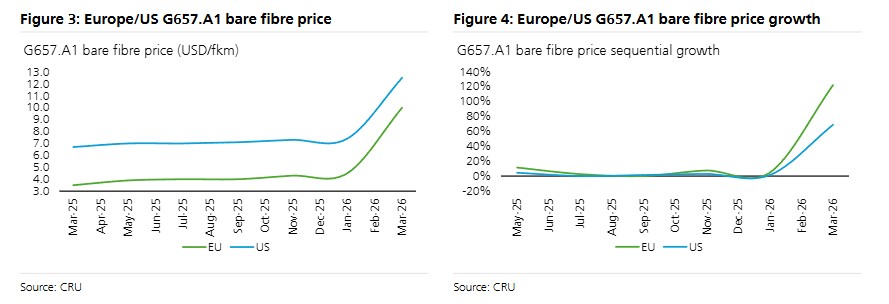
The price of G657.A1 bare fiber, used in indoor and bend-insensitive scenarios, has also climbed significantly.
CRU data indicates that European and US G657.A1 bare fiber prices saw month-on-month increases of 130% and 69% respectively from January 2026, primarily supported by strong data communications demand and tightening supply.
Demand Structure Divergence: Data Centers Take Over from Telecom Operators
On the demand side, China and overseas markets exhibit different structural characteristics.
CRU data shows that China's optical cable consumption volume remained flat year-on-year in the first quarter of 2026. While demand from telecom operators remained weak, growth in data center demand offset this drag. Fiber optic manufacturers are reallocating production capacity to emerging application areas such as data centers and fiber optic drones, leading to continued tightening of upstream preform supply, while the overall industry expansion pace remains relatively restrained.
In overseas markets, demand in YOFC's core overseas markets (Europe, Southeast Asia, Latin America) increased by 2% year-on-year in the first quarter of 2026, continuing the 2% growth momentum seen throughout 2025, consistent with UBS's previous assessment of overseas demand recovery. The US market performed particularly strongly, with demand increasing by 24% year-on-year and 29% month-on-month in the first quarter of 2026, driven by both telecom network construction and the expansion of hyperscale data centers.
Earnings Forecasts Significantly Raised, Valuation Remains Attractive
UBS believes that the sharp increase in fiber optic spot prices aligns with its channel research findings. YOFC's profitability has entered an upward revision cycle, with increased visibility of rising fiber optic prices and product mix upgrades providing continued support.
Regarding earnings forecasts, UBS projects YOFC's revenue to grow from RMB 21.062 billion to RMB 33.742 billion between 2026 and 2030, and net profit to increase from RMB 4.122 billion to RMB 8.526 billion. EBIT margins are expected to rise significantly from 11.4% in 2025 to 24.3% in 2026, further expanding to 32.9% in 2027.
Currently, YOFC's stock price trades at approximately 19 times its 2027 estimated earnings. UBS points out that the core issues investors are currently focusing on are the sustainability of the price rebound and the extent to which spot price increases can be passed on to the company's profits.
