


Computing Power Crisis! SemiAnalysis In-depth Analysis: From GPUs to Memory to Fiber Optics, the AI Supply Chain is Strained Across the Board with Prices Rising in Tandem
SemiAnalysis points out that exploding demand is driving a computing power shortage, with prices for memory, GPUs, and AI servers soaring while supply remains virtually unavailable. The annual rental price for H100 GPUs has surged 40% within five months. The firm believes GPU rental prices will likely continue to rise in the short term. Neoclouds are beginning to gain pricing leverage, but the stock prices of related companies like CoreWeave and IREN have yet to reflect this change
AI computing power demand's explosive growth is pushing the entire supply chain to its limits. From GPU rentals to DRAM memory, from fiber optic cables to data center hosting, prices have surged across the board in just a few months, while supply is virtually nowhere to be found.
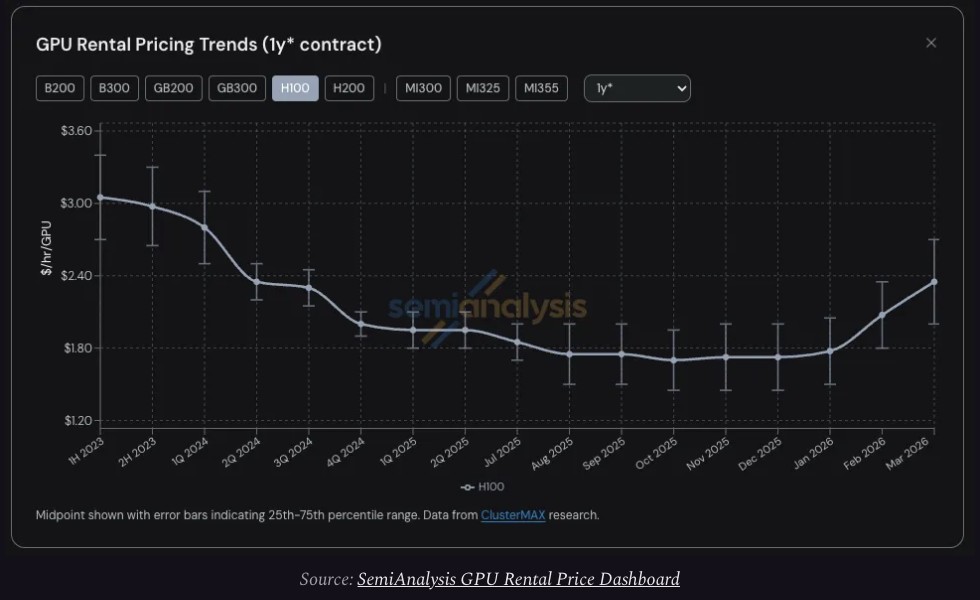
According to the latest report from research firm SemiAnalysis, the price for one-year lease contracts for H100 GPUs has sharply increased from a low of $1.70 per GPU per hour in October 2025 to $2.35 in March 2026, an increase of nearly 40%. Meanwhile, on-demand computing power is completely sold out across all GPU models.
The core driver of this computing power shortage is a structural leap in demand. Anthropic's Annual Recurring Revenue (ARR) skyrocketed from $9 billion to over $25 billion in a single quarter, with multi-agent workloads like Claude Code driving a parabolic increase in computing power consumption.
SemiAnalysis believes that GPU rental prices are likely to continue rising in the short term. Neoclouds are beginning to gain pricing power, but the stock prices of related companies such as CoreWeave, Nebius, and IREN have not reflected this change.
Demand Side: Multiple Outbreaks, Computing Power Consumption Shows Parabolic Growth
The demand-side momentum for the current computing power shortage comes from several overlapping directions.
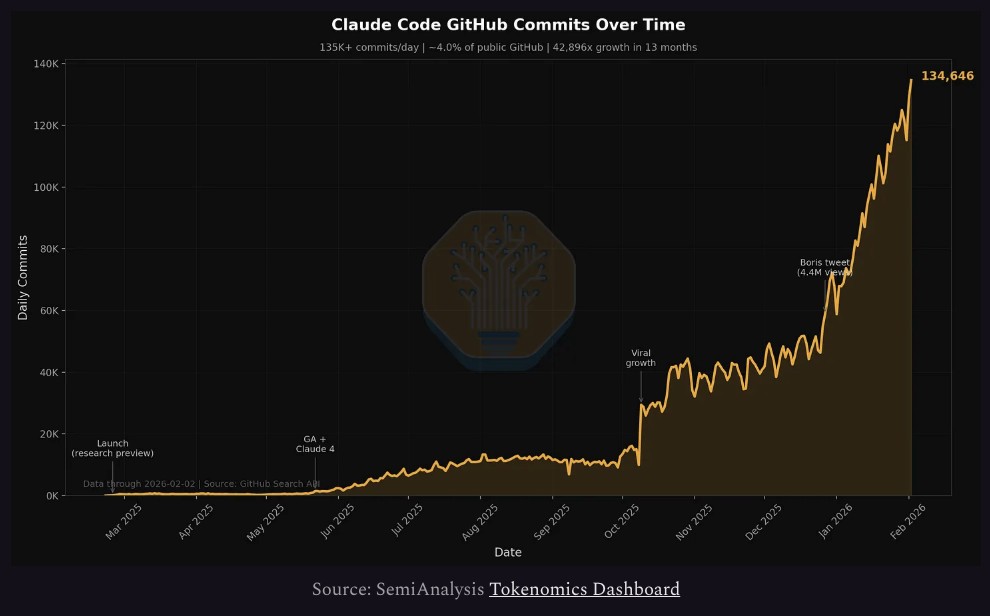
The outbreak of Claude Code is the most significant inflection point. Anthropic's ARR has tripled in one quarter, surging from $9 billion to over $25 billion. The popularity of open-source models like GLM and Kimi K2.5 has further scaled inference workloads.
Concurrently, the massive financing rounds for AI labs like Anthropic and OpenAI have directly created GPU demand.
AI agents are another important driver. These workloads execute multi-step workflows in a high-concurrency manner, continuously iterating and leading to a parabolic rise in computing power consumption.
The native media generation platforms Seedance and Nano Banana are driving massive computing power demand in image and video generation scenarios.
From an economic perspective, this demand exhibits significant price inelasticity. SemiAnalysis points out that if the return on investment for AI tools reaches 5 to 10 times, there is still considerable room for GPU rental prices to rise before demand is inhibited.
"The demand curve has shifted to the upper right, providing a strong and relatively inelastic force driving up GPU rental prices."
Supply Side: Memory Prices Soar, Server Procurement Descends into Chaos
The surge in demand is only one side of the computing power shortage; the soaring prices on the supply side are the other.
January 2026 became another key inflection point, marking an acceleration in price increases for DRAM and NAND memory. According to SemiAnalysis's memory model estimates, contract prices for LPDDR5 and DDR5 are trending towards year-over-year increases of approximately 4x and 5x, respectively, in the first quarter of 2026.
The sharp rise in memory prices quickly translated to the server system level. Original Equipment Manufacturers (OEMs) repriced AI servers, but their price increases significantly exceeded the actual rise in component costs.
Higher server procurement costs have compressed expected project returns, forcing some operators to slow down or even shelve new deployment plans. In other words, supply that would have entered the market is being delayed, further tightening the rental market.
The supply situation for Blackwell's new generation GPUs is also not optimistic. According to SemiAnalysis's understanding, the delivery timelines for new Blackwell clusters have now extended to June-July 2026, primarily driven by strong demand for open-source weight models and the ongoing shortage of inference computing power.
Market Structure: Neocloud Gains Pricing Power, Contract Terms Fully Tightened
The power dynamics in the GPU rental market have fundamentally shifted within six months.
Prior to the second half of 2025, the market was highly competitive, with multiple Neoclouds vying to lower prices to ensure asset utilization.
Now, Neoclouds and hyperscale cloud providers have gained complete control—they can not only secure higher upfront payment percentages, better pricing, and longer contract terms but also flexibly arrange contract start and end dates based on their inventory.
The GPU rental market can be divided into three main tiers:
Short-term rentals (on-demand, spot, and contracts under 3 months): Typically remaining capacity, which is now completely sold out. Holders are unwilling to return capacity to the market even with significant price increases.
Medium-term contracts (3 months to over 3 years): The most active segment of the market. One-year contracts capture marginal demand from non-AI lab customers and are the most sensitive indicator of market tightness.
Long-term bulk agreements (4 to 5 years): Primarily led by large AI labs, with transaction sizes typically reaching 50 to 100 megawatts or more, equivalent to approximately 24,000 to 48,000 GB300 NVL72 GPUs.
These types of transactions are highly attractive to Neoclouds—they can arrange favorable debt financing, lock in double-digit Internal Rates of Return (IRR), and hedge against GPU price risks through long-term contracts. Hyperscale cloud providers sometimes act as guarantors in such transactions, further reducing financing costs.
Price Outlook: Self-Reinforcing Spiral, Yet Neocloud Valuations Are Undervalued
SemiAnalysis believes that the probability of GPU rental prices continuing to rise in the short term is much higher than the probability of them falling.
Current dynamics have clear self-reinforcing characteristics: tight supply drives up prices, higher prices prompt Neoclouds to accelerate hardware lock-ins, further tightening supply, which in turn pushes prices up again.
SemiAnalysis likens this to the GPU shortage cycle of 2023-2024 but believes the server market is now mature enough that OEMs' room for excess profit may be limited.
The rise in rental prices has a dual impact on Neocloud's financials: on one hand, the profit margins of deployed capital expand, improving the Return on Invested Capital (ROIC); on the other hand, higher rental prices extend the economic lifespan of existing GPUs, allowing existing assets to generate cash flow for a longer period before needing reinvestment.
In the current environment, SemiAnalysis believes the Neoclouds that benefit most clearly have the following characteristics: shorter contract durations (allowing for faster repricing), a large stock of H100s, and recent new capacity coming online.
However, there is a significant divergence between this fundamental improvement and public market sentiment. The stock prices of listed Neoclouds such as CoreWeave, Nebius, and IREN remain at the lower end of their trading ranges over the past 6 to 12 months.
SemiAnalysis points out that the market is still dominated by the narrative of "eventual oversupply and commoditization" and has not yet fully factored in the persistent scarcity and pricing power clearly visible on the ground.
Three Key Indicators: Critical Variables Determining Price Trends
SemiAnalysis has identified three core indicators to assess whether GPU rental prices can remain high.
First, the pace of GB300 cluster ramp-up. Whether new computing power capacity can alleviate the current shortage, or if the growth rate of computing power consumption will continue to outpace new supply—this will determine the extent to which AI labs participate in the sub-4-year contract market, thereby influencing pricing trends in that segment.
Second, the worsening degree of silicon shortages. SemiAnalysis has previously reported on the tight supply of logic wafers for TSMC's N3 process, as well as HBM, DRAM, and NAND memory. The complex manufacturing processes mean execution risks exist at any time.
Third, the growth trajectory of AI labs' ARR. The speed of user adoption and the sustained increase in token consumption are the fundamental variables determining the slope of the overall demand curve.
Overall, SemiAnalysis's conclusion is clear: until there is a clear shift in these three indicators, the direction of computing power prices is only one way—upward.
