


60% Surge in Gas Prices and Lowered Growth Forecasts: Is Nuclear Restart Germany’s Last “Lifeline”?
The turmoil in the Middle East has exacerbated Germany's energy crisis, with a 60% surge in gas prices leading to German electricity prices reaching four times those of France. Impacted by this, the German government has lowered its 2026 economic growth forecast to 0.6%. The Minister of Economic Affairs and Chancellor Merz have publicly reflected on the nuclear phase-out policy, characterizing it as a strategic mistake, and have turned to support new nuclear technologies and research in an attempt to escape over-reliance on natural gas and reshape national energy security
Germany's energy predicament is worsening at a visible rate. As ongoing turmoil in the Middle East drives another sharp rise in European gas prices, Germany's Minister of Economic Affairs has publicly called for a re-examination of the country's decades-long stance against nuclear power, admitting that there are no other choices for baseload energy supply.
German Economic Minister Katherina Reiche stated that the nuclear phase-out policy pursued by successive governments has caused Germany to lose all reliable baseload electricity alternatives, leaving natural gas as the only remaining option.
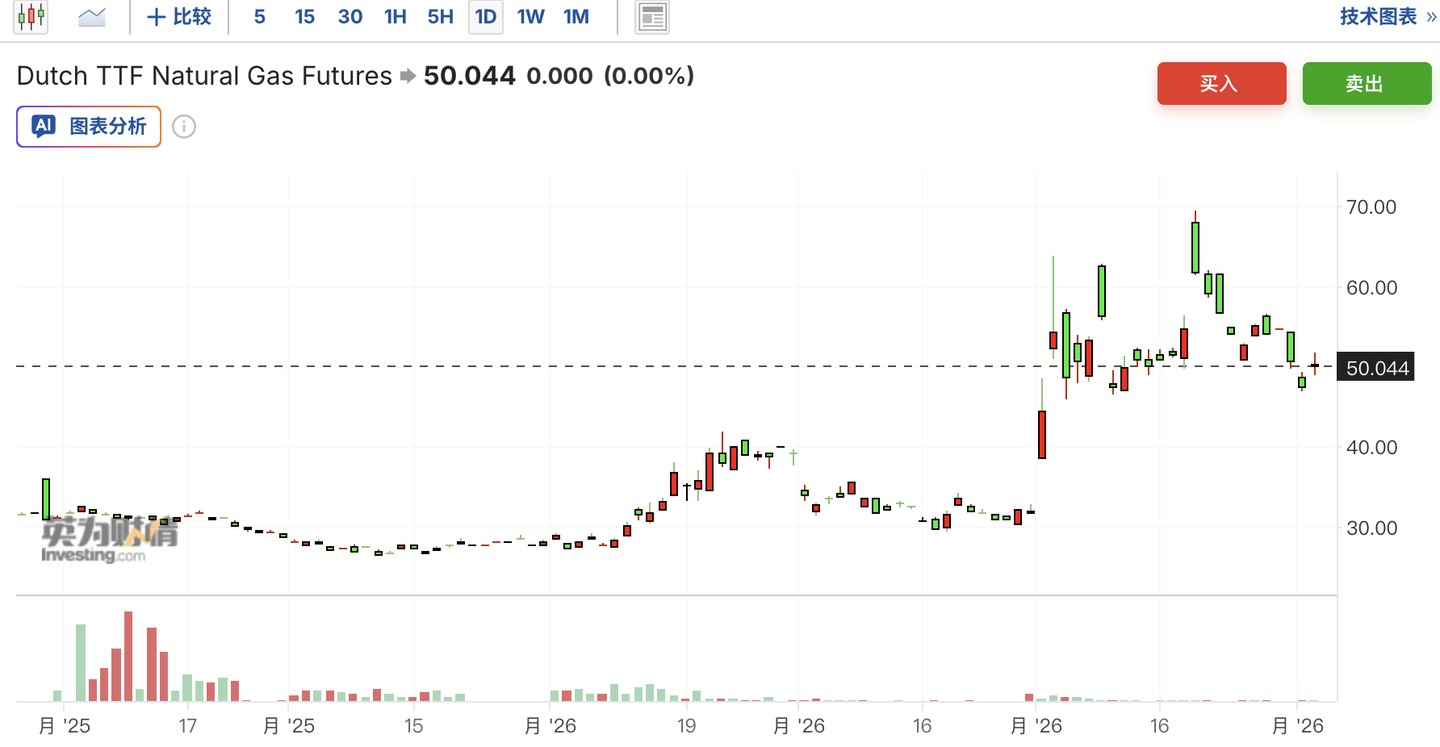
Since the outbreak of the US-Iran conflict, European natural gas prices have risen by over 60% cumulatively; Germany's electricity futures for May are four times those of France.
A consortium of Germany's leading economic research institutes issued a warning this Wednesday that the current energy shock will erase more than half of the previously projected GDP growth for 2026. The latest forecast has lowered the 2026 growth rate to 0.6%, far below the 1.3% predicted last September; the 2027 growth forecast is also only 0.9%.
Chancellor Friedrich Merz has characterized the nuclear phase-out policy as a "major strategic mistake" and has pledged to end Germany's previous opposition to nuclear energy at the EU level.
Gas Prices Surge 60%, German Electricity Prices Four Times Higher Than France's
The trigger for the current energy crisis is market volatility following the outbreak of the Middle East conflict. Since the conflict began, European natural gas prices have risen by over 60% cumulatively, marking the second major energy price crisis in Europe in less than five years.
The pressure on Germany's electricity market is particularly acute. According to data from the energy exchange EEX, Germany's electricity futures prices for May are four times those of France, Europe's largest nuclear power producer. This price gap vividly illustrates the massive divergence in costs between the two energy strategic choices.
The pain of high energy prices has penetrated deep into the fabric of the German economy.
Official statistics show that in the second half of 2025, natural gas prices for German private households were 79% higher than 2021 levels, while electricity prices rose by 23%. For energy-intensive industries already under pressure, the cost shock has further squeezed profit margins.
Aftermath of Nuclear Phase-out: Reliance on Liquefied Natural Gas Imports
Germany's current energy vulnerability is rooted in a policy transition that has spanned over a decade. In 2011, then-Chancellor Merkel decided to initiate the nuclear phase-out following the Fukushima nuclear accident, a policy that was ultimately completed during the term of former Chancellor Scholz.
The nuclear phase-out policy was accompanied by a large-scale push for renewable energy. However, when wind is insufficient and sunlight is scarce, gas-fired power plants become the last line of defense for maintaining grid stability, causing Germany's reliance on natural gas to continue climbing.
After the Russia-Ukraine conflict, pipeline natural gas supplies were abruptly cut off, completely exposing the vulnerability of Germany's energy strategy. Berlin was forced to quickly pivot to importing liquefied natural gas, a large portion of which comes from the United States; US natural gas now accounts for about 10% of Germany's total supply, and energy costs have remained persistently high since then.
Reiche admitted that natural gas is now Germany's "only remaining source of baseload supply." In her view, this structural predicament is the fundamental reason for calling for a reassessment of the stance on nuclear energy.
Economic Growth Forecasts Repeatedly Lowered, Industry Under Pressure
The energy shock is directly eroding Germany's growth prospects. A consortium of Germany's leading economic research institutes issued a warning this Wednesday that the current energy shock will erase more than half of the previously projected GDP growth for 2026.
The latest forecast has lowered the 2026 growth rate to 0.6%, far below the 1.3% predicted last September; the 2027 growth forecast is also only 0.9%.
These figures make the German government's recovery narrative increasingly difficult. Although Berlin has launched a ten-year infrastructure and defense spending plan worth up to 1 trillion euros—the largest fiscal expansion since German reunification—growth momentum remains weak.
Reiche acknowledged that energy-intensive industries are under significant pressure, but emphasized that Germany currently faces no risk of supply shortages.
Re-embracing Nuclear Energy: From Opposition to "Back on the Table"
A subtle but noteworthy shift is occurring in Germany's policy stance.
Chancellor Friedrich Merz has long characterized the nuclear phase-out policy as a "major strategic mistake." While the German government currently explicitly rules out the possibility of restarting closed traditional reactors, it has pivoted to supporting research in small modular reactors (SMRs) and nuclear fusion.
Merz also pledged to end Germany's previous opposition to nuclear energy at the EU level.
In an interview with the Financial Times, Reiche urged Germany not to remain sidelined in the process of Europe's nuclear renaissance. She pointed out that France, Sweden, and Poland are all building new reactors or extending the service life of existing units to leverage the advantages of nuclear energy in terms of low-carbon, dispatchable electricity.
"You can decide not to be interested, and then continue to use gas and become increasingly dependent on a single energy source; or, you can become interested in technology again."
