


Meta's Company-Wide Race: Who Uses the Most Tokens?
A leaderboard called "Claudeonomics" has emerged within Meta, tracking the AI token consumption of over 85,000 employees. In the past 30 days, the total usage exceeded 60 trillion tokens, estimated at approximately $900 million based on public pricing. The top individual user consumed 281 billion tokens. However, some question whether token consumption truly equates to productivity and what its significance is
Within Meta, burning the most AI computing power is becoming a new status symbol.
On April 6, The Information reported that an internal AI usage leaderboard called "Claudeonomics" has appeared at Meta Platforms. This list, voluntarily built by employees on the company's internal network, tracks the AI token consumption of over 85,000 employees and ranks the top 250 "power users." Employees high on the leaderboard can receive titles such as "Session Immortal" and "Token Legend."
The leaderboard's name, "Claudeonomics," is derived from Claude, the flagship product of AI startup Anthropic. According to a copy of the leaderboard obtained by media outlets, the total token usage recorded on this list exceeded 60 trillion in the past 30 days. The top individual user consumed an average of 281 billion tokens – a usage that could cost millions of dollars depending on the model type.
Based on Anthropic's latest public pricing, the average cost for input and output tokens for its Claude Opus 4.6 model is approximately $15 per million tokens. By this estimate, 60 trillion tokens would correspond to a cost of about $900 million. However, it is currently unclear which models Meta actually uses or at what prices they procure them.
"Burning Tokens" Becomes a New Metric for Productivity
This phenomenon reflects the burgeoning "tokenmaxxing" culture in Silicon Valley – using token consumption as a benchmark for productivity and a competitive metric to determine if an employee is "AI-native."
Tech executives are endorsing this trend.
Nvidia CEO Jensen Huang stated last month that he would be "very concerned" if an engineer earning $500,000 annually spent less than $250,000 on AI tokens each year.
Meta CTO Andrew Bosworth said at a tech conference in February that, according to Forbes, a top engineer who spent an amount equivalent to their salary on AI tokens saw a productivity increase of up to 10 times. Bosworth stated directly: "It's a no-brainer, keep doing it, there is no upper limit."
Andrej Karpathy, a former top AI scientist at Tesla and OpenAI, now heading an AI education startup, also said on a podcast last month: "The name of the game is tokens. What is your token throughput? How many tokens can you move?"
How the Leaderboard Works
Employees can track their personal consumption, compare it horizontally with colleagues, and receive gamified rewards – from bronze, silver, gold, platinum, to emerald badges, as well as achievement titles like "Model Connoisseur" and "Cache Wizard."
According to two current employees, some employees, in order to climb the leaderboard, let AI agents run continuously for hours to perform research tasks, maximizing token consumption.
Meta also maintains a separate token usage dashboard for software engineers, and employees in other roles can view their usage. Notably, according to an insider, neither Zuckerberg nor Bosworth themselves appeared on the top 250 power user leaderboard.
In terms of tools, Meta employees use models from Anthropic, OpenAI, and Google, as well as internally developed tools, including Meta's version of OpenClaw (internally known as MyClaw) and Manus, recently acquired by Meta.
A Meta spokesperson said: "As is well known, this is a company priority, and we are focused on leveraging AI to help employees with their day-to-day work."
Doubts: Does Consumption Equal Productivity?
This competition is not without controversy.
Joe Weisenthal, a media personality at Bloomberg, directly questioned on X: "What is the point of measuring productivity by total token consumption?"
He further mocked: "It really gives off a 'real backyard steel furnaces' vibe." This implies that this fervor, which only pursues numerical metrics while ignoring actual quality, is akin to wasteful resource expenditure without regard for cost.
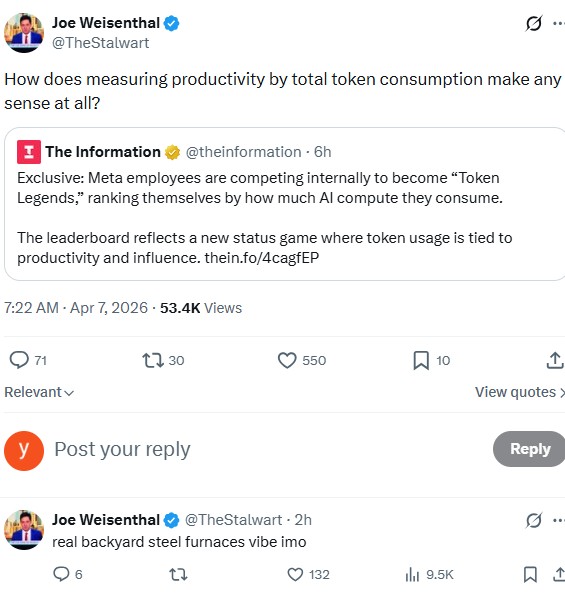
This doubt points to a core issue: token consumption is an input metric, not an output metric. Just as measuring employee work efficiency by the number of pages printed, burning more tokens does not necessarily mean more results. The behavior of some employees letting AI agents "idle" for hours to top the leaderboard precisely illustrates that this metric is susceptible to "data gaming."
In response, renowned tech analyst Noah Brier offered a different perspective: "I don't think it makes sense, but when you're trying to turn a massive organization like Meta, sometimes you have to purposely overcorrect."
However, Weisenthal immediately followed up with: "Even so, what exactly are they trying to reverse, the employees' work habits or the company's money-making model?"
From a market perspective, however, this phenomenon itself sends a clear signal: enterprise-level AI consumption is expanding at a speed far exceeding expectations. For Meta alone, monthly estimated AI computing expenditure could be close to the $900 million mark, which means continuous growth in demand for cloud computing and AI infrastructure providers.
