Replacing Gas Turbines: Are Gas Generator Sets the Top Choice for AI Power?
HSBC believes that natural gas generator sets, with their advantages of short lead times, fast start-up, and high flexibility, are rapidly replacing gas turbines as the preferred transitional primary power source for AI data centers. Orders for leading manufacturers are fully booked through the end of 2027, with supply constraints expected to persist into 2027–2028 and equipment prices projected to rise by 10% to 15% annually during this period
The demand for power generation equipment from AI data centers is reshaping the entire market landscape. A recent research report from HSBC points out that natural gas generator sets are rapidly replacing gas turbines as the preferred transitional primary power source for AI data centers, and the supply-demand imbalance is unlikely to be alleviated in the short term.
According to Zhuifeng Trading Desk, HSBC recently released a report stating that due to the surge in demand driven by AI, orders for leading natural gas generator set manufacturers are fully booked through the end of 2027, and equipment prices have already risen by 15% to 20% in 2025. The tight supply situation is expected to continue through 2027–2028, with equipment prices still projected to rise by 10% to 15% annually during this period.
Natural Gas Generator Sets: Why They Are the New Favorite for AI Data Centers
The rise of natural gas generator sets in the AI data center primary power market stems from their significant advantages in three areas: delivery cycles, start-up performance, and flexibility.
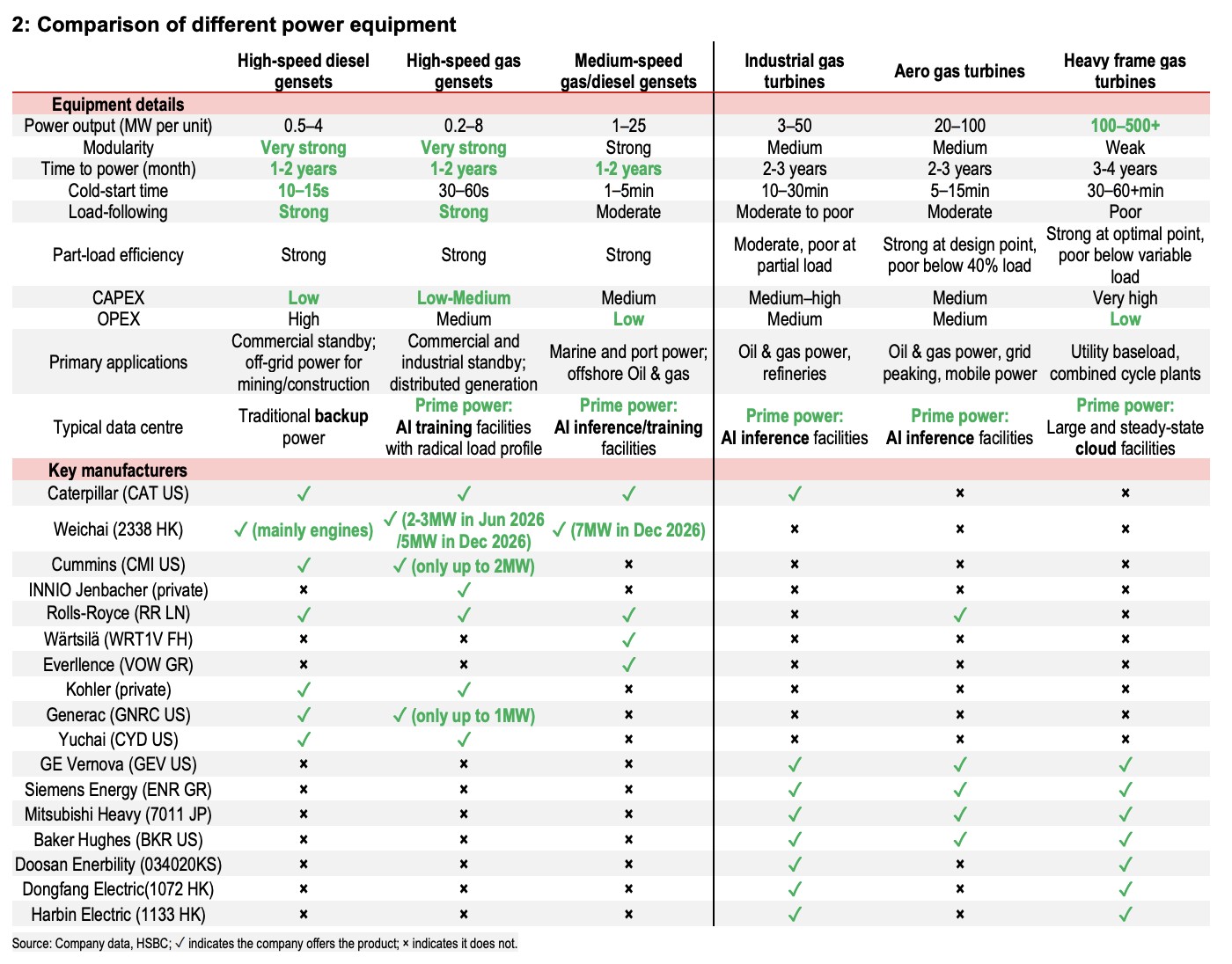
Firstly, the delivery cycle for natural gas generator sets is 1 to 2 years, which is significantly shorter than the 2 to 4 years required for gas turbines, allowing for a faster match with the pace of data center expansion.
Secondly, in terms of cold start time, natural gas generator sets require only 30 to 60 seconds, which is much faster than the 5 to 60 minutes for gas turbines. This is crucial for AI training scenarios with aggressive load fluctuations.
Furthermore, the capacity of individual generator sets ranges from 2 to 8 megawatts, with a high degree of modularity that makes it easy to expand capacity as needed. They can also be flexibly repurposed as backup power once grid connections are completed (expected around 2030).
In contrast, although the capacity of a single large gas turbine can reach over 100 to 500 megawatts, their deployment cycles are long and flexibility is weak. They are more suitable for large cloud computing facilities with stable demand rather than AI training scenarios with aggressive load characteristics.

Supply-Demand Imbalance: Full Order Books and Continuously Rising Prices
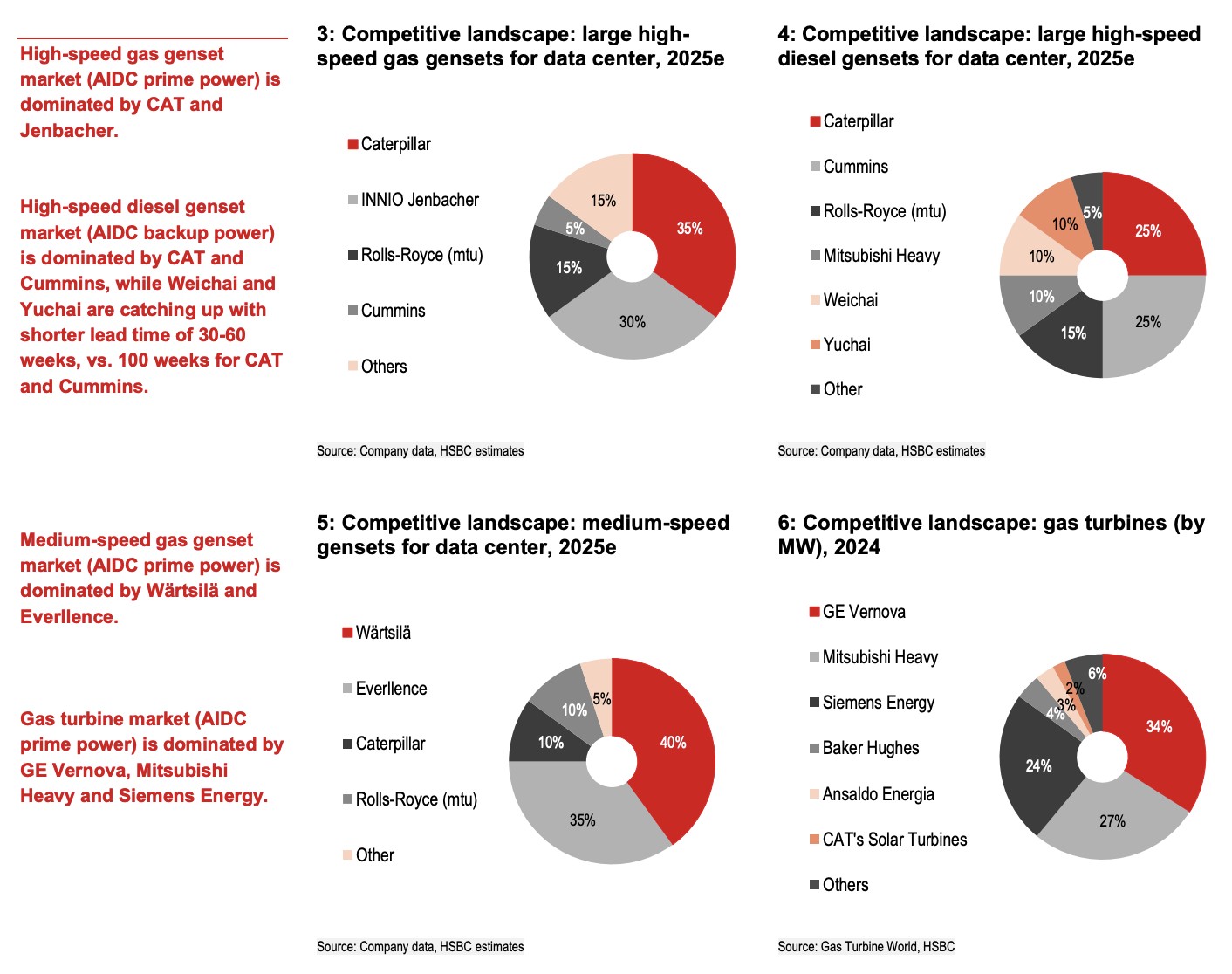
In the high-speed natural gas generator set sector, Caterpillar and INNIO Jenbacher together hold approximately 65% of the market share, and orders for both companies are fully booked through the end of 2027. The medium-speed generator set market is dominated by Wärtsilä and Everllence, with a combined market share of about 75%, and both are also operating at full capacity.
From a pricing perspective, the total capital expenditure for deploying natural gas generator sets in data centers is currently around $1,400 to $1,700 per kilowatt, with the bare unit itself costing about $600 to $1,000, auxiliary equipment about $200, and exhaust treatment about $100.
The bare unit price quotes from major manufacturers vary significantly: Caterpillar, CMI, and MTU (2 to 8 MW models) are approximately $600 to $650 per kilowatt; Jenbacher is approximately $750 to $800; and Wärtsilä and Everllence (20 to 25 MW models) are as high as $800 to $1,000.
The supply and demand for natural gas generator sets are expected to reach a rebalancing point around 2028–2029, at which time prices may see a significant correction. In comparison, the supply-demand inflection point for diesel generator sets is expected to arrive earlier, around 2027–2028.

Core Beneficiary Targets: Caterpillar and Weichai Power
HSBC emphasized two targets in its report, with different rationales for each.
Caterpillar is viewed by HSBC as an "indispensable" supplier in the construction of AI data centers.
The company's product line covers diesel generator sets, natural gas generator sets, and gas turbines, holding a strong market position. In the high-speed natural gas generator set market, Caterpillar ranks first with a market share of approximately 35%; it also holds a leading position in the diesel generator set market.
Weichai Power is seen as an opportunity for potential market share gains. Weichai possesses three main catalysts:
First, it has a shorter delivery cycle (30 to 60 weeks, compared to approximately 100 weeks for Caterpillar and Cummins); second, its natural gas generator set products are scheduled for launch in the second half of 2026, with 2–3 MW models expected in June 2026 and 5 MW and 7 MW medium-speed models expected in December 2026; third, the production capacity of its solid oxide fuel cell (SOFC) business continues to ramp up.