Staunch Bull Tom Lee: Ceasefire Means US Stocks Have "Established a Bottom," Poised for a "Decisive" Rebound

Wallstreetcn
2026.04.08 11:03

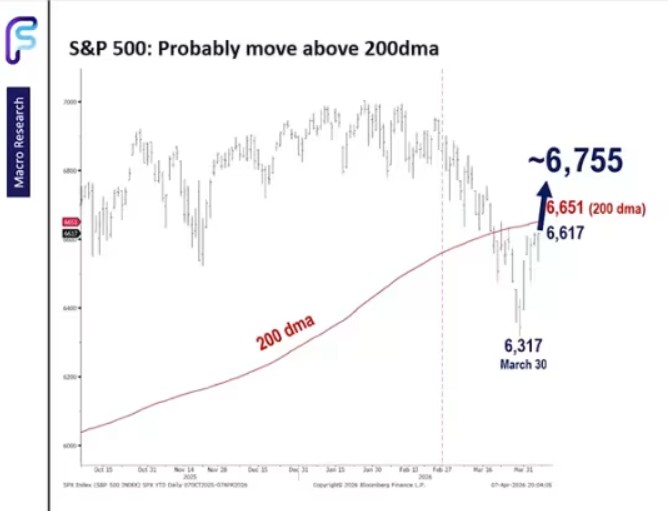
Tom Lee believes that the ceasefire agreement between the US and Iran has eliminated the possibility of large-scale bombing operations, indicating that the US stock market has "established a bottom." If the S&P 500 Index can regain its 200-day moving average, the market will likely see a "decisive upward breakthrough."

The announcement of a ceasefire agreement between the United States and Iran is reshaping market expectations for risk assets.

Wall Street's staunch bull, Tom Lee, co-founder and head of research at Fundstrat, stated on Thursday that the conclusion of the US-Iran ceasefire agreement has eliminated the possibility of large-scale bombing operations, signifying that the US stock market "has established a bottom."

In his daily macro briefing, he pointed out that if the S&P 500 Index can re-establish itself above its 200-day moving average, the market will likely experience a "decisive upward breakthrough."

As of now, E-mini S&P 500 futures continuous contracts have significantly surpassed this key technical level, with gains of nearly 2.5%, trading at 6820 points, well above the current 200-day moving average level of approximately 6617 points.

Buoyed by the ceasefire news, Tom Lee reiterated his optimistic stance on various risk assets, including the "Magnificent Seven" (Mag7) stocks.

Regarding energy and basic materials stocks, Tom Lee also holds a positive view, although he admits that these sectors might face some short-term pressure due to the significant drop in oil prices overnight.

Doubts Linger Over Ceasefire Durability, Market Divergence Emerges

Not all market observers share the same confidence in the sustainability of the ceasefire agreement. Tom Holland, Deputy Global Research Director at Hong Kong-based asset management and research firm Gavekal, expressed clear reservations in an investor report released on Wednesday.

His concerns primarily stem from the significant discrepancies between the statements made by the US and Iran following the ceasefire announcement. The 15-point peace plan proposed by the White House in March and the 10-point plan disclosed by the news agency affiliated with Iran's Supreme National Security Council exhibit clear differences in content.

Tom Holland is among the many observers questioning whether shipping traffic in the Strait of Hormuz can recover to pre-conflict levels in the short term. This uncertainty remains a potential risk that the market needs to continuously monitor.