After Predicting a "Bottom," JPMorgan's Trading Desk Shifts to "Tactically Long": Bullish on S&P 500 Breaking 7000
This shift is predicated on the assumption of Iran reopening the Strait of Hormuz and the renewal of the ceasefire agreement in two weeks. On this basis, improving market sentiment, a recovery in tech stock valuations, and extreme institutional bearish positioning constitute a triple engine driving the index upward, potentially triggering a risk asset re-rating similar to the one following the "reciprocal tariff" policy shift
JPMorgan's market intelligence team has announced a shift to a "tactically bullish" stance, forecasting the S&P 500 to break through the 7000-point mark, the rationale being Iran's reopening of the Strait of Hormuz and the prospect of a renewed ceasefire, which is expected to trigger a risk asset re-rating similar to the one following the "reciprocal tariff" policy shift.
Andrew Tyler, head of JPMorgan Chase's market intelligence, stated that the 7000-point level for the S&P 500 "feels within reach," and that improving market sentiment, a tactical pullback in tech stock valuations, and extremely bearish positions among institutions and CTAs collectively form a triple engine driving the index higher.
According to a previous Wall Street News article, on March 25th, JPMorgan's market intelligence department announced the end of its three-week "tactically bearish" U.S. stock strategy, shifting to a "neutral" position, and is exploring a return to bullishness on gold, demonstrating a relatively accurate grasp of the market bottom.
However, this optimistic judgment is not without its detractors. The head of Goldman Sachs' Delta One business holds an opposing view, believing this rally is more of a technical bounce from short covering rather than a trend worth chasing. He advises clients to reduce positions on strength during the rebound, warning that the market still faces potential risks of renewed escalation.
Core Assumptions Behind the Tactical Shift
This bullish pivot is built on two key prerequisites: first, Iran's reopening of the Strait of Hormuz, and second, the warring parties' ability to renew the ceasefire agreement within two weeks.
Andrew Tyler pointed out that if these conditions are met, the market will likely view the ceasefire as a de facto end to the conflict, even if economic damage in various regions continues to manifest. However, given that both sides have repeatedly violated the ceasefire agreement throughout the day, "this is a generous assumption."
Normalization of traffic through the Strait of Hormuz will have a direct impact on energy markets and inflation trends.
Recent oil prices may remain relatively high due to residual geopolitical risk premiums, but the negative transmission of energy shocks to inflation and consumption "will take time to reflect in the data." Investors are advised to closely monitor employment and consumption data.
Asset Allocation Roadmap: Weaker Dollar, Rising Stocks, Bearish on Energy
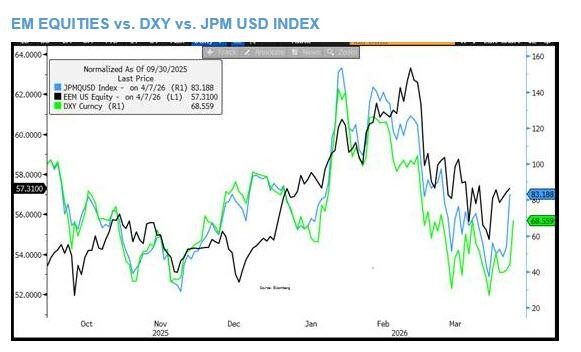
At the asset level, bond yields are expected to decline, oil and energy prices are projected to fall significantly, the dollar is expected to weaken, credit spreads are expected to narrow, and equities are expected to rise across the board.
Within equities, small-cap stocks are expected to lead gains, followed by the Nasdaq 100 and the S&P 500. Sector-wise, technology and cyclical stocks are prioritized, with the "Magnificent Seven" and semiconductor stocks seen as having "explosive upside" potential. Among cyclical stocks, the consumer sector has the most upside potential recently, especially discretionary consumer targets like homebuilders and retailers.
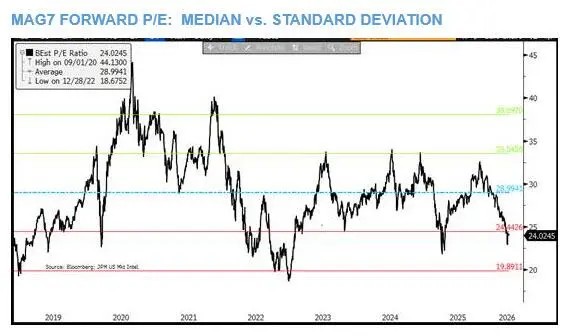
In terms of financial stocks, JPMorgan believes that if Trump facilitates an agreement or policy shift, coupled with an improving macro environment, strong earnings expectations, a bullish steepening of the yield curve, and low positioning levels, the sector could see a sustained rally for several weeks.
Precious metals are expected to benefit from dollar depreciation and stage a strong rebound, while mining stocks may also benefit from recent adjustments in metal tariff policies. Energy stocks are the core target for shorting. Geographically, a "broad-based rally" is expected, with the Asia-Pacific region leading, followed by Latin America, the EU, and the U.S., with emerging markets outperforming developed markets.
Extreme Institutional Bearishness as Fuel for a Rebound
The level of pessimism among institutional investors is comparable to April of last year, and this oversold condition itself provides technical support for a rebound.
Specific indicators show:
Net leverage for hedge funds has fallen 25 percentage points from its 12-month high, ranking among the largest historical declines;
Short selling by hedge funds in ETFs has reached approximately a 2-standard deviation level;
Retail investors have been net sellers of individual stocks on 7 out of the last 8 trading days, with social media sentiment indicators at the 3rd percentile over the past year;
Credit ETFs have seen outflows, while short-term Treasury ETFs have attracted inflows, with the combined effect reaching approximately -2 standard deviations;
The four-week change in the U.S. Tactical Position Monitor (TPM) fell to -2.9z on March 20th, before rebounding to -1.6z by the end of the month.
Historical data indicates that when the JPMorgan U.S. Tactical Position Monitor (TPM) four-week change touches -2.5 standard deviations or lower, the S&P 500 subsequently returns an average of +4.1% over four weeks and +8.2% over three months.
When hedge fund net leverage declines by more than 20 percentage points (end of December 2018, early May 2023, late October 2023, early April 2025), the market subsequently experiences a rebound.
However, it is important to note that the absolute level of the U.S. TPM remains higher than readings at historical bottoms; the absolute value of hedge fund net leverage is still at the 34th percentile of its 5-year history, higher than at several previous market bottoms; and concerns about recession and stagflation have not yet substantially heated up.
Earnings Season Provides Fundamental Support
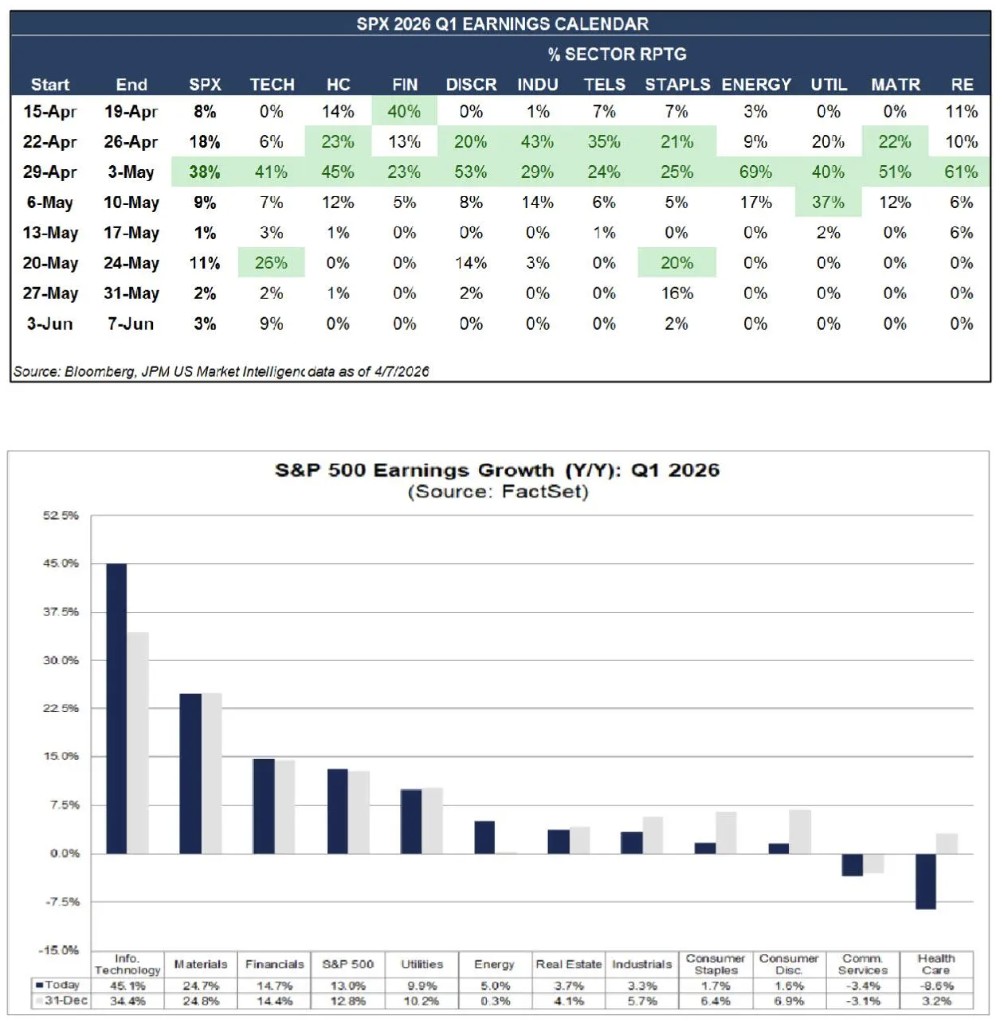
The team holds an optimistic outlook for the Q1 earnings season, believing it will further provide fundamental backing for stock market gains.
Forecasts for Q1 earnings reports indicate: revenue growth of 9.7% year-on-year, earnings growth of 13.0% year-on-year, and a net profit margin of 13.2%.
For reference, Q4 revenue grew by 9.4% year-on-year, and earnings grew by 13.9% year-on-year, marking the highest revenue growth since Q2 2022 and the fifth consecutive quarter of double-digit earnings growth, with net profit margins near the historical high of approximately 14%.
The target for the S&P 500 at the end of 2026 remains 7200 points, corresponding to earnings per share of $315; the earnings per share expectation for 2027 is $355.