


Is the Dollar Collapsing? Eight Key Indicators Reveal a Worrying Truth
U.S. federal debt exceeds $39 trillion, with interest expenses surpassing $1.2 trillion, coupled with the Federal Reserve's balance sheet expansion and renewed monetary easing. This dual fiscal and monetary pressure is intensifying. Concurrently, the 10-year Treasury yield is rising, money supply is expanding, and CPI controversies are growing, while gold reaches historical highs. These eight core indicators collectively point to a single trend: debt-driven growth and excessive money printing are continuously eroding the dollar's purchasing power, presenting a systemic challenge to the U.S. dollar system
U.S. federal debt has surpassed $39 trillion, annual interest expenses exceed $1.2 trillion, and the Federal Reserve's balance sheet has restarted its expansion – multiple key indicators are simultaneously sounding alarms, indicating that the dollar's purchasing power is facing systemic pressure.
From fiscal deficits to money supply, from Treasury yields to gold prices, eight core indicators all point in the same direction: more debt, more money printing, and a continuous erosion of the dollar's purchasing power. This trend poses a long-term challenge for investors holding dollar-denominated assets.
The Federal Reserve recently announced the end of its balance sheet reduction and the restart of its expansion, while shifting towards easing even though inflation is not fully under control. Meanwhile, gold prices have hit record highs, seen as a direct reflection of market confidence wavering in the fiat currency system.
Fiscal Deficit Continues to Worsen
The trajectory of the U.S. federal budget deficit is concerning.
Even under the optimistic assumption of "no wars and no recession in the next ten years," the U.S. government is projected to accumulate over $22 trillion in new deficits, all of which will need to be financed through debt issuance.
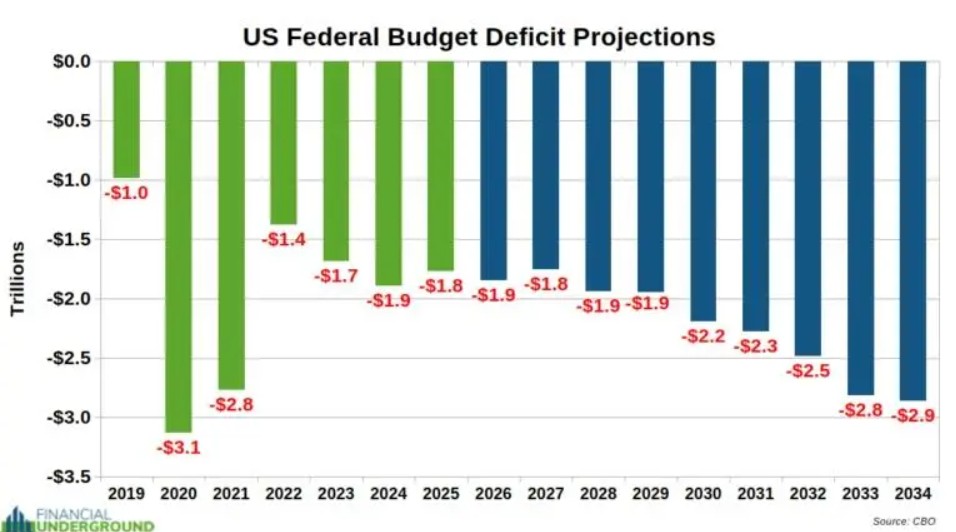
However, this assumption is already difficult to sustain. Reports indicate that the Pentagon has requested an additional $200 billion in appropriations for military operations related to Iran, and this is just the beginning of potential supplemental expenditures.
Debt Exceeds GDP, Economy Overburdened
The total federal debt has now exceeded $39 trillion, representing over 124% of GDP.
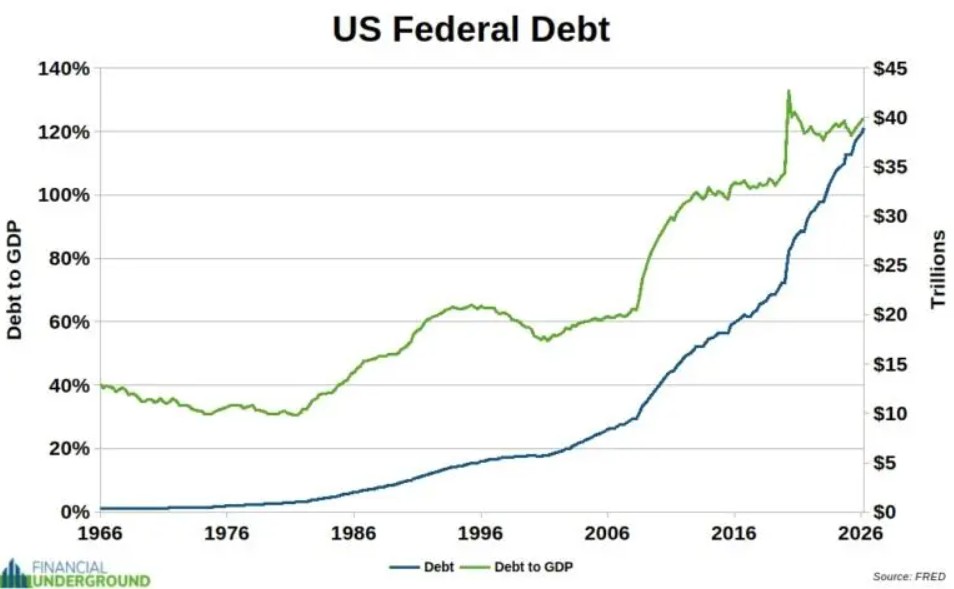
It is noteworthy that GDP statistics themselves count government spending as a positive contribution, and government spending accounts for at least 37% of U.S. GDP. If this factor were excluded, the actual debt-to-productive economy ratio would be significantly higher than what the official data suggests.
Interest Expenses Nearing Social Security, Becoming Largest Fiscal Burden
Annualized interest expenses on the federal debt have surpassed $1.2 trillion, accounting for over 23% of federal tax revenue, and are rapidly climbing.
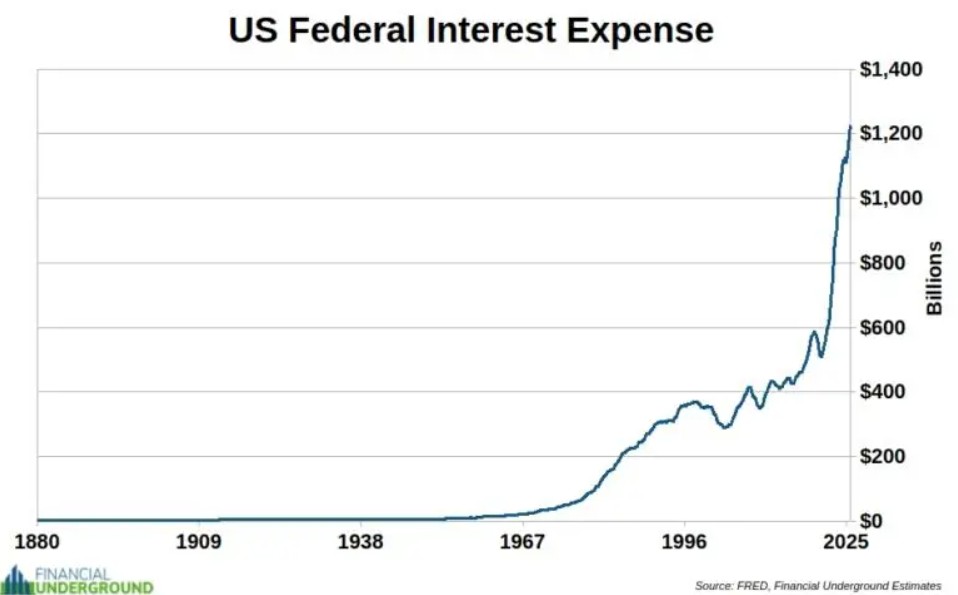
Currently, debt interest is the second-largest expenditure item for the U.S. government and is expected to surpass Social Security payments within months, becoming the largest single federal expenditure.
This dynamic forms a self-reinforcing cycle: rising interest expenses force the government to issue more debt, and the expanding debt size further increases the interest burden, thereby continuously shrinking fiscal space.
Federal Funds Rate and 10-Year Treasury Yield
Central banks, represented by the Federal Reserve, attempting to set interest rates is a behavior akin to a planned economy, which is difficult to sustain long-term and can lead to distortions and losses.
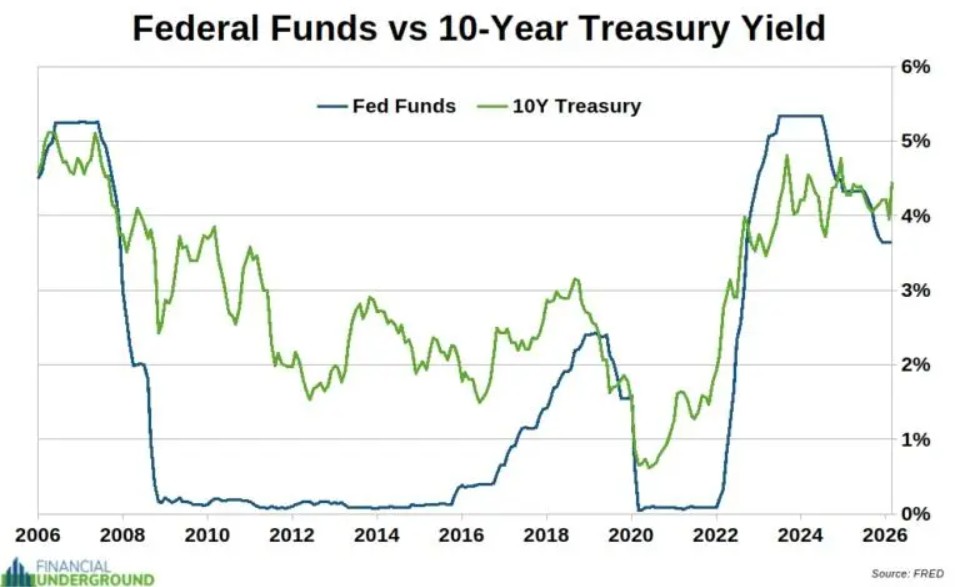
Historically, after the 2008 financial crisis, the Federal Reserve maintained zero interest rates for an extended period; it entered a rate-hiking cycle from 2015–2019; rates were again lowered to zero in 2020 due to the pandemic; after inflation surged in 2022, it aggressively raised rates to over 5% within 18 months. Currently, despite a shift towards easing, inflationary pressures persist.
Mechanically, the Federal Funds Rate is a short-term interest rate directly controlled by the Federal Reserve; the 10-year Treasury yield, however, is determined by the broader market. While influenced by policy, it cannot be entirely controlled.
This yield is considered the core benchmark for global asset pricing. Its rise typically signifies bond sell-offs, increased financing costs, and potential pressure on the dollar system.
Federal Reserve's Balance Sheet Reduction Promise Falters Again, New Expansion Cycle Begins
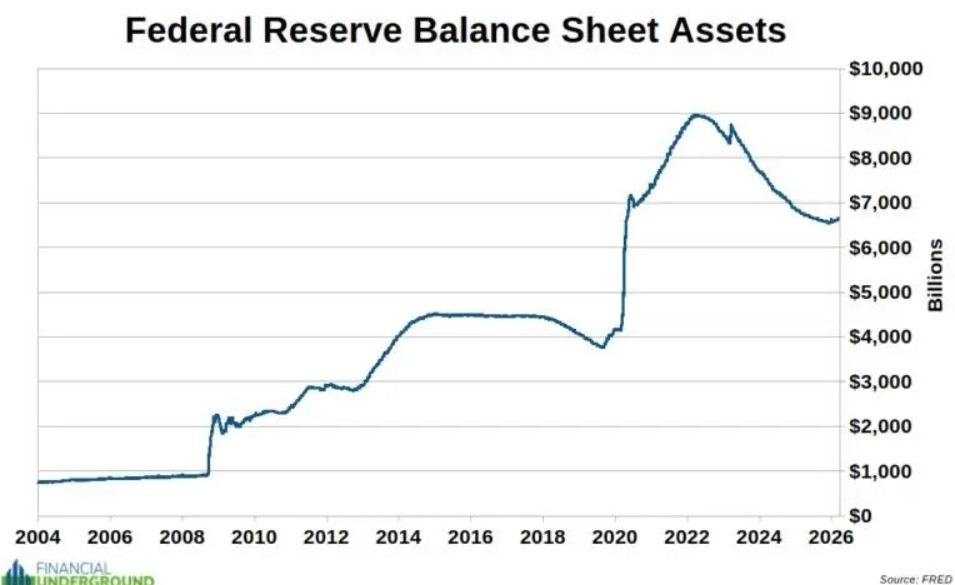
The trend of the Federal Reserve's balance sheet reveals a recurring pattern: every contraction following an expansion has been interrupted by a crack somewhere in the financial system, after which the balance sheet restarts its expansion at a higher level and has never returned to its pre-contraction starting point.
After the 2008 financial crisis, then-Fed Chairman Ben Bernanke promised that the balance sheet would eventually normalize, with a size then of about $2.5 trillion, aiming to return to below $1 trillion before the crisis. Nearly 15 years later, the balance sheet size has more than doubled the promised level at that time and is entering a new expansion cycle.
During the COVID-19 pandemic, the Federal Reserve's balance sheet ballooned from approximately $4 trillion to nearly $9 trillion. After a so-called "quantitative tightening," its size remains more than 50% higher than pre-pandemic levels. The Fed has characterized this new expansion as "reserve management" rather than quantitative easing, but critics point out that regardless of the name, purchasing Treasury bonds with newly created money essentially constitutes money printing.
Excessive Money Printing
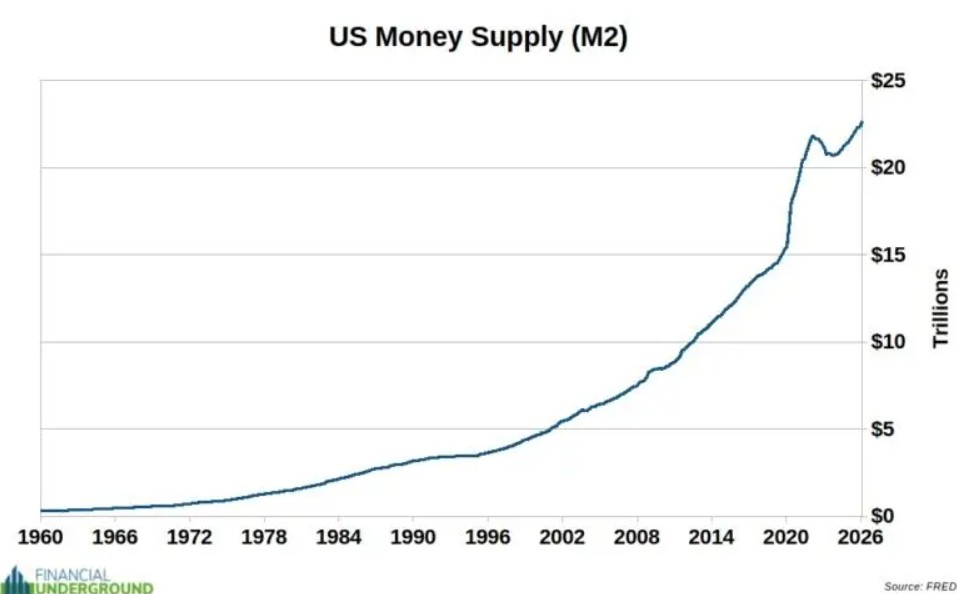
The long-term average annual growth rate of money supply has been around 6.8%.
During the pandemic, the Federal Reserve and other major central banks globally injected massive liquidity, leading to the creation of approximately 40% of the dollar supply in a short period. This was followed by inflation rising to a 40-year high in 2022.
Does CPI Mask Excessive Money Printing?
The Consumer Price Index (CPI) is the most politically manipulated of all government statistics. This indicator attempts to measure the average price change for 330 million Americans using a unified basket of goods, but the actual consumption structure varies significantly among individuals.
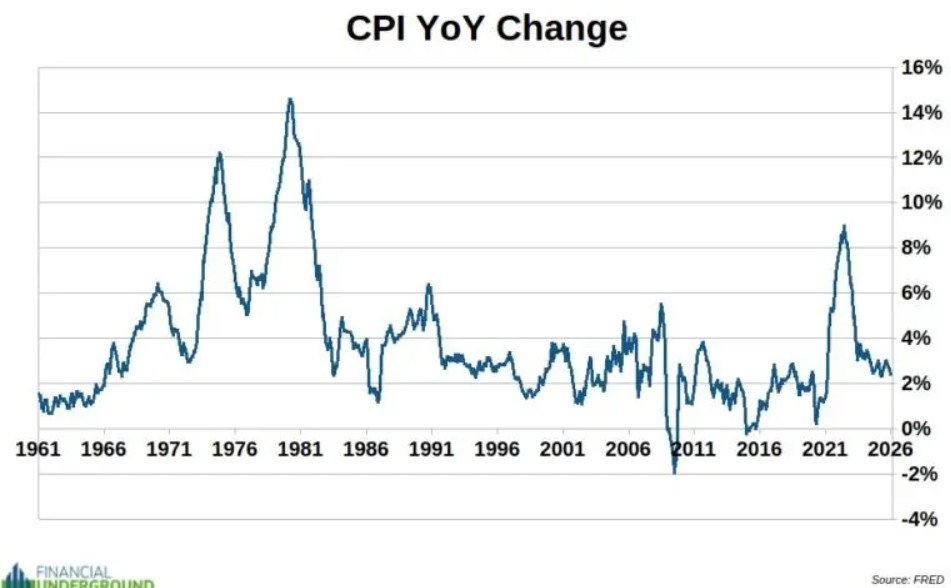
Furthermore, the government has discretion over the composition and weighting of the CPI basket, which calls into question its objectivity as a measure of inflation. Analysts believe that monitoring the CPI is more useful for predicting the Federal Reserve's policy direction rather than for accurately measuring actual inflation levels.
Gold Reaches Historic Highs: A Market Reflection of Fiat System Pressure
Gold prices have touched historical highs, seen as a comprehensive reflection of the multiple pressures mentioned above. Gold's average annual new supply is only 1% to 2%; its supply cannot be arbitrarily expanded, which gives it a natural characteristic of hedging against currency depreciation.
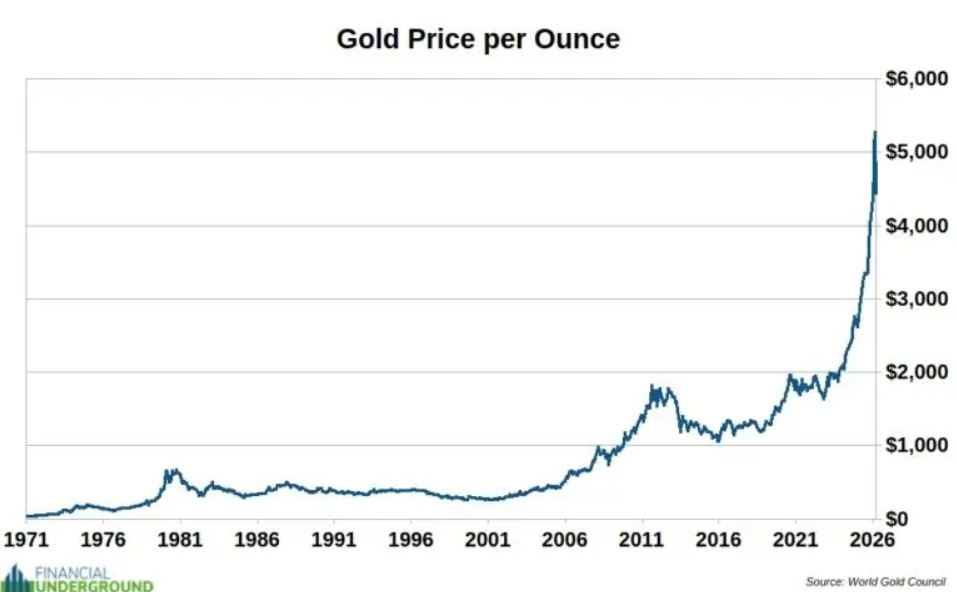
Unlike fiat currency systems, gold's value does not depend on any government credit or counterparty. It possesses inherent internationality and political neutrality. Against the backdrop of the Federal Reserve's balance sheet expansion and continuous growth in fiscal deficits, gold's attractiveness as a store of value is increasing.
The aforementioned eight indicators – fiscal deficit, debt size, interest expenses, Federal Funds Rate and 10-year Treasury yield, Federal Reserve balance sheet, money supply, CPI, and gold prices – collectively paint a systemic picture of pressure on the dollar's purchasing power. Its trajectory warrants continued investor attention.
