


Safe Haven Demand Continues? JP Morgan: Ceasefire Won't Stop U.S. Retail Investors from Selling!
A JP Morgan report shows that despite ceasefire news triggering a market rebound, U.S. retail investors chose to sell, exhibiting skepticism about the rally's sustainability. Retail trading activity has fallen to historic lows, with inflows of only $4.8 billion, far below the weekly average over the past 12 months. Retail behavior has shifted from "buying the dip" to "selling the rally," showing a defensive positioning that could pressure broad-market index ETFs and cyclical sectors
Ceasefire news triggered a market rebound, but U.S. retail investors chose to sell. JP Morgan's latest Retail Radar report indicates a fundamental shift in retail behavior patterns—from the previous "buying the dip" to the current "selling the rally," with defensive tendencies continuously strengthening.
According to the Chasing Wind Trading Desk, JP Morgan released a report on Wednesday stating that overall retail trading activity this week was extremely sluggish, with activity levels at only the 1.2th percentile historically. Despite a record single-day drop in oil prices since 2020 and the VIX fear index falling below 20, which significantly improved market sentiment, retail fund inflows did not recover. Intraday trading saw the largest net selling of ETFs in nearly a year, and by the close, ETF exposure had fallen to its lowest level in over 10 months (0.4th percentile).
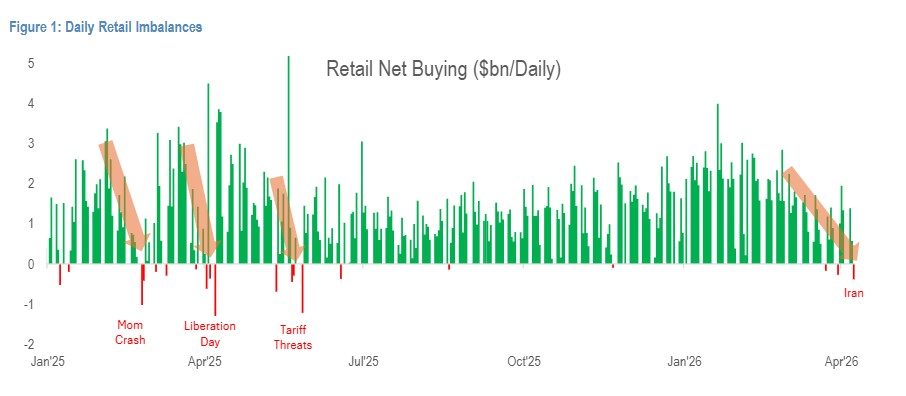
This behavioral shift has direct implications for the market: the retail investor group is clearly skeptical about the sustainability of this rebound. Their defensive positioning could exert continuous liquidity pressure on broad-market index ETFs and cyclical sectors such as energy and industrials, while the Magnificent Seven (Mag7) tech giants remain one of the few directions for retail net buying.
Overall Retail Activity Plummets, Rebound Fails to Boost Confidence
JP Morgan data shows that for the week ending April 8 (April 2 to April 8), total retail fund inflows fell to $4.8 billion, far below the weekly average of $6.6 billion over the past 12 months. Retail investors continued to prefer ETFs (net buying of $5.3 billion), while recording net selling of $460 million in individual stocks.
Intraday data for that day presented this shift more clearly. At 11:00 AM, retail buying activity was only at the 1.6th percentile of the past year, with ETF net selling reaching its highest level in nearly a year. At 1:00 PM, retail briefly turned to small net buying of ETFs and began covering individual stocks. However, by the close, ETF exposure fell back to the 0.4th percentile, and net buying of individual stocks remained at a low 7.6th percentile.
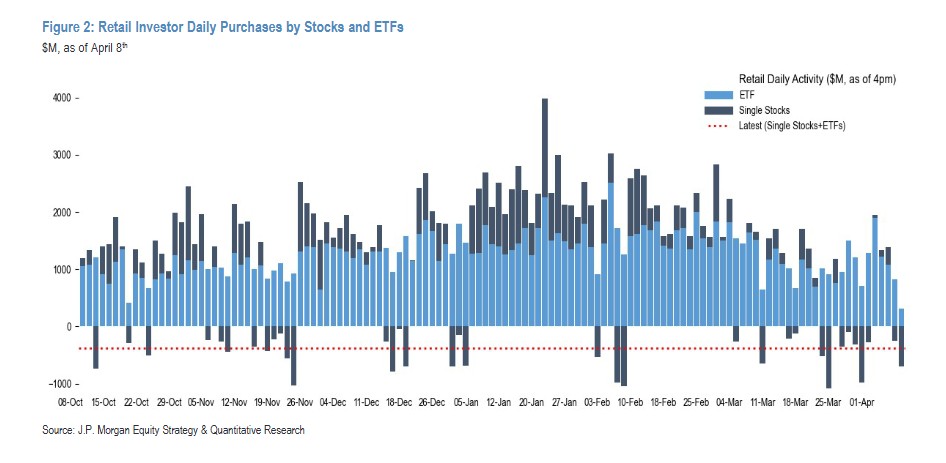
The report notes that this pattern confirms a persistent shift in retail behavior over the past month: retail investors have switched from "buying the dip" to "skipping the dip and selling the rally," with overall positions becoming more defensive.
Broad-Market ETFs See Net Selling, Retail Skeptical of Rebound
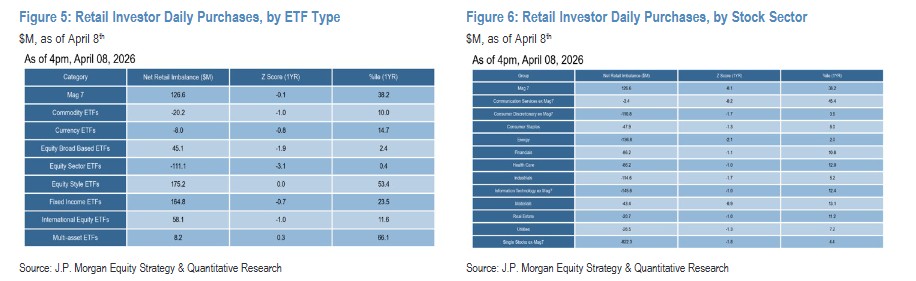
Retail investors' skepticism toward the current rebound is particularly evident at the ETF level. The JP Morgan report shows that retail buying of broad-market equity ETFs on that day was at its lowest in nearly a year (z-score of -2.3), with sustained net selling of SPDR S&P 500 (SPY) and TQQQ until the close.
In terms of sector ETFs, retail net selling was also significant (0.4th percentile, z-score of -3.1), with the semiconductor triple-leveraged ETF SOXL experiencing the largest sell-off (0.8th percentile). Meanwhile, retail investors reduced short positions in oil held through the inverse ETF SCO (z-score of -7.7) and increased holdings in the crude oil ETF USO (75th percentile), indicating an adjustment in their judgment of oil price trends.
Regarding ETF buying, retail investors this week preferred diversified fixed-income sectors ($214 million net buy), large-cap growth style ($209 million), multi-cap broad-market ($192 million), and dividend strategies ($182 million), while energy (-$98 million) and technology (-$81 million) sector ETFs saw net selling.
Energy Sold Off, Mag7 Remains a Safe Haven
In individual stocks, retail net selling covered almost all sectors, led by energy and industrials, with communication services as the sole exception.
The continued sell-off of energy stocks is corroborated by fundamental factors. ExxonMobil disclosed in its 8-K filing that production disruptions in Qatar and the UAE are expected to reduce global oil and gas equivalent output by approximately 6% month-over-month. Damage to two LNG trains (accounting for about 3% of 2025 upstream production) may require a long repair cycle, and Middle East disruptions are expected to bring $700 million in sequential earnings pressure.
In contrast, the Mag7 remains one of the few net buying directions for retail. This week, retail investors bought Tesla ($494 million), Nvidia ($298 million), Microsoft ($282 million), META ($140 million), Apple ($100 million), and Alphabet ($62 million), with only Amazon recording net selling (-$36 million). META received additional inflows partly due to its Superintelligent team releasing a new model.
JP Morgan data shows that non-retail investors net sold $8.5 billion last week, higher than the 12-month average of $7.3 billion. Meanwhile, futures traders net bought approximately $5.2 billion, primarily driven by S&P 500 futures (ES, approx. $1.8 billion) and Nasdaq 100 futures (NQ, approx. $3.4 billion), showing a divergence from retail's defensive operations.
The above content is from the Chasing Wind Trading Desk.
For more detailed interpretations, including real-time analysis and front-line research, please join the [**Chasing Wind Trading Desk Annual Membership**]

Risk Warning and Disclaimer
The market is risky, and investment requires caution. This article does not constitute personal investment advice, nor does it take into account the specific investment objectives, financial situation, or needs of individual users. Users should consider whether any opinions, views, or conclusions in this article are appropriate for their specific circumstances. Investing based on this is at your own risk.