


US March CPI Rises 3.3% Year-on-Year, Below Expectations; Month-on-Month Up 0.9%, Largest Increase in Nearly Four Years, Gasoline Sees Largest Rise Since 1967
More news, continuously updated
U.S. inflation surged in March, with gasoline prices hitting their largest monthly increase since 1967 due to the war with Iran, significantly raising overall price pressures.
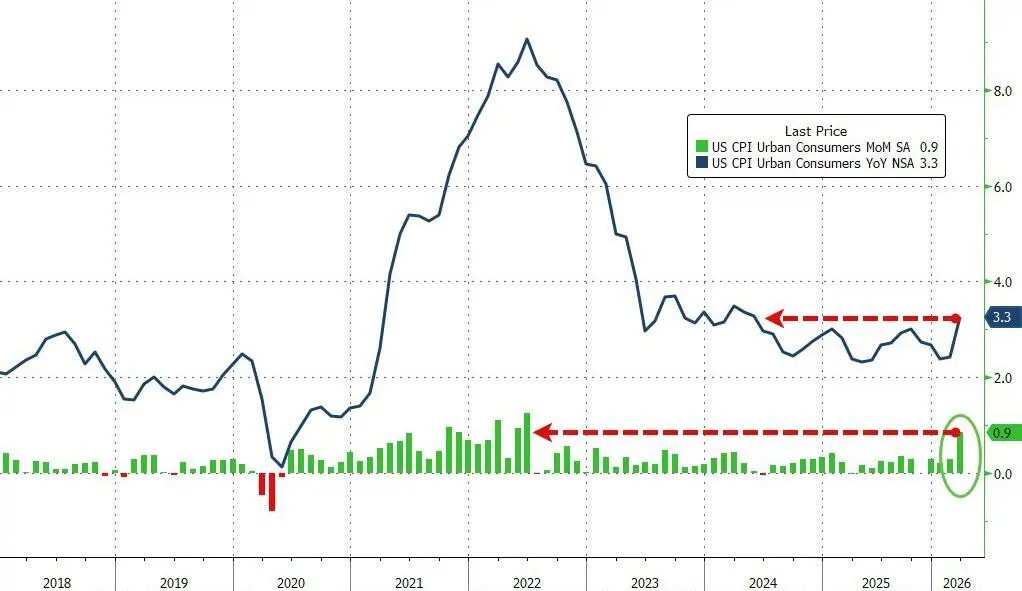
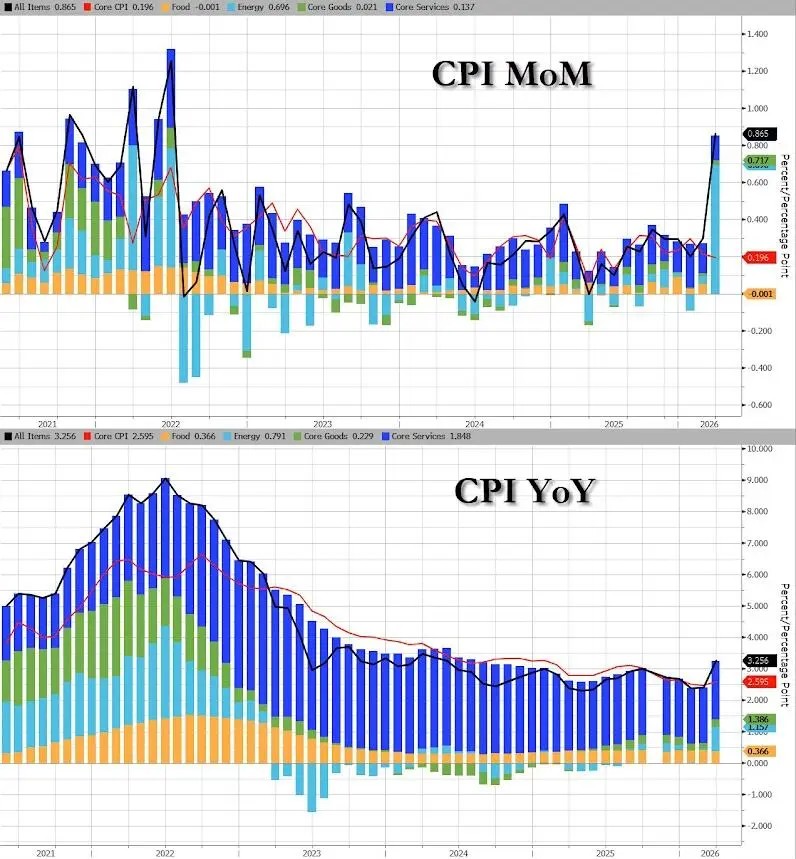
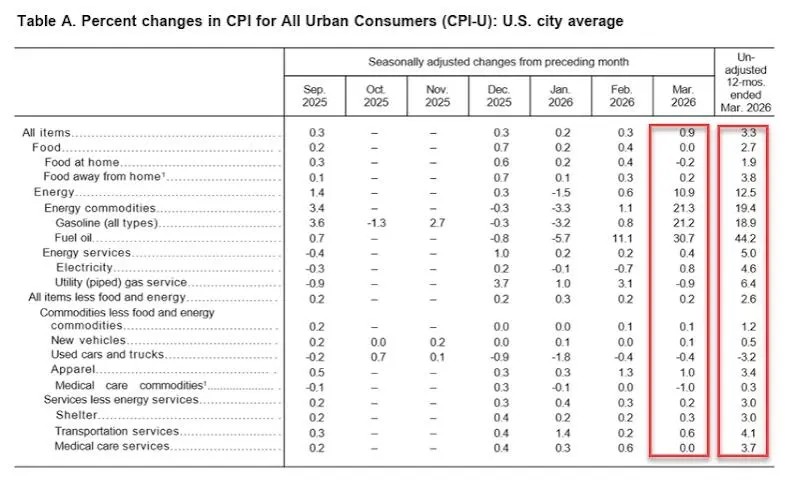
Data released Friday by the U.S. Bureau of Labor Statistics showed that the Consumer Price Index (CPI) rose 0.9% month-on-month in March, in line with market expectations and the largest monthly increase since June 2022; it rose 3.3% year-on-year, a significant acceleration from 2.4% in February and the highest level since the start of 2024. Gasoline prices recorded their largest monthly increase since records began in 1967, almost single-handedly driving the overall increase for the month, contributing nearly three-quarters of the monthly gain.
Core CPI, excluding food and energy, rose only 0.2% month-on-month, below market expectations of 0.3%, bringing some comfort to the market and slightly increasing bets on short-term interest rate cuts. However, economists warned that the secondary effects of this energy shock have not yet been fully reflected in core inflation, and April data faces the risk of further increases.
Inflation data further constrains the Federal Reserve's policy options. The Fed's benchmark overnight interest rate is currently maintained in the range of 3.50% to 3.75%. Minutes from the Fed's policy meeting on March 17-18 showed that an increasing number of policymakers leaned towards the view that a rate hike might be necessary, with some economists considering the possibility of rate cuts this year to be extremely low. Following the data release, S&P 500 futures maintained their gains, and the dollar fell.
Core Inflation Temporarily Mild, Secondary Effects Brewing
Core CPI rose 0.2% month-on-month in March, below expectations, and increased 2.6% year-on-year, a slight acceleration from 2.5% in February. The pace of core services cost increases also slowed slightly, and the overall data did not trigger immediate alarms for policymakers.
However, economists widely cautioned that core inflation has not yet fully absorbed the secondary transmission of the current energy shock. Higher jet fuel prices will lead to increased airfares, with Delta Air Lines already issuing fare hike warnings; rising diesel costs will be passed on to road transportation, subsequently increasing the prices of various consumer goods; rising fertilizer prices are expected to eventually lead to climbing grocery bills; and industrial raw materials like plastics also face upward pressure. The U.S. Postal Service has also warned of impending fee increases.
The Personal Consumption Expenditures (PCE) price index, tracked by the Federal Reserve, already recorded a strong monthly increase in February. Markets are closely watching whether April data will validate the transmission path of secondary effects.
Energy Shock Dominates Gains, Gasoline Prices Hit 57-Year Record
The U.S.-Iran conflict was the direct trigger for this inflation surge. Global crude oil prices have cumulatively risen by over 30% due to the war, and the average retail gasoline price in the U.S. has exceeded $4 per gallon for the first time in over three years. The increase in gasoline prices in March was the largest monthly record since 1967, with the energy component driving the overall CPI jump.
Diesel prices have risen in tandem, with a broader transmission chain into the economy. Meanwhile, the broad-based tariffs previously implemented by the Trump administration continue to be passed on to consumers, further weakening the disinflationary trend. Both core CPI and PCE inflation have been boosted by tariff pass-through, partially offsetting the deflationary trend in rents.
On Tuesday, Trump announced a two-week ceasefire conditional on Iran reopening the Strait of Hormuz, but the agreement appears fragile. Even if a ceasefire is eventually implemented, economists expect oil price pressure to be difficult to dissipate quickly in the near term.
Rate Cut Expectations Under Pressure, Fed Faces Dilemma
Persistent inflation has convinced some economists that the Federal Reserve will not lower borrowing costs this year. The March Fed meeting minutes further reinforced this view – minutes showed that an increasing number of policymakers believe the option of a rate hike might need to be reconsidered.
Nevertheless, some economists believe the window for rate cuts has not completely closed. If labor market conditions deteriorate, there remains room for policy adjustments. March employment data showed a strong rebound in job growth, indicating a stable current labor market. However, if the Middle East conflict persists, oil prices erode household purchasing power, and trigger a contraction in consumption, the labor market may eventually be impacted. Some economists also point out that consumer spending cuts will make it difficult for some businesses to pass on costs smoothly, which might leave some room for rate cuts.
Overall, the current inflation trajectory has significantly narrowed the Fed's policy space between balancing price stability and economic growth. Trump's promise to lower prices if he wins the 2024 election is becoming increasingly difficult to fulfill with the currently rising inflation data.
More news, continuously updated...
