


Middle East Energy Facility War Damage Quantified for the First Time: 60 Facilities Damaged, Refineries Most Severely Affected, Some Repairs May Take Years
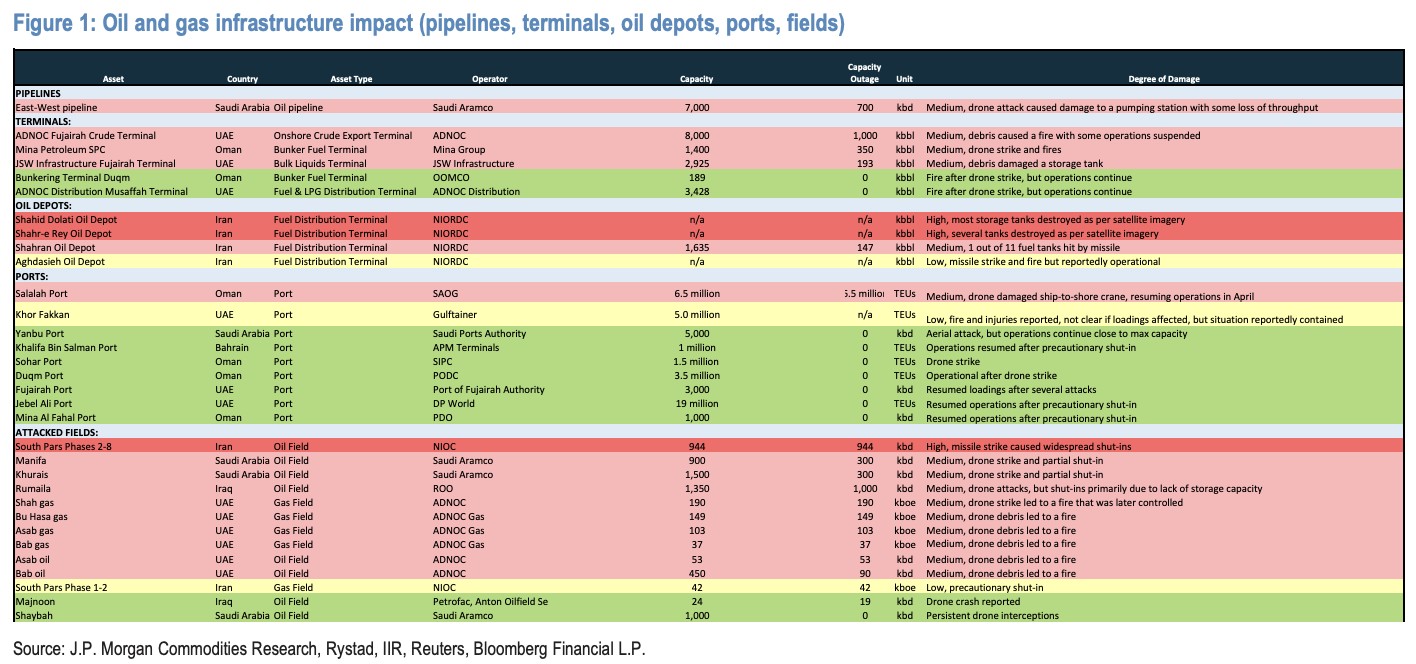
JPMorgan Chase quantifies Gulf energy war damage for the first time: over 60 infrastructure facilities hit by drone and missile attacks, forcing a shutdown of approximately 2.4 million bpd of refining capacity. About 900,000 bpd of this capacity can be restored within weeks, and another 800,000 bpd in about a month. The remaining 700,000 bpd may take years to repair
According to Tempest Trading Desk, JPMorgan Chase's commodity research team released a report on April 9th, providing the first hard quantification of energy facility war damage in the Gulf conflict.
While the market is often swayed by vague headlines of "attacks," this report offers professional investors a crucial benchmark for assessing substantial supply shocks.
Truth of War Damage: Over 60 Assets Affected
Nearly six weeks since the conflict began, the extent of infrastructure damage from the hostilities is significant. The report states:
"In conflict, headlines often focus on the fact of destruction, not the scale. Facilities are 'hit,' infrastructure is 'locked down'... but we rarely get quantitative and qualitative data that is truly meaningful to the market.
What we know is that in the nearly six weeks since the conflict began, over 60 Gulf energy infrastructure assets have been impacted by drone and missile attacks, with approximately 50 suffering varying degrees of damage."
Although most attacks do not lead to long-term disruptions, at least 8 assets have been severely damaged and face lengthy repair periods. For example, restoring 17% of damaged capacity at Qatar's Ras Laffan gas and oil complex may take years, while Bahrain's Sitra refinery suffered two direct hits.
Refinery Havoc: 2.4 Million bpd Capacity Offline
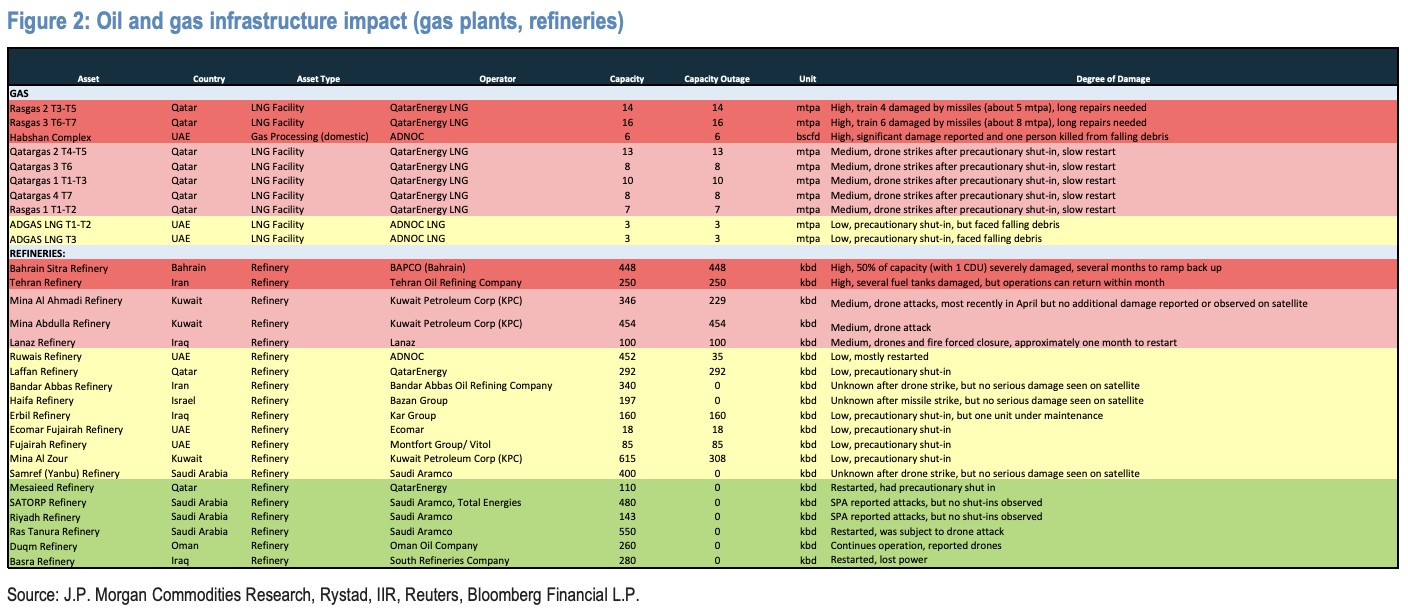
The crude oil refining sector has been hit hard in this conflict. It is estimated that a total of 20 affected refineries have shut down approximately 2.4 million bpd of capacity.
While most facilities were taken offline for precautionary reasons or have already restarted, the timeline for resuming operations remains varied: about 900,000 bpd of capacity can be restored within weeks, another 800,000 bpd in about a month; the remaining approximately 700,000 bpd of capacity (mainly concentrated in Bahrain's Sitra and Iran's Tehran refineries) will inevitably require longer repair periods.
Saudi Declaration: From "Sporadic Interference" to "Substantial Shock"
What truly alerted the market was the full picture of damage disclosed by Saudi officials. With multiple core upstream, midstream, and downstream facilities in Saudi Arabia (including the East-West pipeline, Manifa and Khurais oil fields, etc.) confirmed to have been attacked, the nature of the event has fundamentally changed. JPMorgan Chase commented on this:
"Saudi Arabia's statement today crystallizes the damage and shifts the narrative from sporadic interference to a measurable supply shock."
Particularly noteworthy is that the East-West pipeline's pumping stations were attacked just hours after the ceasefire agreement was announced, directly causing a loss of 700,000 bpd in throughput. Considering this pipeline is a critical bypass for the flow of approximately 5 million bpd of crude oil daily, the consequences of damage to this strategic node are profound.
