


Foreign Capital Outflows from Indian Stock Market Hit Record High Under Dual Pressure of Growth and Oil Prices
In just three months this year, foreign capital has withdrawn $18.84 billion from the Indian stock market, surpassing the annual record outflow of $18.79 billion set in 2025. The US-Iran war has driven up oil prices, which, combined with rupee depreciation, weak corporate earnings, and high valuations, has led to a continuous decline in the Indian market's attractiveness. Global capital is accelerating its rotation toward AI-related economies, further exacerbating the outflows
Global funds are exiting the Indian stock market at a record pace. The energy shock triggered by the US-Iran war, combined with economic growth concerns, has caused the market attractiveness of the world's fastest-growing major economy to continue its decline.
According to data from India's Central Depository Services, in just over three months this year, foreign investors have withdrawn $18.84 billion from the local Indian stock market, exceeding the historical record outflow of $18.79 billion for the full year 2025. The persistent sell-off has pressured the market, with Indian stocks losing over $600 billion in market value since their peak last year. A slight rebound brought by a brief ceasefire earlier this week failed to effectively boost market sentiment.
Year-to-date, the Nifty 50 index has fallen by a cumulative 8%. In the two-year period ending this March, the cumulative net foreign capital outflow exceeded $34 billion. The MSCI India Index has underperformed its regional peers in six of the past eight quarters.
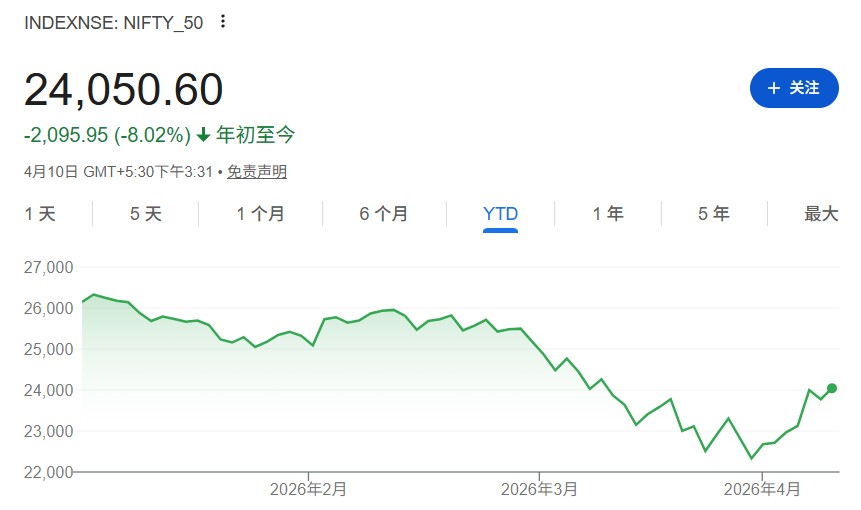
Meanwhile, global capital is accelerating its rotation toward AI-related economies, with semiconductor demand becoming a more central driving logic. As a result, the relative attractiveness of India's $4.8 trillion stock market has further weakened. The oil price shock has amplified India's existing multiple concerns—rupee exchange rate volatility, fragile corporate earnings recovery, and the lack of clear catalysts to attract foreign capital back.
Record Foreign Capital Outflows
Capital flow data clearly illustrates the scale and speed of the foreign capital withdrawal.
According to data compiled by Bloomberg, global funds have withdrawn $3 billion from the Indian stock market so far this month, while the South Korean stock market recorded a net inflow of $3.6 billion during the same period, highlighting a clear divergence in capital flows compared to India.
Notably, the stabilizing role of India's domestic capital has to some extent buffered the impact of the foreign capital withdrawal.
Year-to-date, mutual funds and institutional investors have injected $31 billion into the Indian stock market. Last month, retail investors set a historical record for inflows through systematic investment plans, even as market volatility intensified significantly. However, the sustained entry of domestic capital is still not enough to offset the persistent selling by foreign investors.
Some investors maintain a cautiously optimistic outlook on the market. "Current Indian stock market valuations have become more reasonable. Once the present geopolitical uncertainties dissipate, foreign capital is expected to return, though the timing remains difficult to predict," said Harsha Upadhyaya, Chief Investment Officer of Equity at Kotak Mahindra Asset Management.
However, before clear catalysts emerge, the prospect of foreign capital returning remains highly uncertain. The trend of oil prices, the evolution of the Middle East situation, and whether Indian corporate earnings can achieve substantive improvement will be the key variables determining when foreign capital returns.
Dual Pressure of Growth and Oil Prices
The energy shock is a significant trigger for this round of foreign capital withdrawal. The oil price crisis caused by the US-Iran war has a particularly pronounced impact on India, an economy highly dependent on oil imports. It has not only exacerbated depreciation pressure on the rupee but also worsened the already weak corporate earnings outlook. The sustained outflow of foreign capital recently pushed the rupee to a historical low, forcing the Reserve Bank of India to intervene to stabilize the exchange rate.
From a more macroeconomic perspective, the Indian stock market is facing the dilemma of a missing narrative. Abhishek Thepade, a portfolio manager at Oslo-based DNB Asset Management, stated:
"The Indian stock market lacks a clear story. Corporate earnings are experiencing a cyclical slowdown, and the weakening currency as well as the impact of AI on local software companies are also affecting the market outlook."
By contrast, while the tech-heavy South Korean market recorded an even larger outflow of $24 billion in March, the reaching of a ceasefire agreement is expected to refocus investor attention on AI chip demand, providing stronger rebound support for the Korean market—a logic that is essentially absent in the Indian market.
Valuation pressure is equally impossible to ignore. BofA Securities noted in a research report this week that even after the recent correction, the Nifty 50 index remains expensive relative to its emerging market peers and expects the Indian market's performance to continue lagging behind its competitors.
