


Grand Ambitions, Harsh Reality! Nearly Half of U.S. Data Center Projects Slated for 2026 Face Cancellation or Delay
An estimated 30% to 50% of the 16 GW of data center capacity the U.S. planned to add this year is expected to be delayed or canceled, with only about 5 GW actually entering the construction phase—a jarring contrast to the more than $700 billion in capital expenditures from tech giants. With transformer lead times stretching up to five years, nuclear power promises remaining rhetorical, and community opposition mounting, JPMorgan estimates that supporting the current AI cycle will require no less than $5 trillion
The grand narrative of U.S. artificial intelligence infrastructure expansion is facing a harsh reality check.
According to the latest "2026 Data Center Outlook" report released by Sightline Climate, an estimated 30% to 50% of the approximately 16 GW of data center capacity planned for addition in the U.S. this year will face delays or cancellations, while only about 5 GW has actually entered the construction phase.
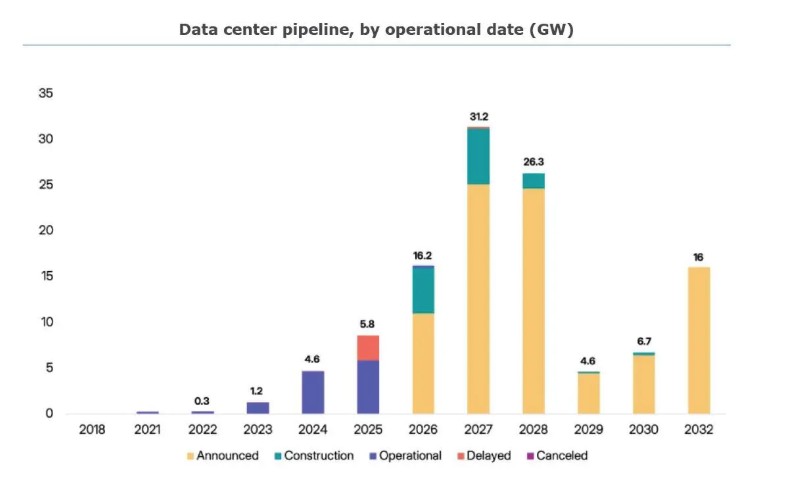
This figure stands in stark contrast to the annual capital expenditure budgets of hyperscale cloud computing companies exceeding $700 billion, revealing the deep-seated bottlenecks in AI infrastructure across power supply, supply chains, and socio-political dimensions.
Canaccord Genuity analyst George Gianarikas summarized the situation as "the U.S. data center boom is hitting a powerful logistical wall of resistance." According to Bloomberg, a severe shortage of electrical equipment such as transformers, switchgear, and batteries is one of the primary causes of delays, as domestic manufacturing capacity is far from sufficient to meet demand, forcing developers to rely on imports. Meanwhile, community opposition, permitting hurdles, and lagging grid integration are collectively narrowing the window for project realization.
Supply-Demand Gap is Alarming, Outlook Beyond 2027 Even Darker
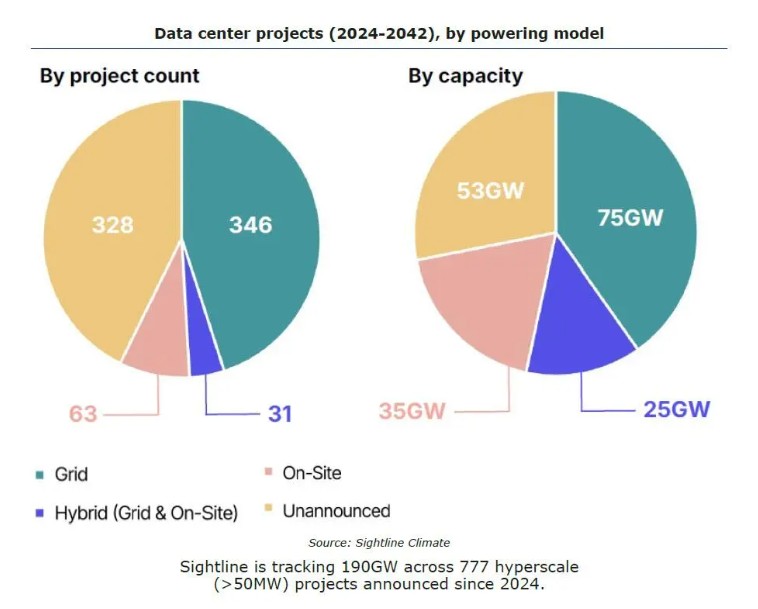
Sightline Climate's report shows that 140 data center projects across the U.S. are planned to become operational in 2026, totaling approximately 16 GW of capacity. Of these, 53% will connect to the grid, 3% will rely on on-site power, and another 25% have not yet disclosed their power supply schemes.
However, of this 16 GW of planned capacity, 11 GW remains in the "announced" stage with no signs of construction. Since typical data center construction cycles range from 12 to 18 months, the likelihood of this capacity coming online on time is extremely low.
Looking toward 2027, the gap widens further. Announced planned capacity has reached 21.5 GW, but the actual scale under construction is only about 6.3 GW. The outlook for 2028 through 2032 is even more dire: the vast majority of planned projects have yet to break ground, and an additional 37 GW of planned infrastructure has not even secured a clear completion date, with only 4.5 GW actually having commenced construction.
Transformer Bottlenecks Strangle Growth, Supply Chain Heavily Reliant on Imports
The shortage of power infrastructure is the core bottleneck constraining data center development. The rapid expansion of data center scales requires higher-power transformers to safely convert electricity from the high-voltage grid before delivering it to chips. Philippe Piron, CEO of GE Vernova's Electrification division, noted that before 2020, lead times for high-power transformers were typically 24 to 30 months—which was "perfectly acceptable" under the old paradigm—but AI companies now typically demand delivery within 18 months.
Surging demand has pushed transformer lead times to as long as five years, while prices have climbed significantly. Some companies are resorting to stopgap measures; for instance, Crusoe has begun refurbishing old transformers from decommissioned power plants for emergency use.
The demand pressure for transformers and other electrical equipment comes not only from data centers; the proliferation of electric vehicles and heat pumps is also driving grid expansion needs. U.S. domestic manufacturing capacity simply cannot keep pace, deepening reliance on imports. This predicament reflects deep structural issues stemming from decades of manufacturing outsourcing—despite recent policy calls for reshoring, substantial capacity increases have so far yielded minimal results.
Nuclear Power Promises Fall Through, Funding Gap Reaches Trillions
The predicament on the power supply side is equally sobering. The Trump administration's promises of a nuclear renaissance currently remain rhetorical, with almost no new nuclear plants breaking ground. While small modular reactors (SMRs) are viewed as a beacon of hope, they are still years away from large-scale practical application.
A few ultra-large self-powered projects are attempting to bypass grid limitations, including a 7 GW project planned by New Era Energy & Digital in Lea County, New Mexico; Homer City's 4.5 GW coal-to-gas conversion project in Pennsylvania; and Crusoe's 1.8 GW hybrid natural gas and renewable energy project in Cheyenne, Wyoming. The report notes that waiting for the grid to provide power of this magnitude "could take a decade."
On the financial front, analysis by JPMorgan indicates that fully supporting the current AI cycle will require no less than $5 trillion. Even if hyperscalers continue to ramp up capital expenditures, the U.S. government still needs to bridge a funding gap of over $1 trillion.
Social Resistance Intensifies, Public Sentiment Shifts Rapidly
Beyond infrastructural hurdles, socio-political resistance is gathering pace. The Maine House of Representatives passed a moratorium on large data centers by a vote of 82 to 62, prohibiting construction through 2027 and establishing a Maine Data Center Coordination Committee to assess impacts on the state’s resources, environment, and finances.
Goldman Sachs Executive Director Shreeti Kapa wrote in a recent report that she sensed a strong consensus during dinner discussions with investors: "Compute is just not enough. Every participant is facing severe compute constraints—from wafer fabs to data center permitting, and then power, memory, and labor. The bottlenecks are real and will persist for a long time."
The latest polling from Quinnipiac University shows that public caution toward the deep integration of AI into healthcare, education, and daily life is rising quickly, further increasing the social friction costs of industry expansion.
Canaccord concluded: "Energy constraints are intensifying, and so are socio-political constraints. Something has to give." Faced with the reality of abundant capital but hindered execution, the expansion of U.S. AI infrastructure is proving to be far more tortuous than the market anticipated.
