


As the earnings season kicks off, Morgan Stanley is actively bullish: profit growth will withstand disturbances from the Middle East conflict, and the correction in the US stock market is in its final stage
Morgan Stanley strategists stated that corporate earnings growth is protecting the S&P 500 from a larger decline, masking a broad pullback in the U.S. stock market. They believe the market is in the final stages of the pullback, with expected earnings per share for the S&P 500 having declined by 18%. The strategists prefer cyclical sectors and high-quality growth stocks, advising investors to increase risk exposure, despite the uncertainty brought by the situation in the Middle East
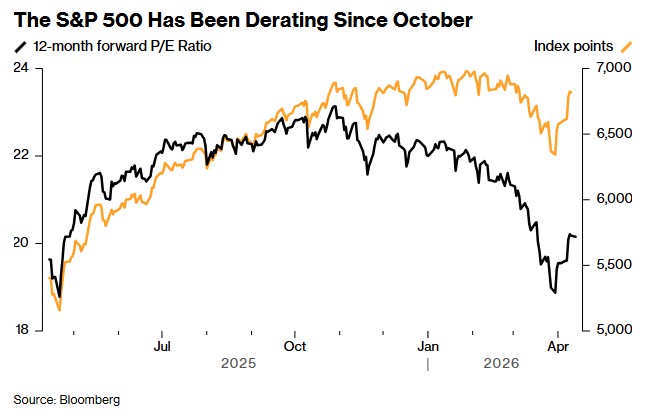
According to Zhitong Finance APP, Morgan Stanley strategists have stated that accelerating corporate earnings are protecting the S&P 500 index from a larger decline while masking a broader pullback in the U.S. stock market. The strategist team, led by Michael Wilson, pointed out that strong earnings performance and ongoing economic recovery are the reasons the S&P 500 index has fallen less than 10% since reaching an all-time high in January. However, beneath the surface, they believe there is evidence that the stock market is in the "final stage" of a pullback.
The strategists believe there are better indicators to assess the extent of the U.S. stock market's pullback—the expected earnings per share (EPS) of the S&P 500 index have declined 18% from last October's peak, while more than half of the stocks in the Russell 3000 index have fallen at least 20%.
Wilson stated, "In our view, this is not market complacency, but rather a market that has appropriately and accurately priced in risks at both the index and individual stock levels." He added that risks from private credit and the impact of artificial intelligence (AI) have also been digested by the market.
Meanwhile, Morgan Stanley strategists continue to favor cyclical sectors—including financials, industrials, and consumer discretionary—due to strong earnings and compressed valuations. They also believe there are opportunities in high-quality growth stocks, such as AI cloud service providers, as market sentiment and valuations in related sectors have adjusted to more attractive levels.
The strategists advise investors to prepare to increase their risk exposure, even as the Middle East conflict continues to bring uncertainty to energy supplies and monetary policy paths. The team wrote, "The final stage of adjustments is often not easy, and the market may need to test lows again, especially if interest rates or bond volatility rise again."
The Earnings Season for U.S. Stocks Begins Amid Middle East Turmoil, Wall Street Optimistic About Corporate Earnings Growth
As U.S.-Iran negotiations have ended without results and the U.S. has stated it will blockade the Strait of Hormuz, investors are concerned that the situation in the Middle East may escalate again, with the S&P 500 index expected to decline again on Monday—at the time of writing, the index futures were down 0.62%.
Amid the disturbances of the Middle East conflict, the first quarter earnings season for U.S. stocks will kick off this week. Investors will actively seek evidence starting this week to determine whether the earnings expansion engine of U.S. companies—especially the large Wall Street banks that hold significant weight in the S&P 500 index, large tech giants closely associated with AI, and retail giants—continues to operate well.
Despite the numerous risks, Wall Street analysts remain optimistic. Analysts generally expect that S&P 500 earnings for the first quarter will grow approximately 14% year-over-year, with the potential for six consecutive quarters of double-digit growth, and the full-year earnings growth forecast for 2026 has been revised upward from about 15% in late February to over 19%.
Like Morgan Stanley, several institutions or market participants have expressed the view that earnings growth (especially in the information technology sector) will support the outlook for U.S. stocks. Senior strategist Ed Yardeni stated that U.S. tech stocks have returned to levels that are attractive for long-term investors after falling from last year's historical highs The uncertainty of the impact of artificial intelligence on the software business, combined with the effects of the Middle East war, has led to a 13% decline in information technology stocks since reaching an all-time high last October. However, during this period, the industry's earnings expectations have accelerated, bringing its price-to-earnings ratio to 20.6 times, which is roughly in line with the S&P 500's price-to-earnings ratio of 19.6 times. Adani wrote in a report sent to clients: "For long-term investors, this is a very attractive entry point."
Wells Fargo Investment Research also upgraded its rating on the U.S. information technology sector from "neutral" to "positive," citing that the sector has underperformed the S&P 500 and that the widespread application of artificial intelligence supports its robust growth prospects. Wells Fargo's global investment strategy team stated that despite concerns over valuations, capital expenditures, and the disruptive impact of artificial intelligence, the fundamentals of the information technology industry remain strong. They cited double-digit earnings growth in the fourth quarter of last year as an example. Strategists also pointed out that since the outbreak of the Middle East war, the information technology sector has outperformed the S&P 500, highlighting the industry's long-term growth and quality characteristics. The strategists stated: "The gradual decline over the past few months has brought valuations to more attractive levels, and we believe the pessimism surrounding the industry is somewhat overstated."
Goldman Sachs noted in a report in March that there is still upside potential for U.S. stocks, predicting that by the end of 2026, driven by continued corporate earnings expansion and moderate economic growth, the S&P 500 index is expected to rise to 7,600 points. This forecast is based on an in-depth assessment of the earnings prospects of constituent companies—Goldman further estimated that the S&P 500 constituent companies' earnings per share will grow to approximately $309 in 2026, further rising to about $342 in 2027, corresponding to annual growth rates of approximately 12% and 10%, respectively.
Goldman Sachs' outlook for the year-end target of the S&P 500 index reflects that even with interest rates remaining high and the financial environment slightly tightening, the market still firmly believes that corporate profitability will continue to expand. Goldman added that technology companies remain the core engine of earnings growth in U.S. stocks, with the information technology sector expected to contribute the largest incremental profit to the S&P 500 index in the coming years—earnings per share for this sector are expected to jump from about $70 in 2025 to $92 in 2026, and further rise to $109 in 2027. Other key sectors are also expected to contribute significant increments, including financials, healthcare, and communication services. However, compared to the technology sector, the earnings growth rates of these sectors are expected to be more moderate.
U.S.-Iran Negotiations Fail: Can Earnings Growth Prospects Support the U.S. Bull Market?
It is worth mentioning that investors will closely monitor whether the Middle East war and the resulting surge in energy costs pose a significant threat to this optimistic corporate earnings growth outlook. The conflict in the Middle East has driven oil prices sharply higher, with U.S. inflation data in March recording the largest increase in nearly four years, and consumer confidence continuing to weaken. Meanwhile, both the MSCI Global Index and the S&P 500 Index have just experienced their worst quarter since 2022. Institutions generally believe that the importance of forward guidance and management commentary for companies this quarter will outweigh the reported performance data itself Negotiations between the United States and Iran broke down over the past weekend, and current oil prices remain significantly higher than levels before the outbreak of conflict in the Middle East. Therefore, another focus for investors is how large publicly listed companies in the U.S. will view the chain reactions brought about by soaring oil prices—rising oil prices are bound to increase costs for a range of businesses and squeeze consumer spending. Additionally, persistently high energy costs may exacerbate inflationary pressures, thereby completely undermining expectations for interest rate cuts by the Federal Reserve. If interest rates remain high, it will undoubtedly be detrimental to corporate profit growth.
The next phase of the U.S. stock market's upward movement does not solely rely on the "U.S.-Iran ceasefire benefits" itself, but rather on whether earnings reports can prove that the war has not eroded profits. Brent Schutte, Chief Investment Officer at Northwestern Mutual Wealth Management Company, stated: "What you will see is whether these future earnings expectations can hold up or will be revised down. Therefore, corporate earnings guidance has become extremely important."
The upcoming earnings reports from major Wall Street commercial banks will provide a key window for investors to observe the health of the economy, and a strong economic condition is typically an important foundation for corporate profit growth. Goldman Sachs will report its earnings on Monday. JPMorgan Chase will release its earnings on Tuesday, and Wells Fargo and Citigroup will also announce their earnings on the same day. Other banks will release their earnings later next week.
Garrett Melson, portfolio strategist at Natixis Investment Managers Solutions, stated that these large commercial banks' latest comments on consumer spending behavior and the impact of oil prices on consumer budgets will be crucial. He noted: "The consumption patterns they observe will be a key basis for the market to judge how substantial the risks of economic slowdown are from a consumer perspective."
