


Doubled in Two Weeks! Credo Acquires DustPhotonics: Is the Charm of Silicon Photonics Unstoppable?
Credo Technology acquires Israeli silicon photonics chip company DustPhotonics for $750 million, marking a strategic inflection point for the AI data center high-speed interconnect industry towards 'opto-electronic integration'. This transaction deeply integrates Credo's electrical interconnect technology with Dust's silicon photonics capabilities, forming an ultrafast optical interconnect market covering 800G to 3.2T. Following the deal, CRDO shares surged 12.35%, reflecting the market's positive response to its transformation from a 'component supplier' to a 'system solutions provider'
Credo Technology acquired Israeli silicon photonics chip company DustPhotonics for $750 million in cash and stock, marking a strategic inflection point for the AI data center high-speed interconnect industry towards 'opto-electronic integration'.
This inflection point signifies a paradigm shift in the global AI interconnect supply chain from a 'division of labor model' to a 'vertical integration model'. By fusing its own electrical interconnect IP (SerDes/DSP) with Dust's silicon photonics (SiPh) chip capabilities, Credo is building an 'opto-electronic integration' moat that competitors find difficult to surmount.
Understand the industry development progress and future blueprint in one article.
I. What Happened? The Surge of CRDO
Credo Technology acquired Israeli silicon photonics chip company DustPhotonics for $750 million in cash and stock, marking a strategic inflection point for the AI data center high-speed interconnect industry towards 'opto-electronic integration'.
This inflection point signifies a paradigm shift in the global AI interconnect supply chain from a 'division of labor model' to a 'vertical integration model'. By fusing its own electrical interconnect IP (SerDes/DSP) with Dust's silicon photonics (SiPh) chip capabilities, Credo is building an 'opto-electronic integration' moat that competitors find difficult to surmount.
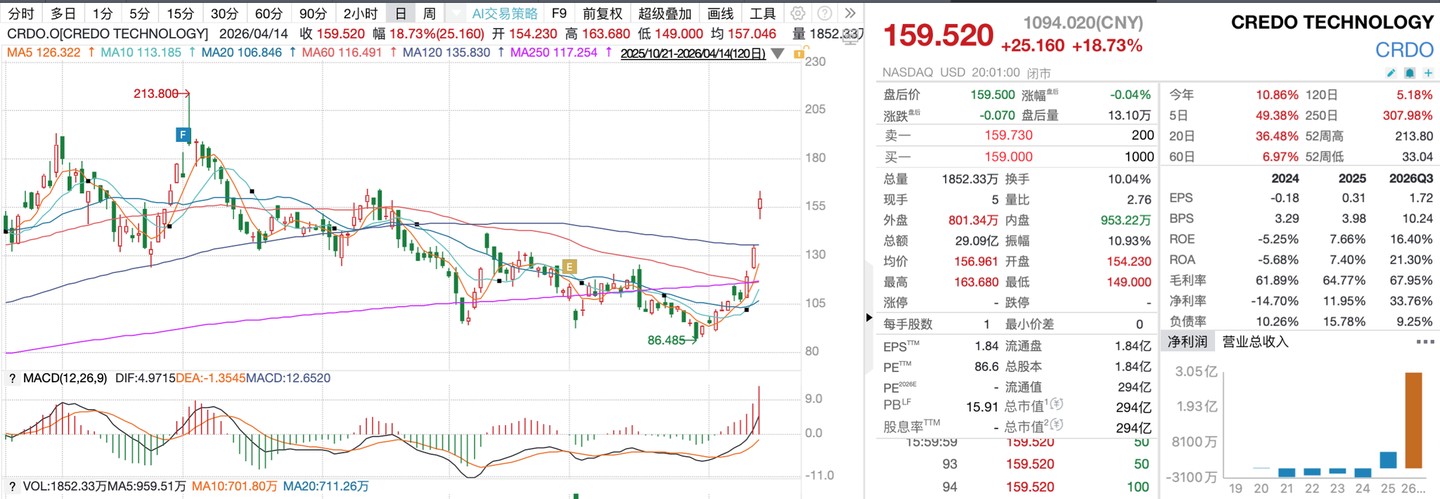
This transaction deeply integrates Credo's technical leadership in electrical interconnects with DustPhotonics' innovative accumulation in silicon photonics PIC fields, forming a vertically integrated connection technology stack covering SerDes, DSP, silicon photonics technology, and system integration. It spans the ultrafast optical interconnect market from 800G to 3.2T. On the day of the acquisition announcement, CRDO shares surged 12.35% to $134.36, and last night the stock price rose above $159.
Its core highlight lies in completing a role transition at the business level from a 'component supplier' to a 'system solutions provider'. In the 1.6T optical module era, signal attenuation and power consumption are the mortal enemies restricting AI cluster expansion. DustPhotonics' silicon photonics technology can integrate lasers, modulators, and detectors onto a single chip, not only reducing physical volume but also lowering production complexity by over 40%. The market's pricing logic for CRDO has shifted from a 'single DSP chip vendor' to a 'high-speed interconnect platform vendor', and this reshaping of the valuation system is the fundamental reason driving the stock price gap jump.
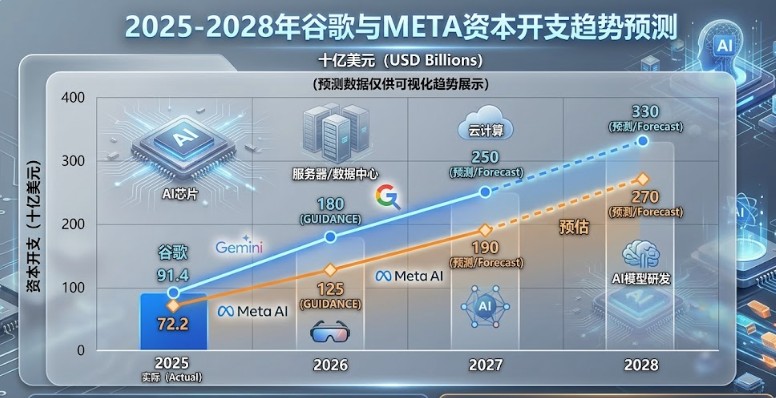
Furthermore, according to the announcement, the acquisition is expected to significantly boost its non-GAAP earnings per share in fiscal year 2027. More importantly, DustPhotonics' technology already has a deep collaborative background in the iteration of silicon photonics solutions among top cloud vendors like Google and Meta. This acquisition is viewed as Credo securing an 'entry ticket' to lock in 1.6T optical module orders from top global cloud vendors for 2026-2027 in advance.
Why is the market so enthusiastic about 'light'?
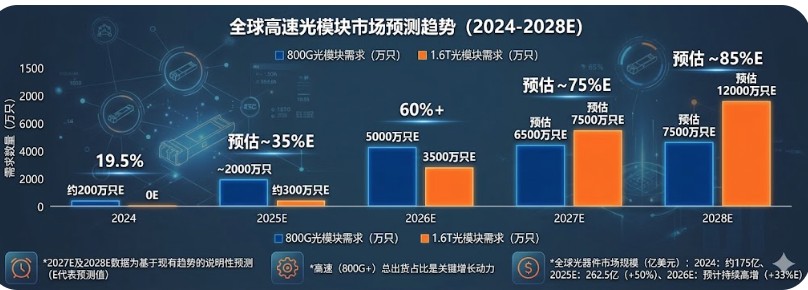
From an industrial background perspective, silicon photonics technology is undergoing a historical leap from a 'backup option' to 'market dominance'. In 2025, the global optical device market size reached $26.25 billion, up 50% year-on-year, with silicon photonics technology accounting for nearly 50% in 800G modules. Affected by indium phosphide material supply bottlenecks and capacity expansion cycles, the supply gap for traditional EML routes will continue to expand in 2026, bringing an unprecedented penetration window for silicon photonics solutions - Galaxy Securities estimates that in 2026, the proportion of silicon photonics solutions in 800G optical modules will exceed 50%, reaching as high as 70%-80% in 1.6T optical modules. The silicon photonics PIC market size is expected to grow to $6 billion by 2030.
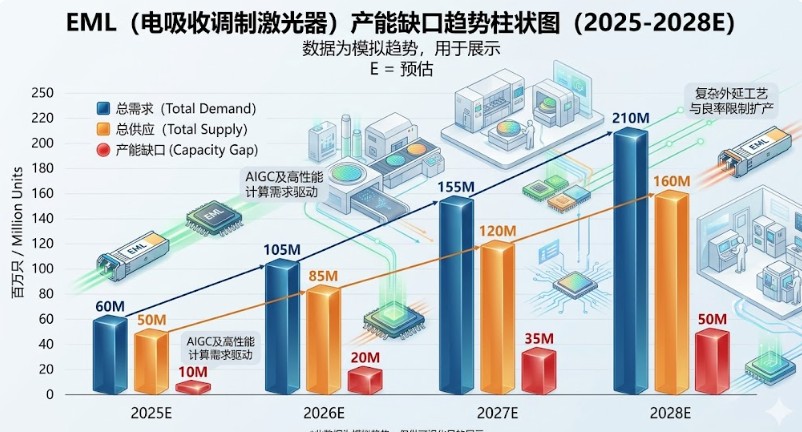
The supply side also faces structural shortages. Delivery cycles for EML lasers are scheduled beyond 2027, and Nvidia has monopolized the capacity of major EML suppliers; key materials such as CW light sources and Faraday rotators are also in short supply, making upstream supply chain management capability a core industry competitiveness. The global industry chain is accelerating its migration to silicon photonics technology - Samsung plans mass production of silicon photonics chips in 2028, TSMC is collaborating with Nvidia to promote mass production of silicon photonics products, and foundries like Intel and GlobalFoundries have long made deep layouts in silicon photonics wafer manufacturing.

The strategic significance of this acquisition far exceeds the financial level. As a leader in the high-speed electrical interconnect field, Credo previously focused on AEC (Active Electrical Cable) and SerDes, DSP chips as its core business, being a key supplier for 'in-rack' interconnects in AI data centers. Under the industry trend of 'optical replacing copper', it was a technology direction destined for elimination. However, after incorporating DustPhotonics' silicon photonics PIC technology, Credo has officially established a vertically integrated connection technology stack covering SerDes, digital signal processors (DSP), silicon photonics technology, and system integration for both horizontal scaling (Scale-out) and vertical scaling (Scale-up) networks, thereby meeting all needs from electrical interconnects to optical interconnects throughout AI infrastructure construction.
William Brennan, Chairman, President, and CEO of Credo, stated in the announcement: "The combination with DustPhotonics is a decisive step in Credo's strategy, aimed at leading the full spectrum of AI connectivity. We have established a strong position in the high-speed electrical solution field, and this decisive move extends this leadership into the silicon photonics field, leveraging the industry's best PIC technology, which complements our ZeroFlap optical transceivers and DSP product portfolio."

II. Why Is It Important? Industry Trends Are Inevitable
In 2025, the global optical communication industry stood at a historical inflection point. The urgent demand for high-speed interconnects driven by AI large model training and inference accelerated the iteration of optical module rates from 800G to 1.6T. According to ICC Stone's annual report, the global optical device market size reached $26.25 billion in 2025, up 50% year-on-year, setting a new historical record. Among them, the annual demand for 800G optical modules was approximately 20 million units (doubling), while 1.6T has begun large-scale commercialization.
Looking ahead to 2026, the high-growth trend continues to accelerate. Cloud vendors like Google are deploying all-optical network architectures, which is expected to push the global shipment proportion of high-speed optical transceiver modules above 800G from 19.5% in 2024 to over 60% in 2026. According to industry survey data, the demand for 800G optical modules in 2026 is expected to be between 45 million and 55 million units, with 1.6T demand conservatively estimated at 30 million to 45 million units.
LightCounting estimates the global 800G/1.6T optical module market size will be approximately $14.6 billion in 2026. Among them, Zhongji Innolight, the global champion in 800G optical module shipments, is expected to hold a 35% market share in 2026, with gross margins on its 800G LPO modules reaching as high as 45%, and shipment volumes expected to reach 3 million units in 2026.
The explosion of silicon photonics technology is not accidental but a structural substitution forced by EML (Electro-Absorption Modulated Laser) capacity bottlenecks.
The capacity of traditional EML optical chip routes is highly concentrated overseas, limited by the supply and expansion cycle of Indium Phosphide (InP) materials, resulting in a significant supply gap for EML routes in 2026. Out of strategic considerations, Nvidia has monopolized the capacity of EML chip suppliers, causing delivery cycles for EML lasers to extend beyond 2027. According to TrendForce data, global optical transceiver modules above 800G reached 24 million units in 2025, and are expected to surge to nearly 63 million sets in 2026, while EML capacity expansion speed cannot keep up with demand growth.
This gap will be mainly filled by silicon photonics solutions. In 2026, the proportion of silicon photonics solutions in 800G optical modules will exceed 50%, and in 1.6T optical modules, it will reach as high as 70%-80%. ICC Stone's annual report also points out that silicon photonics technology accounts for nearly 50% in 800G modules, evolving from a substitute option to a dominant choice.
The structural substitution opportunity gained by silicon photonics technology in this round of EML capacity shortages has strategic value far exceeding cost considerations - it is becoming a key path to alleviate supply chain pressure and improve integration levels. Meanwhile, upstream materials such as Faraday rotators and high-end CW light sources are also in short supply, further reinforcing the importance of silicon photonics technology.
The continuous development of silicon photonics technology has accelerated tech giants' emphasis on this solution, and the global industry chain is accelerating its migration to silicon photonics technology.
Samsung Electronics announced its silicon photonics technology roadmap at the OFC conference in March 2026, declaring plans to achieve mass production of silicon photonics chips in 2028 and launch advanced packaging chips integrating silicon photonics, GPUs, and high-bandwidth memory in 2029.
TSMC is collaborating with Nvidia to promote mass production of silicon photonics products, with silicon photonics chips being an important part of TSMC's long-term development strategy.
Intel, GlobalFoundries, and other foundries have long made deep layouts in silicon photonics wafer manufacturing, with Intel leading the silicon photonics industry chain in IDM mode.
Accelink Technologies launched the world's first 3.2T silicon photonics single-mode NPO module at OFC 2026 and has completed verification with top domestic cloud service providers.
Chinese optical module leaders such as Zhongji Innolight and Eoptolink are also accelerating silicon photonics product shipments, with Zhongji Innolight's silicon photonics ratio and yield continuously improving.
Additionally, against the backdrop of Credo's acquisition of DustPhotonics, understanding the relationship between CPO and silicon photonics is particularly important.
Silicon photonics technology is one of the core underlying technologies of CPO, but they are not the same concept. Silicon photonics is a technology platform for integrating optical functions on a silicon substrate, while CPO is a system-level solution for directly integrating optical engines with switching ASICs or computing processors. After acquiring DustPhotonics, Credo's silicon photonics PIC products can not only be used for traditional pluggable optical modules but are also designed for leading Near-Port Optical (NPO) and Co-Packaged Optics (CPO) applications.
III. What to Focus on Next? How to Launch a Ten-Billion Market
The silicon photonics industry is at the critical point of leaping from a hundred-billion-level to a trillion-level market.
From a broader macro perspective, the global silicon photonics chip market is growing at a high speed. According to ICC Stone's annual report, the global optical device market size reached $26.25 billion in 2025 and is expected to grow to $56 billion by 2030, with a compound annual growth rate of approximately 16.4%. The penetration rate of silicon photonics technology within it is rising from about 50% to over 70%, and the growth of the silicon photonics-related market will far exceed the overall growth rate of the optical device market.
Calculations show that the cost proportion of silicon photonics chips in 800G/1.6T optical modules is as high as 30%-70%, and their foundry capacity and technical level directly determine the development rhythm of downstream industries. China's silicon photonics chip market size is expected to reach $3.27 billion to $4.215 billion in 2026, with data centers and AI accelerators accounting for over 55%. Estimates from LightCounting and Credo show that the SiPho PIC market is expected to grow to $6 billion by 2030. The market space for the entire silicon photonics industry chain, integrating optical DSP, optical transceivers, and system integration, will be even more substantial.

The silicon photonics industry chain can be divided into three core links: upstream materials, midstream manufacturing and packaging, and downstream applications:
Upstream Materials: Mainly includes SOI wafers, III-V laser materials, modulator materials, detector materials, etc. The optical chip link (EML lasers, CW light sources) is the highest value upstream link in the industry chain and also the most constrained supply link currently.
Midstream Manufacturing and Packaging: Includes silicon photonics chip design (EDA tools), wafer foundries (TSMC, Intel, GlobalFoundries), packaging and testing (precision coupling, optoelectronic integration packaging). Silicon photonics chip foundry capacity is the key bottleneck for the entire industry chain in 2026.
Downstream Applications: AI data centers (800G/1.6T optical modules, CPO), telecommunications networks, high-performance computing (HPC), sensors, etc.
The silicon photonics industry is experiencing a historical leap from 'technology verification' to 'scale application', which we divide into three stages:
Stage One (2024-2025): Silicon photonics substitution verification and penetration rate improvement period. EML capacity began to tighten, and the penetration rate of silicon photonics solutions in 800G optical modules rapidly increased from a low level to about 50%. Credo's acquisition of DustPhotonics marks the acceleration of industry consolidation. Chinese manufacturers' global share of optical devices broke through 60%.
Stage Two (2026-2028): Silicon photonics becomes the mainstream solution, and EML supply gaps force comprehensive substitution (current stage). In 2026, the proportion of silicon photonics in 800G optical modules will exceed 50%, reaching 70-80% in 1.6T. Credo's integrated optical business is expected to contribute over $500 million in revenue in fiscal year 2027, validating the 'opto-electronic integration' business model. TSMC's silicon photonics foundry capacity will ramp up and release by the end of 2026. We are currently in the core acceleration phase of this stage.
Stage Three (Post-2028): Silicon photonics becomes absolutely dominant, and CPO enters large-scale commercialization. Samsung achieves mass production of silicon photonics chips in 2028, and silicon photonics technology becomes the standard solution for AI data center interconnects. CPO begins large-scale application in Scale-up scenarios, and the silicon photonics market enters the trillion-level.
Core conclusions are as follows -
Conclusion One: Credo's acquisition of DustPhotonics is a landmark event reshaping the silicon photonics industry landscape. This transaction enabled Credo to form an end-to-end solution capability of 'electrical chips + optical chips + system integration', upgrading from an AEC leader to a full-stack optical interconnect solution platform. The integrated optical business aims for over $500 million in revenue in fiscal year 2027, marking the beginning of realizing the 'opto-electronic integration' business model.
Conclusion Two: EML capacity gaps force silicon photonics to accelerate substitution, with 2026-2027 being the golden window for silicon photonics solution volume expansion. EML delivery cycles are scheduled beyond 2027, while the penetration rate of silicon photonics solutions in 800G/1.6T is rapidly increasing from about 50% to 70-80%. This structural substitution window brings a historic opportunity for silicon photonics vendors like Credo.
Conclusion Three: The Chinese optical module industry chain is in a leading global position during the silicon photonics transformation. In 2025, the global share of domestic Chinese optical device manufacturers reached 63.2%, with Zhongji Innolight holding about a 35% market share in 800G optical modules. Tianfu Communication has achieved mass production capability for 1.6T optical engines, and Yuanjie Technology has made breakthroughs in the EML optical chip field. The systemic competitiveness of the domestic industry chain in silicon photonics solutions is strengthening.
Conclusion Four: Credo's investment value lies in the dual-engine drive of 'AEC Cash Cow + Optical Business Second Growth Curve'. The AEC business is still in a high-growth period, having covered four hyperscale cloud service providers, with patent settlements clearing expansion obstacles. Integrating DustPhotonics into the optical business opens up the $6 billion SiPho PIC market, expected to contribute over $500 million in revenue in fiscal year 2027. Jefferies gave a target price of $175 (about 30% upside from current levels), but the high valuation (dynamic PE around 65 times) has already reflected high-growth expectations, requiring attention to the pace of valuation digestion.
Risk Disclosure and Disclaimer
Market investments carry risks; investors should proceed with caution. This article does not constitute personal investment advice and does not take into account the specific investment objectives, financial status, or needs of individual users. Users should consider whether any opinions, views, or conclusions in this article conform to their specific circumstances. Investment decisions based on this content are the sole responsibility of the investor.
