


Record-Breaking Performance: Morgan Stanley Q1 Revenue and Profit Hit All-Time Highs, Stock Trading Income Sets New Record, Wealth Management Attracts $118.4 Billion | Earnings Insights
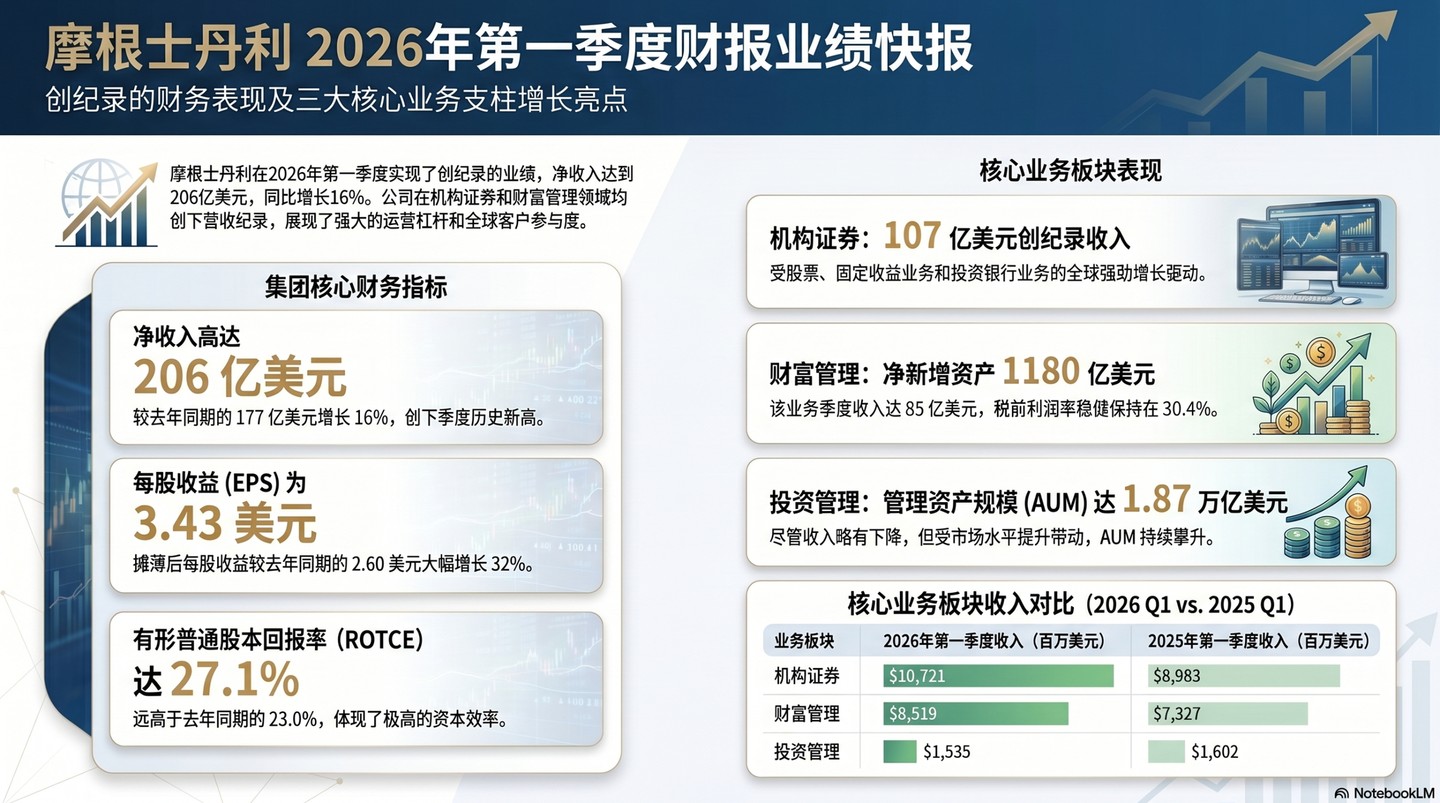
Morgan Stanley reported first-quarter net revenue of $20.6 billion, a 16% year-over-year increase surpassing the $17.7 billion from the same period last year; net profit reached $5.6 billion, up 29% year-over-year; diluted earnings per share rose to $3.43, a 32% jump from $2.60 in the prior-year quarter. Driven by heightened market volatility and significantly increased client activity, net stock trading revenue surged 25% year-over-year to $5.15 billion, setting a new historical record
Morgan Stanley delivered a "record-breaking on all fronts" performance that has captured market attention.
According to the financial report released on Wednesday, Morgan Stanley's first-quarter net revenue reached $20.6 billion, a 16% year-over-year increase surpassing the $17.7 billion recorded in the same period last year; net profit was $5.6 billion, up 29% year-over-year; diluted earnings per share rose to $3.43, a 32% increase from $2.60 in the same period last year; Return on Tangible Common Equity (ROTCE) stood at an impressive 27.1%, far exceeding the 23.0% from the previous year. This marks Morgan Stanley's first-ever single-quarter record for both net revenue and profit.
The Stock Trading business emerged as the standout highlight of the quarter. Driven by heightened market volatility and a significant surge in client activity, net stock trading revenue reached $5.15 billion, a 25% year-over-year increase that set a new historical record. This trend aligns with other Wall Street giants—Goldman Sachs, JPMorgan Chase, Bank of America, and Citigroup—as all five major banks simultaneously achieved their highest-ever stock trading income in the first quarter, collectively underscoring the powerful catalytic effect of volatile markets on trading businesses.
Wealth Management also performed brilliantly. Net new asset inflows for the quarter reached $118.4 billion, exceeding market expectations and outperforming the $93.8 billion from the same period last year; fee-based asset inflows totaled $53.7 billion, nearly double the $29.8 billion from the same period last year. Net revenue for the wealth management division climbed to a record high of $8.5 billion, while maintaining a healthy pre-tax profit margin of 30.4%.
CEO Ted Pick stated: "Morgan Stanley reported record quarterly results. Strong execution drove net revenue to $20.6 billion, earnings per share to $3.43, and ROTCE to 27.1%. Institutional Securities benefited from robust global client engagement, while Wealth Management demonstrated sustained momentum. These achievements validate the competitiveness of our integrated operating model, positioning the company for higher-dimensional operational performance."
Institutional Securities: Dual Drive of Trading and Investment Banking Delivers Record Single-Quarter Revenue
The Institutional Securities division reported net revenue of $10.7 billion for the quarter, a roughly 19% year-over-year increase, setting another historical record, with pre-tax profits rising to $4.2 billion.
Stock Trading: Net revenue reached $5.15 billion, up 25% year-over-year, marking a new quarterly record. Prime Brokerage and Derivatives businesses performed exceptionally well, with growth across the Americas, Europe, and Asia-Pacific regions. The core driver was the surge in client trading demand resulting from intense global market volatility in the first quarter.
Fixed Income Trading: Net revenue was $3.36 billion, up 29% year-over-year. Commodity businesses benefited significantly from energy market volatility, while Credit, Rates, and FX businesses also showed strong performance across the board.
Investment Banking: Net revenue jumped 36% year-over-year to $2.12 billion. Among this, M&A advisory fees surged from $563 million to $978 million, an increase of 74%, primarily driven by a significant rise in completed M&A transaction volume in the Americas. Equity underwriting revenue reached $396 million (+24%), and fixed-income underwriting revenue was $742 million (+10%), the latter benefiting from increased investment-grade bond issuances and M&A financing activities. Notably, actual underwriting performance slightly lagged behind market expectations; the overall high growth in investment banking was primarily pulled by M&A advisory.
Regarding departmental expenses, total expenditures were $6.47 billion, up 15% year-over-year. Compensation expenses rose alongside revenue, while non-compensation expenses increased due to rising costs related to trade execution.
Wealth Management: Asset Management Fees and Net Interest Income Synergy Accelerate Net New Asset Inflows
The Wealth Management division reported net revenue of $8.52 billion for the quarter, setting a new record, up 16% year-over-year, with pre-tax profits of $2.6 billion and a pre-tax profit margin of 30.4%.
- Asset Management Fees: Increased from $4.396 billion to $5.079 billion, a 16% year-over-year rise, driven by asset base growth and the continued accumulation of fee-based assets. Total fee-based client assets expanded to $27.92 trillion, up approximately 19% from $23.49 trillion in the same period last year.
- Net Interest Income: Rose from $1.902 billion to $2.170 billion, a 14% year-over-year increase, supported by continuous loan portfolio expansion (loan balances grew from $162.5 billion to $186.3 billion) and higher levels of average demand deposits.
- Trading Income: Increased to $1.127 billion, up 29% year-over-year, benefiting from widespread client activity across various products. Additionally, the absence of DCP (Deferred Cash Compensation Plan) related book losses in the current quarter, which were present in the same period last year, created a favorable comparative advantage.
In terms of Net New Assets, the $118.4 billion figure for the quarter exceeded market expectations and accelerated compared to the $93.8 billion from the same period last year, indicating that Morgan Stanley's wealth management business retains strong client stickiness and appeal. Fee-based asset net inflows of $53.7 billion reflect the continuing deepening of the structural trend where client assets migrate toward recurring fee accounts.
Investment Management: AUM Hits Record High, But Sharp Decline in Performance Fees Dragged Down Overall Results
The Investment Management division reported net revenue of $1.535 billion for the quarter, a decline of approximately 4% year-over-year, with pre-tax profits dropping from $323 million in the same period last year to $280 million. It was the only one of the three business segments to experience a year-over-year revenue decline.
Asset management and related fees increased slightly from $1.451 billion to $1.496 billion, benefiting from rising market valuations and continuous net capital inflows that pushed average AUM higher. As of quarter-end, AUM reached $1.868 trillion (up from $1.647 trillion in the same period last year).
However, performance fees and other income plummeted from $151 million in the same period last year to just $39 million, a drop of 74%. The primary reason was the reduction in accrued carried interest rights for private equity funds, which directly dragged down the division's overall revenue performance. Long-term net capital inflows were $3.3 billion; while still positive, this represented a clear slowdown compared to the $8.6 billion from the same period last year.
Market disturbances in the private credit sector are also worth noting. During the first quarter, Morgan Stanley's North Haven Private Income Fund, along with several similar products, imposed caps on redemption requests. This reflects the redemption pressures and liquidity management challenges facing the retail end of the $1.8 trillion private credit market, with institutional investors and regulators paying significantly increased attention to this asset class.
Expenses and Capital: Layoff Costs Recognized, Yet Efficiency Metrics Continue to Improve
Morgan Stanley's total non-interest expense for the quarter was $13.471 billion, up 12% year-over-year, slightly above market expectations. Compensation expenses were $8.542 billion (+14%), primarily driven by higher revenues and the amortization of equity incentive costs; non-compensation expenses were $4.929 billion (+9%), with rising trade execution-related costs being the main driver.
Notably, the company conducted a workforce optimization initiative in the first quarter and recognized $178 million in severance costs, affecting approximately 2% of employees globally, impacting all three divisions: Institutional Securities ($94 million), Wealth Management ($61 million), and Investment Management ($23 million). Despite this, the total employee count as of late March rose slightly from 82,992 at the beginning of the year to 83,922, reflecting ongoing recruitment efforts in certain areas.
The overall expense efficiency ratio improved from 68% in the same period last year to 65%, demonstrating that the company maintained operational leverage despite expanding investments. Regarding capital adequacy, the standardized CET1 capital ratio stood at 15.1%, indicating a robust capital base.
On shareholder returns, the company repurchased $1.75 billion of common stock in the first quarter (average price $169.15, 10 million shares) and announced a quarterly cash dividend of $1.00 per share, payable on May 15, 2026. Benefiting from tax incentives on equity incentives, the effective tax rate for the quarter dropped to 19.6%, down from 21.2% in the same period last year.
Strategic Progress: First Acquisition Completed, Positioning for Private Equity Liquidity Platform
In the first quarter, following CEO Ted Pick's appointment, Morgan Stanley completed its first merger and acquisition deal under his tenure—the acquisition of the EquityZen platform. EquityZen specializes in providing secondary market trading services for private company shares to clients. This move aims to connect Morgan Stanley's high-net-worth client base with the burgeoning private equity secondary market. Immediately after completing the acquisition, the company halved pricing for most transactions on the platform in February, employing an aggressive pricing strategy to capture market share and create clear differentiation from competitors.
From an overall strategic perspective, Morgan Stanley's positioning as an "Integrated Firm" was fully reflected in this quarter—Institutional Securities provides explosive elasticity for trading and investment banking revenue, Wealth Management contributes stable and continuously growing recurring income, and Investment Management builds a long-term fee base through AUM accumulation. The synergy among these three business lines gives the company both offensive and defensive capabilities during market volatility, representing the deepest logical support behind the record-breaking performance of this quarter.
