


Alibaba Launches 'Pipi Gu', China Literature Creates 'Yuegu Mi' App: Tech Giants Battle for the Billions-Valued Goods Sector
Alibaba and China Literature Group are actively laying out the goods economy, launching their respective applications to attract young consumers. Alibaba's Lingxi Interactive Entertainment has introduced 'Pipi Gu', integrating information, community, and gacha features, while China Literature is developing the 'Yuegu Mi' App to establish market differentiation. With rapid market growth, the goods economy is expected to reach 168.9 billion yuan by 2024, becoming a new consumption hotspot. Major platforms are entering this field, driving a reshaping of the market landscape
"Goods," derived from the English word "Goods" (transliterated), refers generally to derivative merchandise based on IPs such as anime, games, idols, and tokusatsu. It is becoming a popular consumption choice that young people are willing to pay for. Due to its enormous market potential, it is attracting more and more players to enter the sector.
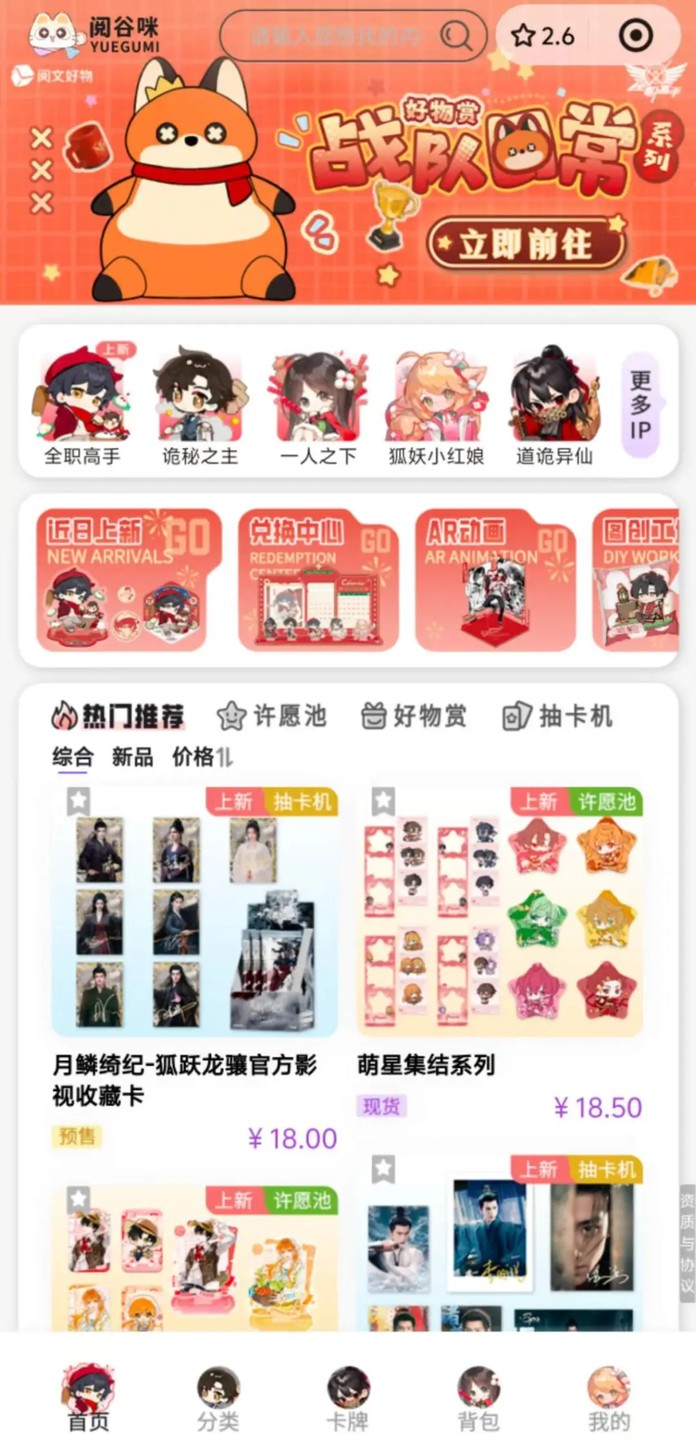
Tech Planet learned exclusively that Lingxi Interactive Entertainment, the gaming division under Alibaba, is building a goods business called "Pipi Gu" that integrates information, community, and gacha features. The official account "Pipi Gu Gacha Machine" has already been launched. Tianyancha data shows that its operating entity is 100% held by Guangzhou Lingxi Interactive Entertainment Information Technology Co., Ltd. A mini-program with the same name is also expected to launch soon. Meanwhile, China Literature Group's "Yuegu Mi" goods mini-program, launched at the end of 2024, is currently advancing the development of an independent App version, attempting to build a differentiated barrier in the goods economy which is undergoing a period of consolidation.

The goods sector has become a must-fight territory for major internet companies. Kuaaituantuan, under Pinduoduo, has specifically launched a "Pin Gu Group Buy" tool, recruiting group leaders open to the goods circle. It supports functions such as batch price adjustment, schedule management, and one-click group creation, covering multiple popular 2D IPs. Relying on a private domain group buy model, it is rapidly penetrating the young consumer group. Baidu, centered on the "Dao Gu" App, focuses on earthy trends, hot memes, and DIY gameplay. Combining its own content ecosystem with AI features, it has carved out a differentiated path.
From content communities and gacha tools to private domain group buys and AI-driven goods, various platforms are cutting into different scenarios within the goods economy. It can be anticipated that the goods sector is moving from wild growth to refined operations, and a new round of market landscape reshaping is about to begin.
Explosion of the Billions-Valued Goods Sector: From Niche Hobby to Consumption Trend
In recent years, the goods economy has broken out of niche circles at an astonishing speed, growing into a new consumption sector worth tens of billions of yuan.
According to data from iMedia Consulting, China's goods economy market size reached 168.9 billion yuan in 2024, up 40.63% year-on-year, far exceeding the 3.48% growth rate of total retail sales of consumer goods during the same period. It is expected to exceed 300 billion yuan by 2029, maintaining a compound annual growth rate of over 12.8% over the five years. These derivative products, such as badges, standees, cards, and shikishi, spawned from anime, games, web novels, and idol IPs, are restructuring the consumption patterns of young groups.
Data from Qichacha shows that as of April 2025, there were over 6.672 million enterprises related to the goods economy in China, with newly established companies accounting for a high of 87.7% in the past three years, indicating the industry is in a period of rapid expansion.
Behind the market explosion is the drive of Generation Z becoming the main consumer force and the rise of emotional consumption.
Unlike traditional commodities, the core value of goods does not lie in their practical function but in emotional connection and subculture identity. A dealer who has worked deeply in the 2D channel for many years told Tech Planet that the explosive power of popular IP goods is amazing. Under the overlay of online flagship stores, offline exhibitions, and themed stores, the sales of a single hit badge easily exceeded hundreds of thousands, with top IPs even reaching millions. The repurchase frequency and single-product popularity far exceed ordinary cultural creative products.
A player who has long purchased "Genshin Impact" merchandise admitted that he spends hundreds or thousands of yuan monthly on goods for his favorite characters. "It's not for use; I just want to collect them all and display them. Seeing them makes me happy. Showing off goods and swapping goods with peers has also become part of daily social interaction."
Furthermore, the rise of domestic IPs has completely changed the market landscape, ending the era dominated by "Japanese Goods" and accelerating the adoption among domestic users. Xianyu transaction data shows that in the first quarter of 2025, the transaction volume of domestic IP goods reached 1.2 times that of Japanese goods, with "Domestic Goods" officially overtaking the latter.
The strong monetization capability of domestic IPs has also allowed companies like China Literature and miHoYo to successfully capitalize on the dividends.
On March 17, China Literature Group released its full-year 2025 financial report, showing that the GMV of IP derivatives in 2025 broke through 1.1 billion yuan, more than doubling year-on-year. Meanwhile, peripheral sales driven by top game IPs such as "Genshin Impact" and "Honkai: Star Rail" had already exceeded 100 million yuan several years ago.
Additionally, offline channels have exploded simultaneously. Over a hundred shopping malls across the country have now laid out 2D goods sections. In core commercial districts of first-tier cities like Shanghai and Guangzhou, daily foot traffic in goods stores exceeds 10,000 people. Furthermore, traditional retail locations such as supermarkets are transforming into goods sales points. For example, some traditional clothing retail malls located in the Jianghan Road Pedestrian Street area in Wuhan have completely transformed into hubs for trendy toy goods over the past year and a half.
In fact, the goods economy is no longer just self-amusement within a niche circle but has integrated into the mainstream commercial system, becoming the most promising golden track in the field of cultural consumption. This also opens up entirely new incremental space for internet platforms.
Major Players Deploy Heavy Forces: Full-Scenario Positioning Reshapes the Goods Circle Landscape
Under the temptation of a market worth billions, internet giants and leading enterprises are densely entering the goods sector, launching a comprehensive competition to reshape the industry landscape. Players including Alibaba Lingxi Interactive Entertainment, China Literature Group, Pinduoduo, and Baidu are cutting into specific scenarios leveraging their own ecological advantages.
China Literature builds core barriers through IP advantages. After launching the "Yuegu Mi" mini-program at the end of 2024, it is currently advancing the development of an independent App. "Yuegu Mi" relies on popular web novel IPs such as "The King's Avatar," "The Outcast," and "Fox Spirit Matchmaker" to create a closed loop from content creation to derivative monetization. Covering all categories including badges, standees, shikishi, and cards, it achieves order conversion through the model of "IP Content" to "Fan Community" to "Goods Consumption." It has now become a significant revenue entry point for China Literature's "goods" business.
Alibaba Lingxi Interactive Entertainment takes a different approach, launching the "Pipi Gu" business that integrates information, community, and gacha features. The "Pipi Gu Gacha Machine" official account has already been launched, and a mini-program with the same name is about to land. Leveraging game operation experience, it creates a lightweight interactive consumption scenario, capturing the entertainment needs of young users for "pulling goods."
Kuaaituantuan under Pinduoduo previously launched the "Pin Gu Group Buy" tool last year, recruiting group leaders open to the goods circle. It supports functions such as batch price adjustment, schedule management, and one-click group creation, covering dozens of popular 2D IPs. Compared to traditional e-commerce, goods circle group buying places greater emphasis on community trust and group leader credibility. Kuaaituantuan reduces operational thresholds through toolization, accelerating the commercialization of private domain traffic.
Baidu launched a revised version of the "Dao Gu" App last year, creating an all-in-one platform integrating goods creation, secondary creation tools, OC nurturing, and community exchange. Focusing on AI gameplay and lightweight DIY, it has formed a differentiated development path.
In addition, game manufacturers such as miHoYo and Papergames, along with Bilibili, rely on their own IPs to build a complete ecosystem from in-game operations to out-of-game goods consumption, launching related derivative products that serve as important pillars for their IP monetization.
Offline scenarios have become a new focal point of contention for major players. Leading brands are accelerating offline store expansion. Chain brands such as Chaowan Planet have seen their store count break the hundred mark, covering core city commercial districts nationwide. China Literature has also laid out offline goods stores named "China Literature Goodies." In the card field, "China Literature Goodies" launched 21 sets of card products in 2025, with production volume ranking among the top in domestic animation. Hit products such as the "Lord of the Mysteries" birthday limited gold coin and the "The King's Avatar" Swiss tour series pain bag topped relevant Tmall lists with single-item GMV. Unlike traditional retail stores, these goods stores focus on immersive experiences, enhancing user dwell time and social dissemination through goods walls, gacha boxes, and themed check-in areas.
Behind the Hype: Entry by Giants Is Not Smooth Sailing
However, although the goods sector appears lively, there are numerous challenges behind the scenes. Even internet giants with traffic, proprietary IPs, and mature channels must face various industry problems. Some platforms rushed in only to withdraw hastily after a brief trial.
Tencent once leveraged its own QQ IP to lay out both online goods and offline trendy toys. In 2023, Tencent QQ launched "QQ Card Collection," focusing on an online card-opening and offline delivery model. It released multiple IP cards such as the QQ 25th Anniversary set, Minions, and "Non-Human Era," attempting to enter the card goods market via its social ecosystem.
Tech Planet has been tracking the development of this business, but progress was not smooth. Early on, frequent card shortages occurred. Later, due to the excessive issuance of rare cards, the second-hand market price plummeted significantly. Finally, QQ Card Collection directly stopped card sales. In 2025, the platform launched a "Give Up Delivery for Compensation" feature, signaling the formal conclusion of this business.
On the offline front, QQfamily stores operated by Chuangmeng Tiandi under Tencent authorization were also an important carrier for its layout in trendy toys and goods. The first flagship store opened at Shenzhen Happy Coast, focusing on QQ IP merchandise, trendy toy sales, and offline experiences.
However, under a heavy asset model, high rent, high labor costs, unstable foot traffic, combined with the limited appeal of the QQ IP itself to the core 2D audience, made the stores difficult to profit. Starting in 2023, offline stores nationwide were basically closed. This confirms a reality: offline goods stores require large investments and slow returns; even backed by a major company's IP, it is difficult to sustain in the long term.
Besides Tencent, other leading players in the industry also face tests.
Known as the "King of Cards," Kayou's path to listing has been quite bumpy. According to a December 2025 report by Beijing Time Finance, Hong Kong Stock Exchange data shows that Kayou's prospectus has again become invalid. Although the company achieved annual revenues exceeding 10 billion yuan relying on cards featuring Ultraman and Naruto, its blind box model has long been controversial and is viewed by outsiders as one of the main reasons for the IPO obstacles.
"Goods appear to have low barriers and high heat, but they actually test IP operation capabilities, supply chain control, and understanding of subculture very much. Compliance is the bottom line. Relying solely on traffic to rush in makes it hard to last long," a person in the goods circle told Tech Planet.
Amidst the hype, those who truly understand the circle, control risks, and settle down to work on IPs are perhaps the ones who will go the furthest.
Tech Planet
Risk Disclosure and Disclaimer
There are risks in the market; investment requires caution. This article does not constitute personal investment advice and was not prepared considering the special investment objectives, financial status, or needs of individual users. Users should consider whether any opinions, views, or conclusions in this article are suitable for their specific circumstances. Investment based on this is at the user's own risk.
