


Strait of Hormuz Reopens, Hopes for Long-Term Truce Rise as Crude Oil Plunges Over 10% Intraday
After Iran announced the reopening of the Strait of Hormuz to commercial shipping, European natural gas futures fell by up to 10% intraday. US crude oil recorded a weekly decline exceeding 10% for two consecutive weeks, erasing gains made over the past five-plus weeks alongside Brent crude. While short-term tensions in the Strait of Hormuz have eased, uncertainty remains. Analysts suggest Friday's selling may have been excessive, noting that the negotiation landscape could be more fragile than current oil prices reflect
Against a backdrop of sharply easing geopolitical risks, the global oil and gas market was hit hard on Friday. After Iran announced it would reopen the Strait of Hormuz to commercial vessels, financial markets grew increasingly optimistic about the resumption of US-Iran ceasefire negotiations and the potential for a long-term peace agreement. As a result, crude oil prices tumbled intraday, hitting a new low in over a month.
Following the announcement during European trading hours on Friday, declines in international crude oil futures and European natural gas futures widened rapidly. The benchmark Dutch natural gas futures contract for May on the European continent fell by as much as 10% intraday, closing down 7.7%. During the early session of US stocks, WTI crude oil intraday dropped nearly 15%, while Brent crude fell more than 13%, marking its first double-digit intraday plunge in a week since last Wednesday.
By the close, both US crude and Brent crude had erased all gains from the past five-plus weeks, reaching their lowest closing levels since March 10. WTI May crude oil futures settled down 11.45% at $83.85 per barrel; Brent June crude oil futures settled down 9.07% at $90.38 per barrel.
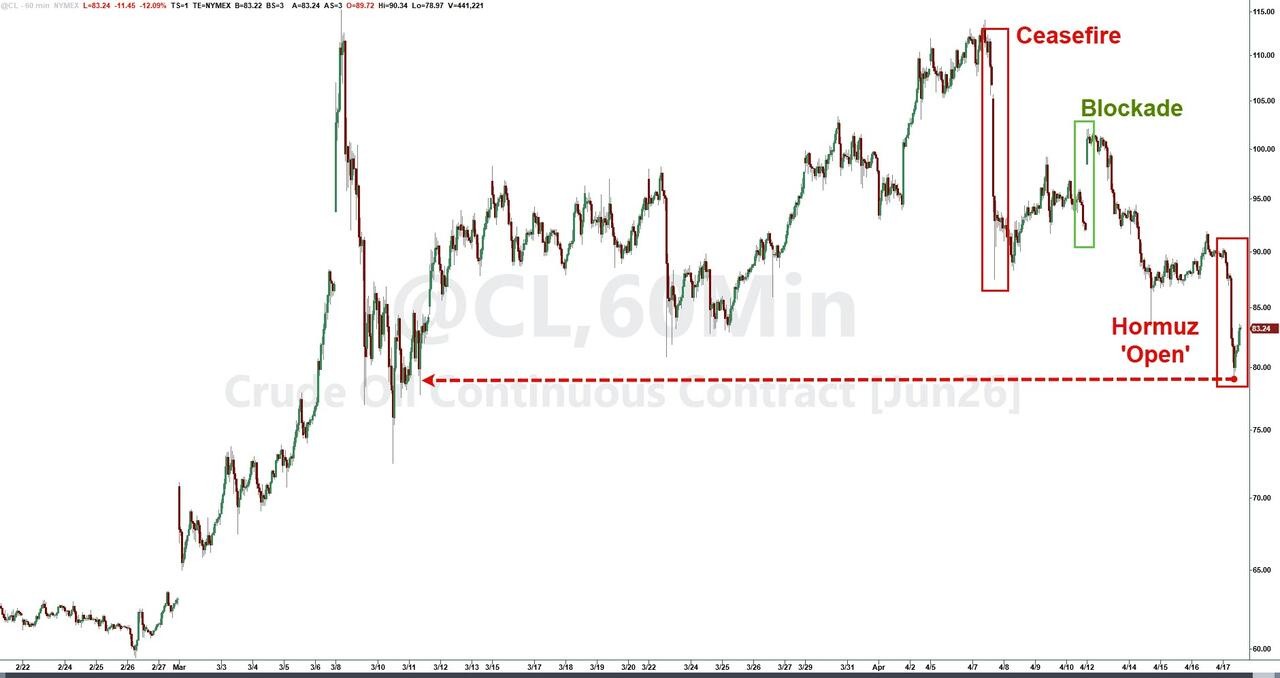
Crude oil has now fallen for two consecutive weeks. US crude oil declined 13.17% this week, approaching the largest single-week drop since April 2020 set last week. With losses exceeding 10% for two consecutive weeks, the cumulative drop over the two weeks reached 24.83%, marking the largest two-week decline since April 2020. Brent crude oil fell 5.06% this week. Although this is less than the nearly 12.7% drop seen last week, after seven consecutive weeks of gains, it has now retreated nearly 20% over two weeks.
Geopolitical Risk Premium Rapidly Cleared as Market Shifts from Supply Disruption Panic to Supply Normalization
The core driver behind this sharp decline in oil prices is the market's re-pricing of supply disruption risks.
Previously, due to escalating conflict in the Middle East, the Strait of Hormuz faced the risk of blockade. This waterway handles approximately one-fifth of global oil shipments; any interruption would have dealt a major blow to global energy supplies, causing oil prices to significantly incorporate a "war premium."
However, on Friday, Iran explicitly stated it would allow commercial ships to pass, which the market viewed as a significant signal of de-escalation. Meanwhile, according to the US President, following direct talks over the weekend, the US and Iran will hold further talks this weekend, with most key terms of a peace agreement already finalized. An agreement is expected within "one or two days."
Media commentary noted that improved prospects for US-Iran negotiations prompted markets to reassess supply outlooks. Other commentators suggested that signs of a potential US-Iran deal suppressed the risk premium.
Analysts believe this shift indicates that the "extreme supply disruption scenario" previously priced into oil is being rapidly removed.
Oil Prices Shift from War Premium to "Fundamental Pressure"
As geopolitical risks cool, attention in the oil market returns to supply and demand fundamentals.
On one hand, if the strait remains open, crude exports from the Middle East will normalize, significantly alleviating pressure on global supply chains. On the other hand, should US-Iran relations ease or even see partial sanctions lifted, there is room for Iranian crude exports to rebound further, providing additional supply to the global market.
Morningstar cited analysis indicating that if the conflict fully de-escalates and transport normalizes, oil prices may gradually return to "pre-war levels." Previous price increases were largely driven by risk premiums rather than significant tightening in supply-demand fundamentals.
Furthermore, on the demand side, uncertainties remain regarding global economic growth prospects. Coupled with the fact that the previous rapid rise in oil prices had already dampened consumption, oil prices became more prone to sharp corrections once geopolitical support vanished.
Short-Term Easing in Strait of Hormuz Tensions, But Uncertainty Remains
Despite Iran's announcement to open the Strait of Hormuz, the market remains cautious regarding its sustainability.
First, current statements from the US and Iran are primarily "policy signals," and the actual resumption of navigation requires observation of factors including insurance coverage, shipping company risk assessments, and changes in the military situation. Second, regional stability has not yet been fully achieved; any sudden incident could reignite the risk premium.
Arne Lohmann Rasmussen, Chief Analyst at Global Risk Management, stated, "The market is currently pricing in the end of war and the closure of the strait. However, we note that only vessels sailing along the Iranian coastline are currently allowed passage, so it may not be fully open yet."
Some analysts point out that the market is quickly retreating from the "worst-case scenario" but has not yet fully entered a "stable supply" state, meaning short-term oil price volatility may remain high.
Tyler Richey, Editor of Sevens Report Technicals, believes the sharp sell-off in the oil market on Friday may have been somewhat excessive, as details regarding a final, lasting ceasefire agreement between the US and Iran have not yet been fully finalized, and the current negotiation landscape may still be more fragile than what Friday's oil price movements reflected.
Outlook: Oil Prices May Enter a High-Volatility Range
Synthesizing institutional views, future oil price trends will depend on two key variables:
- Geopolitical progress: If ceasefire or negotiations achieve substantive progress, oil prices may have further room to fall;
- Pace of supply recovery: Including Iranian exports, OPEC+ policy adjustments, and global inventory changes.
In the short term, the market has completed a round of intense risk re-pricing, shifting oil prices from being "geopolitically driven" to "fundamentally driven." Against a backdrop where uncertainty has not been fully eliminated, the oil market may enter a phase characterized by high volatility and rapid responses to policy and news developments.
