


Strait of Hormuz 'Reopened'? US and Iran 'Clash Over Facts'! Oil Prices Plunge, But Tankers Remain Skeptical
Iran's Foreign Minister announced the Strait of Hormuz is open to commercial vessels; Trump immediately posted a message confirming it. Oil prices plummeted over 9% in response. Subsequent reports indicated that at least 25 tankers were heading toward the strait, but at least 12 turned back. The Iranian Ministry of Defense emphasized this was a 'conditional, temporary opening,' while the Speaker of Parliament directly refuted Trump, stating his remarks were 'all false.' Analysts noted that Iran is still 'selecting' which vessels may pass
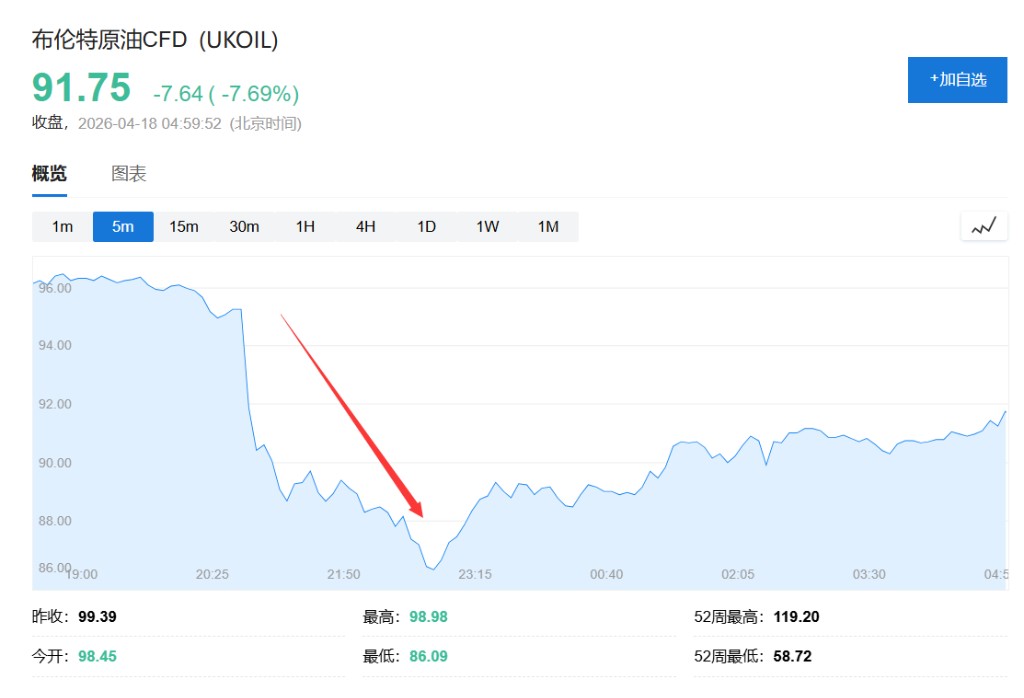
Oil prices fell more than 9% in a single day, yet tankers hovering at the strait entrance are expressing doubt through their actions.
According to Xinhua News Agency, on April 17 local time, Iranian Foreign Minister Araghchi announced that, given the ceasefire agreement between Lebanon and Israel, Iran would open the Strait of Hormuz to all commercial vessels during the truce period. Trump immediately confirmed this on social media, writing: "Iran has just announced that the Iranian Strait is fully open for full passage. Thanks!"
The news triggered a fierce market reaction. Brent crude oil fell 9.1% to $90.38 per barrel, hitting a five-week low; European natural gas prices dropped by 7%. US stocks rose in tandem, with the S&P 500 index gaining 1.2%, recording its third consecutive weekly advance—the index has rebounded more than 9% since April.
However, the actual situation on the strait is far more complex than the statements suggest.
Tankers "Skeptical": Heading Toward the Strait, Then Turning Back
Following the announcement, a key observation window emerged in the market—the actual movements of tankers.
According to Bloomberg, within hours of the Iranian Foreign Minister's announcement, at least eight tankers quickly headed toward the Strait of Hormuz. Five of these had previously been anchored in waters north of Dubai and began entering the strait waterways on Friday afternoon following the news; three other vessels waiting about 70 miles away also started moving toward the strait.
The report stated: If these vessels continue their journey, their movement would be one of the clearest signals since the outbreak of war on February 28 that the Strait of Hormuz is open to non-Iranian-related vessels.
The UK's Financial Times described that satellite tracking of ships showed at least 25 vessels heading toward the strait, including three container ships under French shipping company CMA CGM, four Greek tankers, and several Chinese vessels.
Yet among the vessels that set sail after Iran's announcement, at least 12 turned back mid-journey, and multiple others, including one from CMA CGM, stopped at the entrance of the strait.
Several executives in the oil and shipping industries stated that the situation remains unclear. Concerns that the strait may have been mined or that Iran is still attempting to exercise control have led some Western vessels to prepare to withdraw from the Gulf.
Phillip Belcher, Maritime Director of the International Association of Independent Tanker Owners (Intertanko), said: "Before any transit resumes, the industry must receive clear, verified information from Iran and explicit details on measures taken by the United States."
Matt Smith, an analyst at energy intelligence firm Kpler, bluntly stated: "Iranian authorities appear to still be acting like gatekeepers, selecting which vessels can pass through the strait."
Previously, the Strait of Hormuz carried about one-fifth of global oil shipments. The blockade has lasted approximately seven weeks, triggering severe volatility in global energy markets.
Iran: Conditional, Temporary Opening
According to Xinhua News Agency, the Islamic Revolutionary Guard Corps Navy Command issued new regulations for vessel passage later that evening on the 17th, clarifying three points: First, civilian vessels must follow routes designated by Iran; second, military vessels remain prohibited from passage; third, all vessels must coordinate with the Revolutionary Guard Navy in advance.
Subsequently, a spokesperson for the Iranian Ministry of Defense further narrowed the scope, stating that the Strait of Hormuz is "only conditionally open under a ceasefire status; vessels affiliated with hostile forces cannot pass; if Lebanon faces pressure, the situation will revert to its previous state."
This means Iran's "opening" comes with explicit prerequisites and time limits—the ceasefire agreement is set to expire late Tuesday night.
Iranian Parliament Speaker Directly Contradicts Trump
A greater variable stems from hardline voices within Iran.
Mohammad Bagher Ghalibaf, Speaker of the Iranian Parliament and head of the negotiation delegation, posted on the X platform, directly refuting Trump's remarks: "The US President issued seven statements within an hour, all of them false."
He explicitly warned: If the US maritime blockade continues, the strait "will not remain open."
Trump himself admitted that he ordered a maritime blockade on Iranian ports earlier this week, which will continue until both sides reach an agreement to end the war.
This creates a direct contradiction: Iran views the US blockade as a violation of the ceasefire agreement. According to Tasnim News Agency, cited by Xinhua, a source familiar with the matter stated that if the blockade persists, Iran will close the strait.
How Markets Price This Uncertainty
The sharp drop in oil prices reflects the market's initial reaction to the "opening" news, but analysts remain cautious about future trends.
Rapidan Energy Group, an energy research institution, stated in a report that they are skeptical of signs indicating the US and Iran are nearing an agreement. They expect tanker traffic through the Strait of Hormuz to remain at extremely low levels at least until the end of April.
The firm pointed out: "Iranian negotiators insist that Iran must retain control over passage through the Strait of Hormuz, which is an unacceptable bottom line for the Trump administration. Differences over terms of a nuclear agreement are equally vast."
In other words, the market has already priced in the "opening," but whether actual passage can resume still depends on a political stalemate that remains unresolved.
