


This Round Was Spot-On" Goldman Sachs: Maintains Prediction of Middle East Oil Flow Recovery Before Mid-May, Keeps Oil Price Target Unchanged Amid Increased "Two-Way Risks
Goldman Sachs identifies three sources of downward pressure: progress in peace talks dissipating geopolitical premiums, actual March output cuts in the Persian Gulf falling short of expectations, and a rapid weakening in demand for jet fuel and petrochemical feedstocks. Upside risks include a longer-than-expected disruption at the Strait of Hormuz or permanent damage to infrastructure. The logic of unidirectional long positions has significantly weakened, making volatility strategies and cross-commodity spread trading more attractive for allocation
Goldman Sachs maintains its oil price forecast unchanged but notes a significant increase in "two-way risks," prompting investors to re-examine their positioning logic.
According to Trading Desk reports, on April 17, Goldman Sachs' Daan Struyven team released the latest research report on the crude oil market. Amid a sharp drop in crude prices driven by the "reopening" of the Strait of Hormuz, Goldman Sachs maintained its full-year average price forecasts for Brent and WTI crude in 2026 at $83 and $78 per barrel, respectively.
As noted by Wallstreetcn, in last week's report, the Daan Struyven team expected crude exports from the Persian Gulf to return to pre-war levels within about a month thereafter. However, news of the "reopening" of the Strait of Hormuz on Friday triggered algorithmic programs to liquidate large positions in crude oil longs.
WTI crude futures fell over 11% in a single day, dropping to their lowest level since March 10.
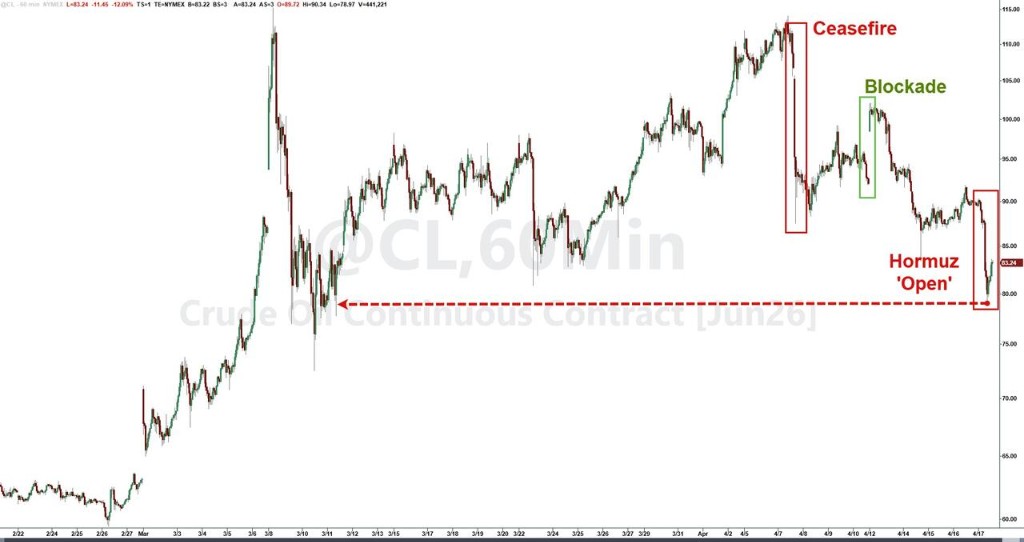
(Trend of US crude futures prices over the past two months)
This latest report emphasizes that, looking at quarterly distribution, the forecast peak is expected in Q2 2026, with an average Brent price of $90 per barrel and WTI at $87 per barrel. Prices are then projected to decline sequentially quarter-by-quarter, with Brent dropping to $80 per barrel in Q4.
The report adheres to the core assumption that "oil flows in the Persian Gulf will gradually normalize before mid-May." However, the risk structure previously characterized by Goldman Sachs as "significantly net upside" has been rebalanced to "two-way risks."
In other words, oil prices face the possibility of a sharp surge due to prolonged flow blockages, alongside significant downward pressure from unexpectedly weak demand and rapid progress in peace negotiations.
This means the logic of unidirectional long positions in crude oil requires re-examination, while the value of options-based hedging tools is rising.
Risk Premiums to Fade Quickly; Actual Output Cuts Lower Than Previously Expected
The report states that if substantive progress is made in Middle East peace agreement negotiations, the geopolitical risk premium currently embedded in oil prices will face rapid normalization pressures, constituting a significant downside risk to recent oil price forecasts.
The sharp drop in crude futures on April 17 confirmed the real-world impact of this logic.
Secondly, on the supply side, Goldman Sachs revised down its estimate for March crude output cuts in the Persian Gulf.
Goldman Sachs now estimates that the average daily crude output cut in the Persian Gulf region in March was 8 million barrels per day, lower than its mid-March expectation of 9.7 million barrels per day.
By country, current estimates indicate output cuts of approximately 500,000 bpd for Iran, 3 million bpd for Iraq, 800,000 bpd for Kuwait, 300,000 bpd for Qatar, 2.1 million bpd for Saudi Arabia, and 1.3 million bpd for the UAE.
Goldman Sachs believes that storage capacity in the Middle East is higher than previously expected, which is one of the key reasons why actual output cuts were lower than anticipated.
This implies that even if the disruption in Hormuz flows continues, its actual impact on global supply may be milder than expected, constituting potential downward pressure on medium-term oil price forecasts.
Demand Is More Fragile Than Anticipated
Market attention is shifting from geopolitics to economic fundamentals. Preliminary data shows that oil demand, particularly the segments most sensitive to price, is declining rapidly.
Goldman Sachs points out that weak demand is concentrated in two areas: aviation fuel and petrochemical feedstocks (such as naphtha and liquefied petroleum gas).
Air travel carries consumption elasticity; when oil prices soar, people reduce flying. Petrochemical companies' raw material demand is directly profit-driven; when product prices cannot cover high raw material costs, they cut production.
Why was the demand response so severe this time? Goldman Sachs provided three specific reasons.
First, the pain felt by end consumers has been amplified.
Currently, global refining margins (the spread between refined products and crude) are at extremely high levels. This means that although crude prices themselves may not have broken historical peaks, gasoline and diesel prices at gas stations, as well as chemical raw material prices for factories, have risen even more.
Goldman Sachs calculated that when Brent crude is around $100 per barrel, if refining margins remain at current high levels, every $10 increase in refined product prices will lead to a reduction in global oil demand of approximately 900,000 barrels per day after 1-2 quarters. This figure is far higher than the 600,000 barrels per day seen when refining margins are at average levels.
Second, supply tightness and price pressures coincidentally hit the most vulnerable segments and regions of demand.
In addition to aviation fuel and petrochemical feedstocks, emerging markets such as Asia and Africa, which are more sensitive to prices, bore greater impacts.
Third, signs of rationing and shortages appeared in some markets.
In countries implementing price controls, governments manage retail fuel prices through various means including fiscal subsidies, state-owned enterprises compressing profit margins, and restricting product exports.
When crude prices exceed $80 per barrel, state-owned enterprises must compress profit margins on their own. However, this control model itself brings risks of supply shortages and rationing.
Upside Risks: Supply Disruptions May Last Longer Than Expected
Although downside risks have increased significantly, Goldman Sachs simultaneously emphasized that there remain notable upside risks for oil prices, primarily stemming from two scenarios:
First, the duration of low-flow conditions in the Strait of Hormuz exceeds expectations. The current 92% flow gap means that every day of stalemate accumulates supply pressure; if negotiations break down or the situation escalates, oil prices could surge sharply.
Second, crude and refined product production capacity suffers permanent damage. Potential destruction of Middle Eastern refineries and oilfield infrastructure due to war impacts could make capacity recovery take much longer than market expectations.
Synthesizing Goldman Sachs' analytical framework, for investors in crude oil and related assets, the core change in the current situation is: the risk structure has shifted from the previous "significantly net upside" to a true two-way game.
Against this backdrop, the risk-reward ratio of simply going long on crude oil has significantly weakened. Instead, volatility strategies, such as buying crude option implied volatility, and cross-commodity spread trades, such as crude vs. refined product crack spreads, may better capture the structural characteristics of the current market.
