


Sheng Songcheng: Now is a Favorable Time to Enhance the RMB's Financing Function
Sheng Songcheng pointed out at the 'China-Europe Lujiazui Financial 50 Forum' that the current period presents a favorable opportunity to enhance the RMB's financing function. As the RMB's role in international trade finance grows, cross-border investment and financing demand continues to rise, becoming a critical component of financial support for the real economy. Data shows that in RMB cross-border settlements, current account transactions account for 67.9%, while direct investment shares are also increasing, reflecting the deepening global industrial chain layout of Chinese enterprises
Introduction:
Against the backdrop of accelerating global industrial chain reconstruction and the "dual-wheel drive" of Chinese enterprises expanding abroad through trade and investment, the booming demand for cross-border RMB investment and financing has become a crucial link in high-quality financial support for the real economy. With the steady elevation of the RMB's status in international trade finance, its deepening function as a financing currency is entering an unprecedented window of opportunity. At the "China-Europe Lujiazui Financial 50 Forum · 2026 Spring Conference," Sheng Songcheng, Senior Academic Advisor of the China-Europe Lujiazui International Finance Research Institute and Dean of the Chief Economists Forum Research Institute, revealed the core financing advantages of the RMB amidst low-interest-rate environments and complex international situations through detailed data. This article is compiled based on Professor Sheng's on-site speech.
Abstract: Providing Important Perspectives on the New Stage of RMB Internationalization
Enterprise Global Expansion Drives Growing Demand for Cross-Border RMB Investment and Financing
Before diving into the main topic, let us examine two data charts. From the structure of RMB cross-border settlement amounts, it typically includes two major categories: current account transactions and direct investment. Currently, current account settlements account for 67.9% of the total scale, amounting to 17.86 trillion yuan (see chart below). Goods trade remains dominant within the current account, accounting for 52.1% with a value of 13.72 trillion yuan; meanwhile, the share of services trade and other current account items is showing a steady upward trend, now totaling 15.7% of the scale, amounting to 4.14 trillion yuan.
Structure of RMB Cross-Border Settlement Amounts
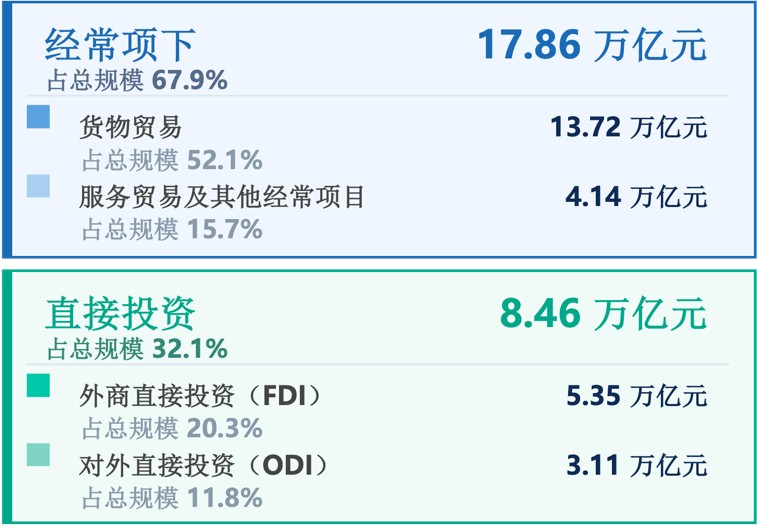
Source: People's Bank of China
In terms of direct investment, it encompasses two dimensions: Foreign Direct Investment (FDI) and Outward Direct Investment (ODI). Currently, FDI accounts for 20.3% of RMB cross-border settlements, while ODI's share has risen to 11.8% (see chart below). The sustained growth of China's ODI indicates that our layout in global industrial chains and supply chains is becoming increasingly comprehensive and deep. This is also a significant manifestation of Chinese enterprises enhancing their international competitiveness and optimizing resource allocation globally.
Structure of RMB Cross-Border Settlement Amounts
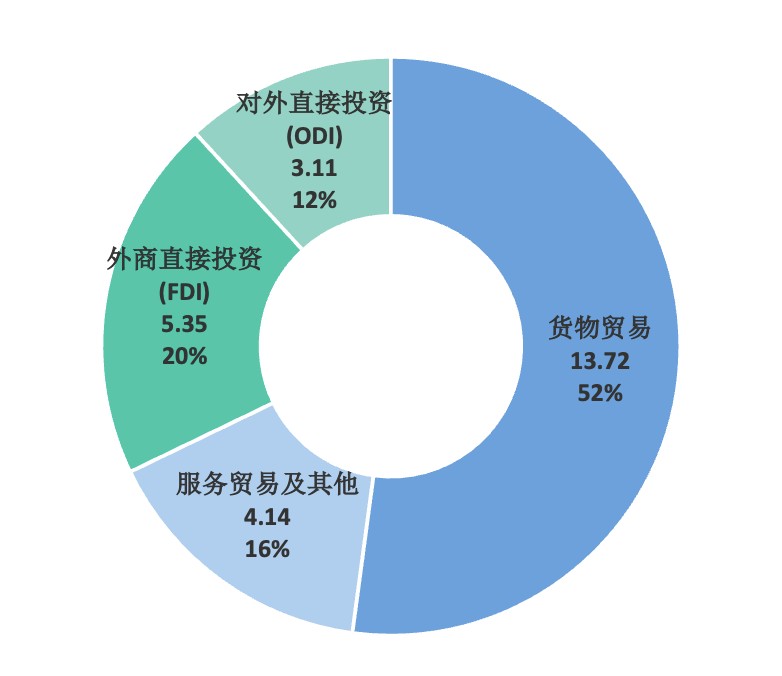
Source: People's Bank of China, calculated and organized by author
These data strongly demonstrate that trade and investment are jointly driving the booming demand for cross-border RMB investment and financing. This once again confirms that financial support for the real economy is not merely an abstract slogan; it has concrete and rich content—supporting enterprises in deeply participating in globalization is indeed one of the key functions of current financial work.
Also worth noting is the rapid growth of China's foreign trade. In the first quarter of this year, the total import and export volume priced in RMB reached 11.84 trillion yuan, up 15.0% year-on-year, a growth rate 11.26 percentage points higher than the full previous year. Among them, exports grew by 11.9%, and imports surged by 19.6%, with growth rates exceeding those of the same period last year by 5.17 and 25.43 percentage points, respectively.
This fresh batch of data fully illustrates that we are forming a virtuous cycle of "large-scale imports and exports." Whether in imports or exports, growth is significant, indicating that China is unwaveringly expanding high-level opening-up, which stands in sharp contrast to the "small yard, high fence" strategy adopted by some countries.
From a micro-enterprise perspective, the market breadth and operational depth of Chinese enterprises' international operations continue to strengthen. Data shows that the average ratio of overseas business revenue to total operating revenue for A-share listed companies has steadily climbed from 12.3% in 2018 to 18.2% in 2024 (see chart below). Simultaneously, the average ratio of net investment income from overseas operations to total operating revenue has risen from 5.7% to 9.6%.
Overseas Revenue and Investment Status of Chinese Listed Companies
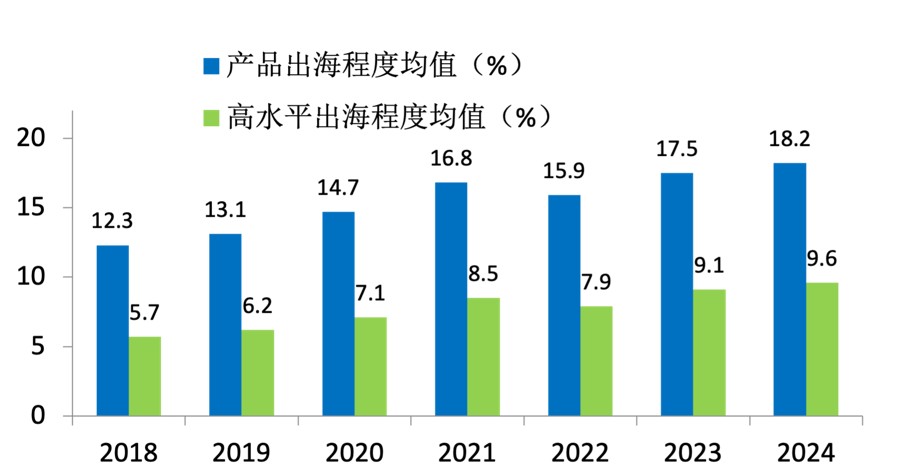
Source: Calculated based on annual report disclosures of listed companies over the years, Wind
From a trend perspective, apart from slight fluctuations in 2022 due to the impact of the pandemic on domestic and international exchanges, both the proportion of overseas business revenue and the proportion of overseas net investment income have been growing year by year in recent years. This fully corroborates a fact: Chinese enterprises going global is certainly not done just for the sake of going global; such global layouts have indeed produced tangible benefits for the development, expansion, and profit growth of the enterprises themselves. It also reflects that China's economy is integrating into the international market at a deeper level.
RMB's Function as an International Financing Currency May Be Entering a Favorable Period
In recent years, the RMB's financing function has significantly strengthened. According to the "RMB Internationalization Report (2025)" released by the People's Bank of China, over the past five years, the RMB has maintained a top-three ranking among global trade financing currencies, rising to the second position multiple times in recent months. Its market share has increased substantially from around 2% to approximately 7%. This is quite an impressive achievement, indicating that as China's economy develops, the RMB plays an increasingly important role in the international financing system.
In the bond market, as of the end of 2024, the outstanding amount of RMB international bonds reached $256.1 billion, 2.6 times that of the end of 2019. Among them, "Panda Bonds" issued by overseas entities within China and "Dim Sum Bonds" issued in Hong Kong performed particularly well. To briefly explain: "Panda Bonds" are characterized by being issued by overseas entities within China and denominated in RMB; "Dim Sum Bonds" refer to RMB-denominated bonds issued in Hong Kong. In 2024, new issuance of "Panda Bonds" was nearly 200 billion yuan, while the issuance scale of "Dim Sum Bonds" reached as high as 1.2 trillion yuan.
Furthermore, the performance of RMB external loans has also been impressive. As of the end of 2024, the outstanding balance of RMB external loans exceeded 2 trillion yuan, accounting for 45% of the total balance of RMB and foreign currency external loans during the same period, a year-on-year increase of 14 percentage points, showing strong momentum. Meanwhile, the cross-border receipt and payment amount for inter-enterprise financing businesses reached 7.3 trillion yuan, up 9% year-on-year. Maintaining such a growth rate in the current complex international environment is no small feat.
At the policy level, in March 2026, the People's Bank of China and the State Administration of Foreign Exchange raised the macro-prudential adjustment coefficient for offshore lending by domestic enterprises from 0.5 to 0.6. This term may sound professional, but simply put, it means raising the upper limit on the amount enterprises can lend offshore.
Previously, the balance of enterprise offshore lending was strictly controlled; enterprises could not lend whatever amount they wished. There is a formula involved: Upper Limit of Offshore Lending Balance = Latest Audited Owner's Equity of the Lender × Macro-prudential Adjustment Coefficient. The increase of the coefficient from 0.5 to 0.6 directly means that enterprises have a larger space to mobilize cross-border funds.
Upper Limit of Offshore Lending Balance _= Latest Audited Owner's Equity of the Lender × _Macro-prudential Adjustment Coefficient ( 0.6 _)
Offshore Lending Balance =∑ Lender's RMB and Foreign Currency Offshore Lending Balance+ ∑ Lender's Foreign Currency Offshore Lending Balance
× _Currency Conversion Factor ( 0.5 _)
From the perspective of capital flow, when a domestic parent company lends RMB to its overseas subsidiary, the subsidiary can use these funds to directly purchase domestic equipment, pay for engineering services, or repay trade debts to related parties domestically upon receipt. Once these projects generate sales revenue or profits, subject to local laws, enterprises can choose according to their own operational needs whether to keep the funds abroad for continued investment or repatriate them to China.
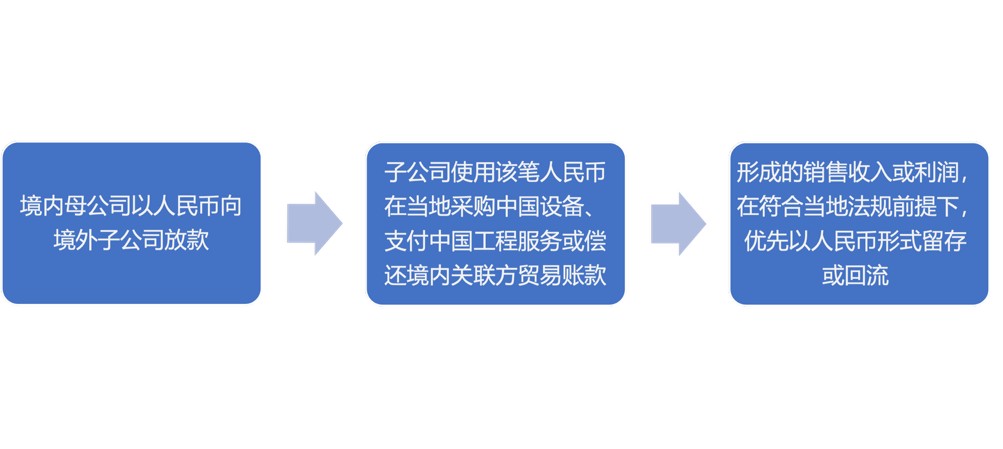
Currently, we do not mandate that RMB must be repatriated; instead, this choice is left to the market and enterprises. This shift from "administrative guidance" to "market-driven" mechanisms actually provides a solid foundation for strengthening the RMB's international financing function and is a direct manifestation of financial support for the real economy.
From the external macro-environment perspective, geopolitical conflicts have led to continuously tightening global liquidity, and the Federal Reserve's monetary policy faces a dilemma. According to the latest data, U.S. CPI rose 3.3% year-on-year in March, a significant rebound from 2.4% in February, reaching a new high since May 2024; month-on-month CPI growth was 0.9%, also a new high since June 2022. Energy prices were the main driver behind the March CPI increase. Historically, the Fed's policy core has sought a balance between "price stability" and "full employment," but currently, these two goals present certain contradictions: geopolitical conflicts have driven up oil prices, making inflation show considerable stickiness.
So, how is the U.S. employment situation actually? The U.S. unemployment rate stood at 4.3% in March, down slightly by 0.1 percentage points from the previous month. On the surface, unemployment appears to be falling, but another key indicator—the labor force participation rate—is also declining simultaneously. Currently, the U.S. labor force participation rate has dropped from 62.0% to 61.9%, the lowest level since the end of 2021. This implies that the decline in the unemployment rate is largely not due to an increase in job openings, but rather because some workers have exited the labor market.
This also explains the "dilemma" I mentioned earlier regarding the Federal Reserve: facing inflationary pressure, it should raise interest rates, but underlying concerns in the employment market make it hesitant, trapping it in a predicament between "raising rates to fight inflation" and "cutting rates to protect employment."
In comparison, China adheres to a moderately loose monetary policy stance. Currently, various RMB interest rates (deposits, loans, government bonds, etc.) are at low levels among major currencies. Although we will make minor adjustments based on price levels, it is expected that RMB interest rates will remain generally stable or gradually decline over the next two years. This decline will be moderate, as we retain sufficient policy tool reserves and do not need to exhaust all policy space in one go.
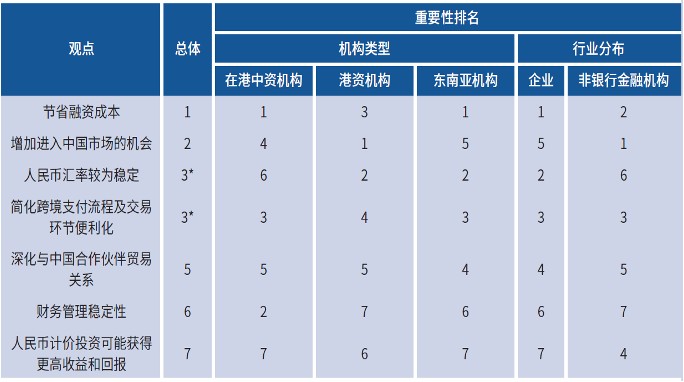
As a financing currency, the RMB's core advantage lies in its low cost of funds. A 2024 survey by Bank of China (Hong Kong) in ASEAN countries confirmed this: surveyed institutions cited saving financing costs as the primary advantage of using the RMB, followed by opportunities to enter the Chinese market and exchange rate stability (see chart below).
Market Institutions' Views on the Advantages of Using the RMB
Source: People's Bank of China "RMB Internationalization Report (2025)"
This attractiveness is intuitively reflected in actual data. For instance, the 6 billion yuan offshore RMB green sovereign bonds issued by China in London in 2025 saw subscription amounts reach 41.58 billion yuan, with a subscription multiple of nearly seven times. Such a fervent subscription scene fully reflects international investors' preference for RMB assets.
Therefore, based on Purchasing Power Parity and the development of China's economy and technology, the RMB will undergo a slow appreciation process in the long run. Of course, the RMB exchange rate will not fluctuate too rapidly or drastically. Maintaining the characteristic of the RMB as a "strong currency" is a necessary condition for its internationalization and becoming a mainstream currency. Although this will be a long process, the direction is certain.
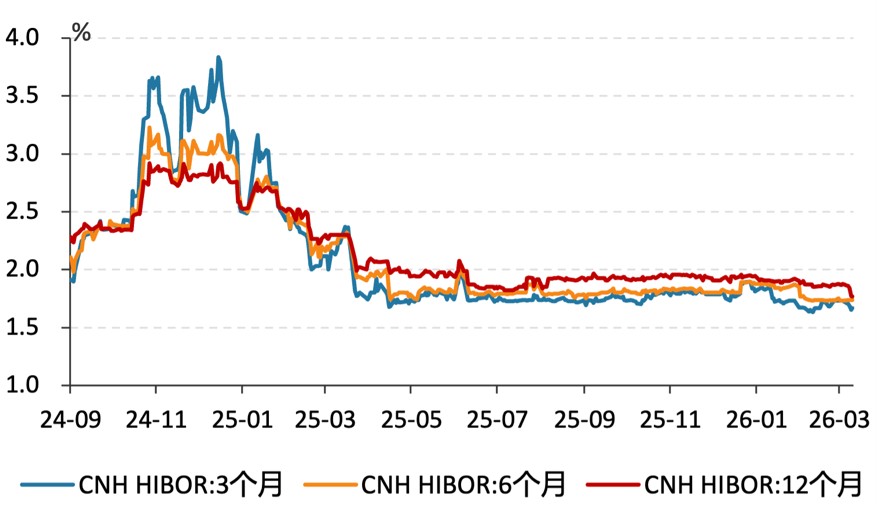
Additionally, the trend of Hong Kong offshore RMB interbank lending rates also indicates that current rates across various maturities are basically kept below 2% (see chart below), remaining stable with a downward trend. This low-cost, high-efficiency financing environment indeed provides a rare favorable opportunity to enhance the RMB's international financing function.
Trend of Hong Kong Offshore RMB Interbank Lending Rates
Source: Wind
Improve the Offshore Financial System Construction and Maintain Basic Exchange Rate Stability
Finally, I would like to briefly offer three suggestions.
First, increase the supply of safe RMB assets in the offshore market. We should regularly issue RMB government bonds and central bank bills offshore to perfect the offshore RMB yield curve. In fact, while most countries issue government bonds, few issue central bank bills offshore like China does. Central bank bills are issued by the People's Bank of China, while government bonds are issued by the Ministry of Finance. This dual approach reflects the close coordination between China's monetary and fiscal policies. Issuing RMB safe assets timely according to market needs is crucial for consolidating the foundation of the offshore market.
Second, enhance the collaborative linkage between Shanghai and Hong Kong financial centers. Currently, Hong Kong and Shanghai, as two major international financial centers, have been elevated to national strategies. We must steadily promote high-level opening-up of China's financial markets and continuously enhance Shanghai's global resource allocation function as an international financial center. This is also the result of Shanghai's unremitting efforts over the years. I believe Shanghai will certainly live up to expectations and become a more influential and competitive international financial center.
At the same time, we must build an offshore financial system commensurate with Shanghai's international financial center to support enterprises in high-level global expansion. I have always believed that financial support for the real economy is comprehensive; supporting enterprises in laying out industrial chains and supply chains worldwide to enhance international competitiveness is one of the important tasks of finance. As enterprise global expansion continues, the financial synergy between Shanghai and Hong Kong will provide stronger support for the global operations of enterprises.
Third, adhere to the decisive role of the market in exchange rate formation, maintain exchange rate elasticity while strengthening expectation guidance. Maintaining the basic stability of the RMB exchange rate at a reasonable and balanced level will help expand the two-way investment cooperation space for ODI (Outward Direct Investment) and FDI (Foreign Direct Investment).
There are two key sentences here: First, adhere to market-oriented principles based on market supply and demand; Second, maintain basic stability and curb excessive exchange rate overshooting. For a long time, China has consistently emphasized maintaining the basic stability of the RMB exchange rate at a reasonable and balanced level. This means that the RMB will present a trend of slow, steady appreciation in the long run, which not only aligns with China's development direction as a strong currency but also benefits import-export trade and cross-border investment and financing.
Author: Sheng Songcheng, Wall Street Journal Columnist, Source: Sheng Songcheng
Risk Warning and Disclaimer
Markets involve risks; investment requires caution. This article does not constitute personal investment advice and does not take into account the specific investment objectives, financial status, or needs of individual users. Users should consider whether any opinions, views, or conclusions herein are suitable for their specific circumstances. Investments made based on this content are at the user's own risk.
