


15 Days Left! Iran's Oil Industry Forced to Cut Production, Then Shut Down Completely
JPMorgan estimates that if the US implements a comprehensive export blockade on Iran, with land-based storage tanks filling up, Iran will be forced to cut production within 15 days and shut down completely within 30 days, reducing exports of nearly 1.9 million barrels per day to zero. May 20 could become the critical turning point, where daily fiscal losses of $435 million combined with risks of reservoir damage will push this test of wills toward a true inflection point
The standoff over oil sanctions between the US and Iran is entering its countdown phase, presenting markets with a clear and urgent time window.
According to the latest analysis by JPMorgan Commodity Markets Head Natasha Kaneva, under a scenario where the US Navy enforces a "comprehensive export blockade," Iran would be forced to begin production cuts in about 15 days and complete a full shutdown around day 30—meaning exports of approximately 1.9 million barrels per day would cease entirely around May 20. This timeline is rapidly becoming the core anchor for pricing in global energy markets.
Currently, Iran's onshore storage tank capacity stands at approximately 86 million barrels, with about 54% full (around 47 million barrels), leaving effective remaining capacity of roughly 40 million barrels—equivalent to about 22 days of export buffer.
Additionally, approximately four Iranian-linked Very Large Crude Carriers (VLCCs) currently stranded in the Strait of Hormuz, if fully loaded, could provide an extra 8 million barrels of buffer, extending the window to about 26 days. According to Kpler data, Iran currently has about 176 million barrels of crude oil stored on tankers outside the strait, of which about 142 million barrels have already left the Gulf region and can still be supplied externally for the time being.
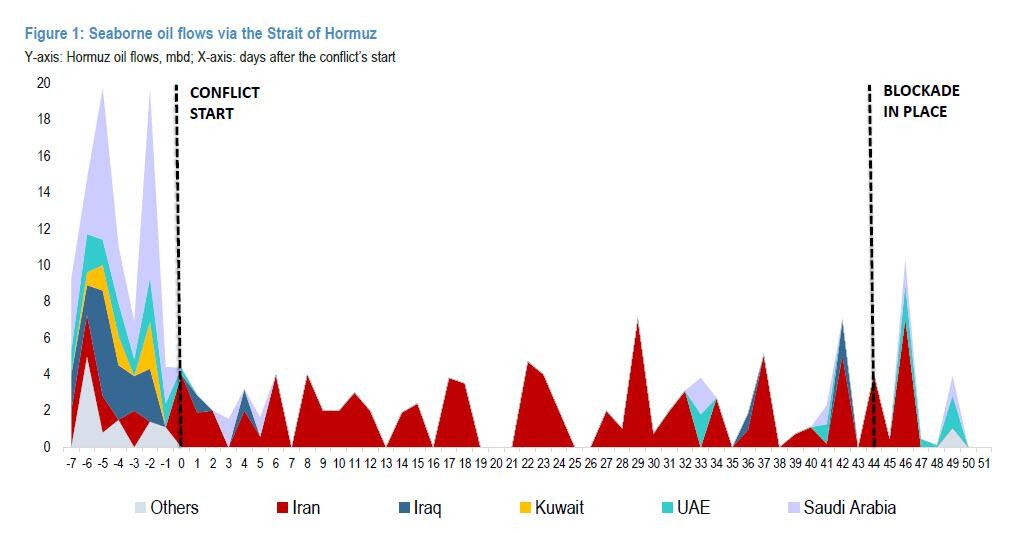
The blockade situation is tightening rapidly. Over the weekend, transit volume through the Strait of Hormuz dropped to about 4% of normal levels—the lowest since April. Iran's current actual export volume is about half of March levels, approximately 800,000 barrels per day. Meanwhile, US sanctions exemptions for Iranian oil exports are set to expire on April 19, further strengthening the policy framework for the blockade.
Reserves Running Low: A 16-Day Critical Window
JPMorgan analysis suggests that Iran's onshore storage has about 40 million barrels of available capacity. At an export rate of approximately 1.8 million barrels per day, it would be full in about 22 days; adding the potential cargo of tankers inside the strait extends the buffer window to 26 days.
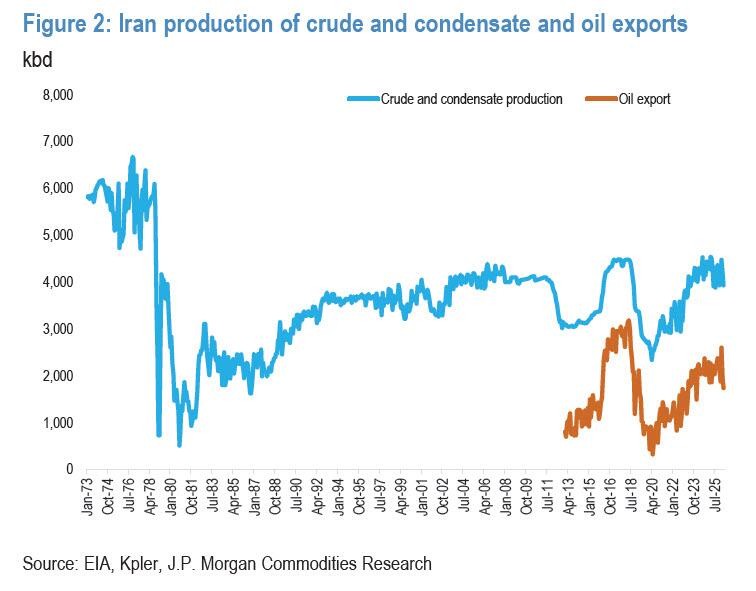
However, in practical operations, production cuts will begin before the tanks fill up. Natasha Kaneva's calculations show that in about 16 days, Iran will need to start cutting production, with the reduction magnitude gradually increasing until around day 30, when the cutback scale will approach the full export volume of about 1.9 million barrels per day.
Iran's daily output is about 3.6 million barrels, with approximately 1.8 million barrels used for domestic consumption and another 1.8 million barrels for exports. Even under extreme blockade scenarios, to maintain domestic demand, Iran's upstream production must sustain a baseline level of about 1.8 million barrels per day. Historical data shows that since 1973, Iran's crude oil production has only fallen below this threshold during the 1979 revolution.
The Logic of Cuts: Reservoir Damage Risks Force Early Action
From an industry perspective, proactive production curbs are generally preferable to being forced into a complete well shutdown. A total shutdown carries the risk of causing long-term, even irreversible, damage to underground reservoirs, with extremely high costs for resuming production. Other regional producers had already reduced output well before their storage tanks filled up at the onset of the conflict.
Historically, Iran has accumulated extensive experience in adjusting production during past sanction cycles—including utilizing gray market flows and third-country transshipment logistics to evade sanctions. This physical blockade differs fundamentally from previous financial sanctions: it restricts flow mechanisms rather than just imposing financial constraints, significantly narrowing the space for Iran to circumvent.
Iran may still attempt to delay tank saturation by hiding crude oil on moored ships while exploring alternative routes, including leveraging third-country logistics and Chinese-flagged tankers to transport Iranian crude.
Fiscal Shock: The Economic Cost of the Blockade
JPMorgan's analysis indicates that if the blockade takes effect, Iran's export revenue of about 2 million barrels per day would be completely interrupted during the blockade period. Oil and gas exports account for over 80% of Iran's total export earnings, meaning the fiscal impact will be extremely direct.
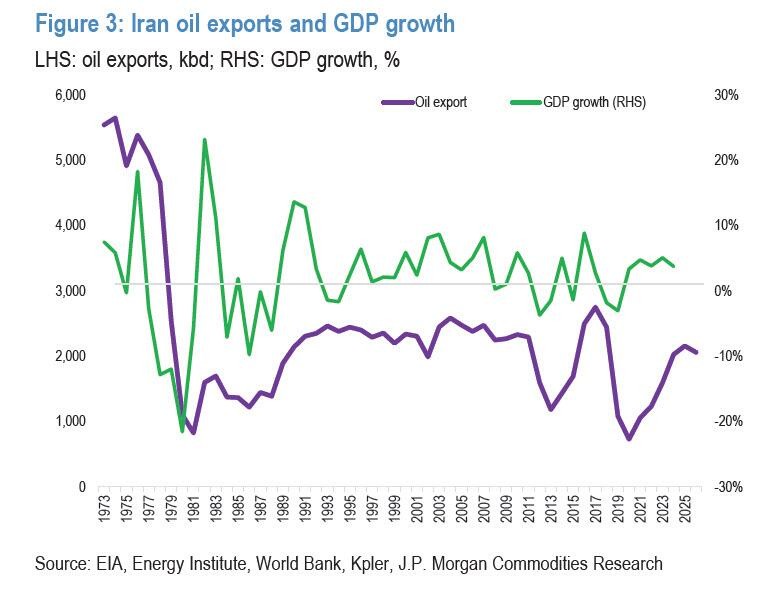
According to estimates by Iranian analysts, Iran's crude oil revenue during the conflict has nearly doubled compared to pre-war levels and exceeds government budget expectations for 2026, providing a certain fiscal buffer to withstand the blockade in the short term.
In the early stages of the blockade, Iran continued exporting while other regional producers sharply cut output, achieving excess returns as prices surged significantly. However, this window is closing. Miad Maleki, an analyst at the US think tank Foundation for Defense of Democracies, estimates that once the full blockade is implemented, Iran will lose approximately $435 million per day.
Notably, Iran's dependence on gasoline imports has decreased significantly compared to pre-2018 levels—when import dependence reached 100,000 barrels per day. The commissioning of the Persian Gulf Star Refinery in 2017, followed by a ramp-up completed around 2019, enabled Iran to achieve basic self-sufficiency in gasoline, compressing import demand to about 8,000 barrels per day. This has somewhat weakened the blockade's effect of pressuring the domestic market by cutting off refined product supplies.
Counter-Threats: Red Sea Could Become a New Battlefield
Iran has made it clear it will not passively endure the blockade. Hamid Hosseini, spokesperson for the Federation of Iranian Oil, Gas, and Petrochemical Exporters, stated that crude exports "cannot simply be stopped like this."
Iranian analyst Saeed Laylaz warned that if oil exports are blocked, Iran might use Yemen's Houthi forces to close the Bab el-Mandeb Strait—a key route Saudi Arabia currently uses to bypass exports. Iranian state media reported on Sunday that Houthi forces have entered a high state of alert. If Red Sea shipping lanes are disrupted, the spillover risks to regional energy supply chains will expand significantly.
Additionally, Tehran has hinted that Iranian tankers will retaliate against any intercept attempts, raising operational risks for US Navy enforcement actions.
Test of Will: Who Will Give In First?
Sanam Vakil, Director of the Middle East Program at Chatham House, stated that the blockade will exert "immense pressure" on Iran, but for a regime viewing the current conflict as a matter of life or death, the psychological logic is "stubborn resistance at the expense of its people," despite bringing "further legitimacy crises." She also noted, "Psychologically speaking, Iran can hold out longer than Trump. This is a test of will and endurance."
JPMorgan's Natasha Kaneva characterized this blockade as "an attempt to seize leverage from Iran," while simultaneously warning that the Trump administration may struggle to bear the cost of prolonged waiting.
Currently, the approximately 142 million barrels of crude oil stored on tankers outside the Strait of Hormuz constitute Iran's buffer reserves to maintain external supply for several weeks. The rate at which these reserves are consumed will largely determine when this game reaches its inflection point—and whether Iran will adjust its negotiation stance first before production stoppages cause irreversible reservoir damage.
